Monthly Archives: August 2026

Why is rr different from ch and ll?

Yesterday I had a linguistic panic attack at my gym. I always speak Spanish with the staff there, who are are uniformly Latina, and they know that I’m interested in the language. Yesterday one of them asked me why Spanish has more letters than English. This was a mistake on her part, because I immediately launched into an explanation of how the Real Academia Española (more accurately, a majority of the world’s Spanish language academies) eliminated ch and ll from the alphabet in 1994.

Afterwards the question popped into my head: what about rr, the Spanish double r that denotes a trill? Along with ch and ll, rr is the language’s third purely consonantal digraph, meaning a sequence of two consonant letters that together represent a single consonant sound. Was rr also affected in 1994? (I was 99% sure that it wasn’t.) If not, why not? And why hadn’t I thought about this before? (That was the panic part.) I bailed on my workout early.

Once I got home and consulted my bookshelf and the Internet, I quickly reassured myself that rr had never been part of the Spanish alphabet, and so had not merited the same scrutiny as ch and ll. Any easy proof of rr‘s inferior status is that words containing an rr have always been alphabetized as they would be in any other language. For example, in the 2006 compact Berlitz dictionary that I still keep on my shelf (but rarely use these days), corrupción precedes corsetería and perro precedes persecución. You will find the same order in an older dictionary. If rr were part of the alphabet, between r and s, then all cor- words would precede all corr- words, and all per- words would precede all perr- words.

That is exactly how ch and ll were treated before 1994. In a modern dictionary pecho ‘chest’ precedes pecoso ‘freckled’ and callar ‘to be quiet’ precedes calor ‘heat’. However, in pre-1994 dictionaries, pecoso preceded pecho and calor preceded calle. Because the digraphs ch and ll were then considered full-fledged elements of the Spanish alphabet, all pec– words preceded all pech– words, and all cal- words precede all call- words.

In fact, this uniquely Spanish version of alphabetical order motivated the 1994 alphabet reform. As I wrote in my first book,

The change in the alphabet...simplified language processing software. Before 1994, software routines that relied on alphabetical order needed to make exceptions for Spanish, since all Spanish words with c were alphabetized before those with ch, and likewise for l and ll. For example, culebra ‘snake’ was considered alphabetically prior to chico ‘boy,’ and luchar ‘to fight’ prior to llano ‘flat, plain’—a bizarre phenomenon from a non-Spanish perspective. With ch and ll eliminated as separate letters, Spanish no longer required special computational handling. [From Question #45, "What happened to ch and ll?"]

The question remains: why was rr never treated like a letter in the first place? I don’t know (maybe some reader does), but I have a theory. In written Spanish, words can begin with any consonant, and also with ch or ll, but not with rr. Because a single r at the beginning of a word is pronounced as a trill, there would be no difference between, say, rojo ‘red’ and a hypothetical rrojo. In this sense the ch and ll digraphs were more salient than rr. Surely this is why they were added to the alphabet.

Catching some z’s

By now I’m well into the “c” section of Spanish Word Histories and Mysteries. This is decent progress, since in my previous post inspired by this book I was only in the “b’s”. However, my perusal ground to a halt yesterday when I read about the English word cedilla, which is a straight borrowing of the Spanish word cedilla. The cedilla is the little hook that some languages use under a letter, most often the letter c, to represent certain pronunciations. In French the cedilla softens a c to a /s/ before a or o, as in français ‘French’ or garçon ‘waiter’. A plain (no-cedilla) French c is pronounced /k/ before these vowels, as in carte ‘menu’ or couper ‘to cut’.

The cedilla is not used in Modern Spanish, but in Old Spanish ç was pronounced /ts/, as in the middle of pizza. As in French, ç was only used before a or o, for example in Old Spanish caçar ‘to hunt’ (now cazar) and alço ‘I raise’ (now alzo). As Old Spanish became Modern, the sound /ts/ disappeared, and words previously written with a ç switched to a z, as shown above, that was (and is) pronounced either s or th, depending on one’s dialect.

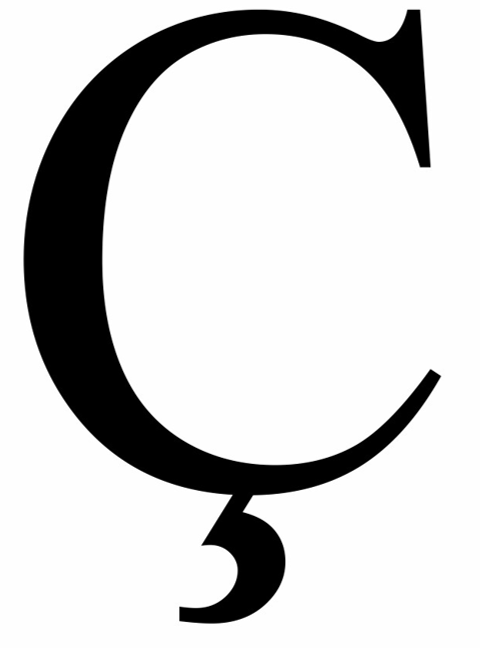
Histories and Mysteries explains that the cedilla under ç originated as a miniature letter z. This is apparent if you look at a large ç (below). In Spanish, ceda is a variant spelling of zeta, the name of the letter z, so cedilla, with the diminutive -illa suffix, simply means ‘little z‘.

I never knew this! and it makes me enormously happy because the tilde (~) over the beloved Spanish ñ originated as a small letter n. What an awesome parallel! But it also made me realize, for the first time, the irony of zeta, the Spanish word for the letter z.

Why ironic? Because one of the rules of Spanish spelling is that z is only used before a, o, and u, and is replaced by c before e or i. You can see this in the Spanish spelling of cebra and cero (below), and in spelling alternations like empezar ‘to begin’ and empiezo ‘I begin’, versus ¡Empiece! ‘Begin!’ and empecé ‘I began’. Most words that violate this rule are recent borrowings like zepelín ‘zeppelin’, zenit ‘zenith’, zig-zag, zinc (the metal) and zigoto ‘zygote’. Ironically, the word zeta is another exception.

As far as I know, this rule lacks a logical explanation, since the pronunciation of the letter z isn’t affected by the vowel that follows it. The c/z alternation is thus different from the language’s other spelling alternations, which are well motivated. For example, adding a u to a g in verb forms like pagué ‘I paid’ preserves the hard /g/ sound of the verb pagar. For this reason I’m afraid I used to tell my students that it was “a stupid rule of Spanish” to always use c, not z, before e and i. Honestly, I’ve looked for explanations, but have never found one that satisfies me.

So the “irony of zeta“, alluded to above, is simply that its spelling violates the Spanish spelling rule for the letter z. To put it another way, you can’t state the rule “Don’t use the letter z before e or i” without breaking it: No se usa la letra zeta antes de e o i.” What an oxymoron! I don’t know if cedilla will be one of my 100 words, but I must mention this irony.

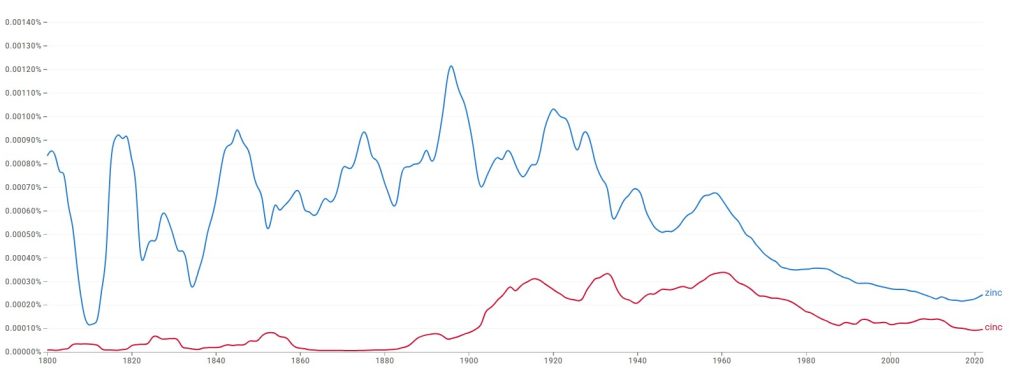
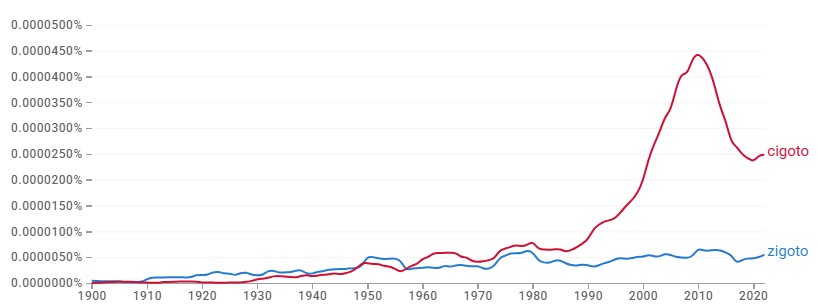
By the way, although zepelín and zig-zag seem to be maintaining their alien z spellings, the hispanized spellings cinc and cigoto have threatened or surpassed the originals, as shown in the Google ngram results in the slideshow below. This shows that the c/z spelling rule, motivated or not, maintains its force in modern Spanish.

Much ‘-ado’ about nothing

Yesterday I made good headway in Spanish Word Histories and Mysteries: thirteen words, many of which will be useful grist for the mill of my next book. I’ve titled this post “Much ‑ado about nothing” because the -ado or -ada endings of three of these words — armada, bastinado (from Spanish bastonada), and avocado — make them look like Spanish past participles, but two of them are faking it.

A grammatical aside: a “past participle” is a verb form like cerrado ‘closed’ in the sentence He cerrado la puerta ‘I have closed the door’. A participle can also be used as an adjective, as in La puerta está cerrada ‘The door is closed”, in which case it must agree with the noun it modifies (puerta is feminine and singular). Compare libros cerrados ‘closed books’, where noun and adjective are both masculine and plural.

  • Armada did, in fact, originate as a past participle, although it is obviously a noun. It means ‘navy’, and in English it normally refers to the famous Spanish Armada, the enormous fleet of Spanish ships that in 1588 attempted to spearhead an invasion of England, but lost decisively. (An English “counter-armada” against Spain the next year, led by Sir Francis Drake, failed as well.) Armada is the feminine form of the past participle of the verb -armar ‘to arm’, and therefore means ‘armed’. In Spanish one often sees it in the phrase fuerza armada ‘armed force’ or its plural, fuerzas armadas ‘armed forces’.

    I was curious to know why the noun armada is feminine. Is this because of its frequent usage as a feminine adjective, as shown above? The answer turns out to be “sort of.” The direct antecedent of armada was the feminine plural form of the LATIN past participle armatus, found commonly in naves armatae ‘armed ships’. So: feminine by association, yes — but in Latin, not Spanish.

  • English bastinado has a few related meanings. It can refer to beating someone with a stick, a single blow with a stick, or a stick used for beating people. It is based on the Spanish word bastonada, which appears to be another feminine-past-participle-turned-noun, this one based on a verb bastonar. However, this verb doesn’t exist, and never did. Rather, bastonada was formed from the noun bastón ‘stick’ (related to the French word baton) plus the suffix -ada, which Spanish uses to derive nouns that describe physical violence. A cabezada (from cabeza ‘head’) is a header in soccer or a headbutt in a fight. A cuchillada (from cuchillo ‘knife’) is the cut that a knife makes: a stab or a slash. A puñada (from puño ‘fist’) is a punch. And so on.

    Someone who doesn’t know Spanish might be surprised to learn that it has such a specific suffix. For me, the surprise was learning that it has two. I already knew about its -azo suffix, which has the same meaning but is more productive, in the linguistic sense of being freely applied to almost any noun of the speaker’s choice. The Real Academia (previous link) comments that because of this productivity, los diccionarios no puedan recoger todas las voces admisibles así formadas — that is, dictionaries cannot possibly include all the words of this type. For example, if you hit someone with an elephant, this would be an elefantazo.

    In fact, three out of the four -ada ‘blow’ words above have more common -azo cousins: bastonazo, cabezazo, and puñetazo. Only cuchillada beats its cuchillazo alternative, although when we talk specifically about navajas (pocket knives) navajazo is more common than navajada.

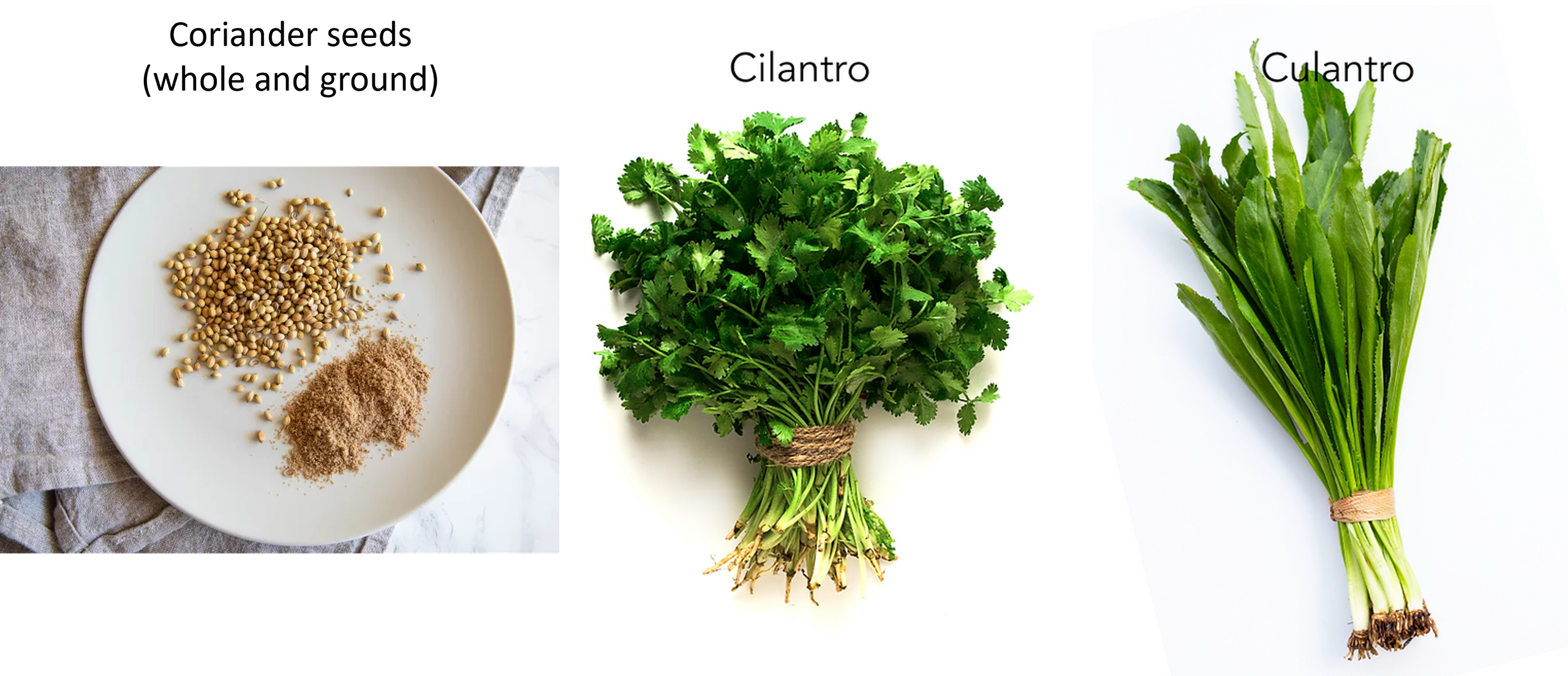
  • Finally, the English word avocado looks like another noun based on a past participle. However, it comes instead from the Spanish word aguacate, borrowed from Nahuatl ahuacatl. The -tl consonant cluster, seen also at the end of the language name itself, was difficult for Spanish speakers to pronounce, and changing it to -te was a common solution. Thus tomate, the Spanish word for tomato, comes from Nahuatl tomatl.

    Why did English adapt aguacate as avocado? According to Histories and Mysteries, avocado was a variant form used by Spanish speakers before aguacate emerged as the standard. Elsewhere this variant form is attributed to ‘folk etymology’, i.e. the word form being assimilated to a similar pre-existing word, in this case abogado ‘lawyer’. In French, ‘avocado’ and ‘lawyer’ ended up identically, as avocat.

    All this was familiar to me before I read the avocado entry in Histories and Mysteries. But I was happy to learn that guacamole comes from the Nahuatl word ahuacamolli, literally ‘avocado sauce’. The second part of the word, molli ‘sauce’, is the source of the culinary term mole (the Mexican sauce). I have to confess that for decades I pronounced this word moLÉ, to rhyme with the exclamation ¡Olé!. This certainly captures how I feel when I eat chicken with mole sauce.

I didn’t forget the paragraph

My (adult) children still remember that when they they were schoolchildren, if they left the house in the morning but ran back a minute later crying “I forgot my lunch!” I would always say, “You didn’t FORGET your lunch, you REMEMBERED your lunch”. This undoubtedly got old after a while.

Anyway, today I realized that I forgot to include a vital paragraph in yesterday’s post, about the ways that words in Spanish changed once they entered the lexicon. I have now added the paragraph; you can find it easily if you search down for the phrase “Once each word.”

So…I didn’t forget the paragraph, I remembered it. Enjoy!

Crystal Clear

After more months than I ever would have imagined, I have finally finished taking notes on David Crystal’s The Story of English in 100 Words. As I had expected, this book was an invaluable first step in my research for the analogous book about Spanish that I plan to write. Now I will move on to the American Heritage Dictionaries’ Spanish Word Histories and Mysteries, into which I dipped my toe (and my pen) some days ago, when I had temporarily misplaced The Story of English.

When I sat down to scope out my new book I wrote out a list of several dozen words that I wanted to include. This list contained specific words like yugo and canoa as well as placeholders like “a word from Galician/Portuguese” or “a name of a Latin American country.” As I worked through Crystal’s book this list mushroomed to 172 words. This isn’t a problem: although each entry in the book will focus on one word, it will also discuss other words that are relevant in some way. In fact, I expect that the list will continue to grow as I do more research. The real challenge will be condensing the list into the ideal 100 words, each with its supporting cast.

My main goal in choosing those words is still to capture the entire history of the Spanish language. This organization will lend itself naturally to covering the full range of languages that have contributed to Spanish, from its Latin core to modern borrowings from Asian languages and technology.

While a canonical borrowing adds a new word for a new concept, such as canoa, the Arawak word for a kind of boat that the Spaniards encountered in the New World, my list includes borrowings that are more complex, such as:

  • calques: words that translate a foreign term part-by-part into Spanish (e.g. tranvía, modeled on English tramway)
  • words that passed through multiple languages en route to Spanish, such as adobe (see previous post);
  • doublets: borrowings that co-exist with older words from the same source, e.g. limpio ‘clean’ and límpido ‘clear, limpid’, which both came from the Latin word limpidus. Limpio is an older word that came from Vulgar Latin, whereas límpido is a 19th-century learned borrowing from the same Latin root.
  • borrowings that were adapted to Spanish pronunciation (biftek), that are pronounced according to the rules of Spanish spelling (club, pronounced with a Spanish /u/), or that expanded the horizons of Spanish pronunciation (the tl- in chipotle, or the Mexican Spanish tlapalería ‘hardware store’).

I’d like to address, if possible, the general question of why Spanish, like English and in contrast to French, has been so accepting of borrowings. But I wonder: how can I even pose this question without anthromorphizing “Spanish”?

Many Spanish words are neither from Latin nor borrowed from another source. My list includes examples from a myriad of other sources and processes, such as:

  • names of people (biro), places (jerez), or commercial brands (celo), both real and fictional (quijotesco)
  • onomotapoeia (chirriar)
  • truncation (moto)
  • texting (jajaja)
  • compounding (lavaplatos)
  • affixation (desencadenar)
  • back-formation (debate, from debatir)
  • phrases (usted, pordiosero)
  • blends (agridulce)
  • acronyms (sida)

Once each word entered the Spanish lexicon, it was not frozen in form and meaning, but rather was vulnerable to the normal currents of language evolution. My list includes words that changed their form. For example, harina ‘flour’, which began with an f- in Latin (farina), dropped the initial /h/ sound between Old (medieval) Spanish and Modern Spanish, although the letter /h/ was maintained in spelling. The same happened to other words of this type such as hierro ‘iron’ (from Latin ferrus) and higo ‘fig’, from Latin ficus. I also include words that changed their meaning in a variety of ways. Some:

  • became more negative or positive, such as siniestra ‘sinister’ and choza ‘house’, which originally meant ‘left’ (the direction) and ‘hut’;
  • became more general or narrow in meaning, such as pariente ‘relative’ and infante ‘prince’, which originally meant ‘parent’ and ‘child’.
  • acquired new meanings as the culture changed, such as pavo, whose meaning changed from ‘peacock’ to ‘turkey’ when the latter was encountered in the New World;
  • absorbed meanings from other languages, such as ratón ‘mouse’, which absorbed the meaning of the English computer ‘mouse’;

Most words on the list are nouns and verbs, but there are also adjectives, prepositions, pronouns, adverbs, and exclamations. The list includes examples of dialectal variation in meaning (tortilla) and pronunciation (cerveza).

Spanish spelling is fairly straightforward, but I have included words that illustrate

  • the use of accent marks
  • the ñ
  • spelling changes in conjugated forms (busqué ‘I looked for’, from buscar ‘to look for’)
  • spelling adaptations for casual language (pa’ for para)
  • texting abbreviations (q or k for que)
  • gender-neutral language (amig@s)
  • words whose place in alphabetical order changed when the Real Academia eliminated ll and ch as digraphs in 1994. (The change was promulgated in its 2010 revision of its Ortografía, or spelling manual.)

As I converge on a definitive list I hope to represent most of the two dozen semantic categories in the anthropology-based World Loan Database (WOLD), such as kinship terms, food and drink, motion, and spatial relations. Based on Crystal’s book I’ve added other categories such as swear words, politeness expressions, words for unknown people or things (fulano, chisme), and titles (señor).

Finally, my ideal final set of words will illustrate fundamental properties of Spanish grammar and its evolution, such as verb forms based on haber, verbs with irregular conjugations and nouns with irregular gender, reflexive verbs, the various origins and pronunciations of ll, and pluralia tantum (like tijeras).

It will be interesting to see how my list continues to grow and change as I work through additional sources.