Tag Archives: Spanish alphabet

Why is rr different from ch and ll?

Yesterday I had a linguistic panic attack at my gym. I always speak Spanish with the staff there, who are are uniformly Latina, and they know that I’m interested in the language. Yesterday one of them asked me why Spanish has more letters than English. This was a mistake on her part, because I immediately launched into an explanation of how the Real Academia Española (more accurately, a majority of the world’s Spanish language academies) eliminated ch and ll from the alphabet in 1994.

Afterwards the question popped into my head: what about rr, the Spanish double r that denotes a trill? Along with ch and ll, rr is the language’s third purely consonantal digraph, meaning a sequence of two consonant letters that together represent a single consonant sound. Was rr also affected in 1994? (I was 99% sure that it wasn’t.) If not, why not? And why hadn’t I thought about this before? (That was the panic part.) I bailed on my workout early.

Once I got home and consulted my bookshelf and the Internet, I quickly reassured myself that rr had never been part of the Spanish alphabet, and so had not merited the same scrutiny as ch and ll. Any easy proof of rr‘s inferior status is that words containing an rr have always been alphabetized as they would be in any other language. For example, in the 2006 compact Berlitz dictionary that I still keep on my shelf (but rarely use these days), corrupción precedes corsetería and perro precedes persecución. You will find the same order in an older dictionary. If rr were part of the alphabet, between r and s, then all cor- words would precede all corr- words, and all per- words would precede all perr- words.

That is exactly how ch and ll were treated before 1994. In a modern dictionary pecho ‘chest’ precedes pecoso ‘freckled’ and callar ‘to be quiet’ precedes calor ‘heat’. However, in pre-1994 dictionaries, pecoso preceded pecho and calor preceded calle. Because the digraphs ch and ll were then considered full-fledged elements of the Spanish alphabet, all pec– words preceded all pech– words, and all cal- words precede all call- words.

In fact, this uniquely Spanish version of alphabetical order motivated the 1994 alphabet reform. As I wrote in my first book,

The change in the alphabet...simplified language processing software. Before 1994, software routines that relied on alphabetical order needed to make exceptions for Spanish, since all Spanish words with c were alphabetized before those with ch, and likewise for l and ll. For example, culebra ‘snake’ was considered alphabetically prior to chico ‘boy,’ and luchar ‘to fight’ prior to llano ‘flat, plain’—a bizarre phenomenon from a non-Spanish perspective. With ch and ll eliminated as separate letters, Spanish no longer required special computational handling. [From Question #45, "What happened to ch and ll?"]

The question remains: why was rr never treated like a letter in the first place? I don’t know (maybe some reader does), but I have a theory. In written Spanish, words can begin with any consonant, and also with ch or ll, but not with rr. Because a single r at the beginning of a word is pronounced as a trill, there would be no difference between, say, rojo ‘red’ and a hypothetical rrojo. In this sense the ch and ll digraphs were more salient than rr. Surely this is why they were added to the alphabet.
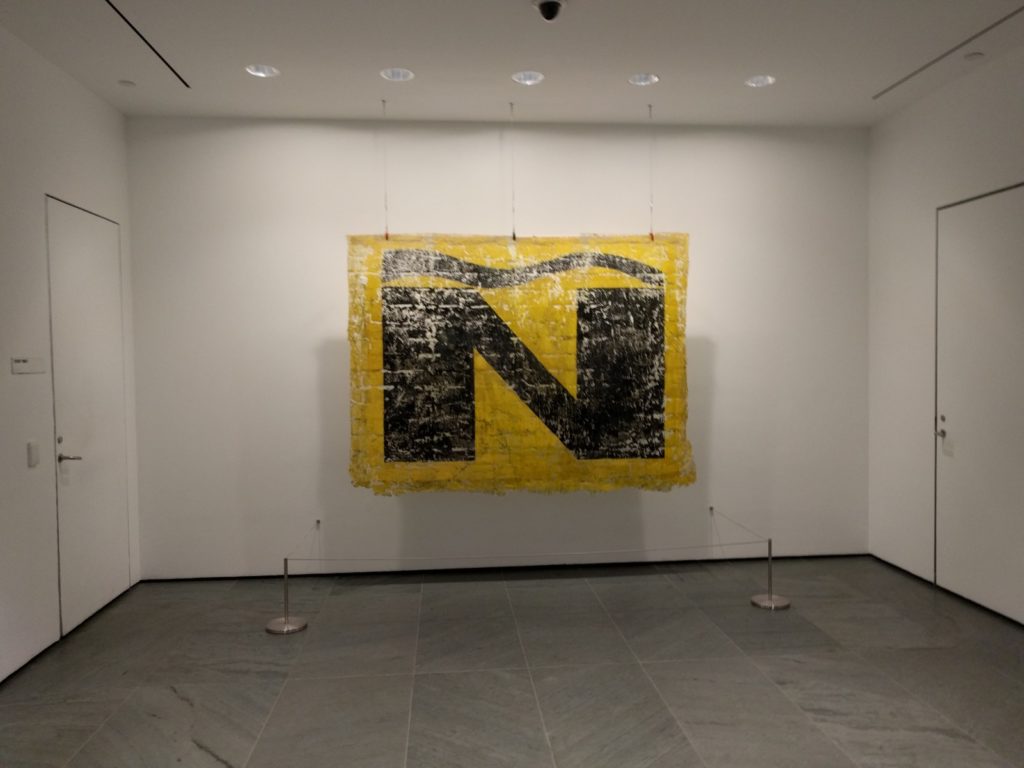
Eñe as art, with a shout-out to García Márquez

Besides Spanish, my two other main passions are my family and art. I managed to combine all three during a trip to New York’s Museum of Modern Art (MoMA) this past week with my husband and in-laws. At the foot of the main escalator — a prominent position — the museum had hung a new acquisition: a giant painting of the Spanish letter ñ, or eñe, by the Peruvian painter José Carlos Martinat. The picture below shows the painting with its surrounding wall space so that you can see its scale (about 6 by 8 feet).  For a closer view, please visit the relevant page on MoMA’s website.

Ñ (José Carlos Martinet, 2013)

Ñ (José Carlos Martinet, 2013)

I reacted strongly to the painting as both a Spanish linguist and an art lover. On the one hand, the giant Ñ on the wall seemed like a banner welcoming lovers of the Spanish language to the museum. While it is shared by a number of other languages, ñ has emerged as a symbol of Spanish. My favorite anecdotal proof of ñ‘s importance dates from 1991, when the European Community recommended that Spain repeal a regulation that required all computers sold in the country to have an ñ key. Protests came from Spain’s Foreign Ministry, from the Real Academia Española, and even from Colombia’s Nobel Prize-winning author Gabriel García Márquez, whose defense of the ñ, published as an op-ed in El País on May 15, stated that:

It is scandalous, to say the least, that the European Economic Community has dared to propose that Spain eliminate the letter ñ of our alphabet, and even worse, only for reasons of commercial convenience. The authors of such abuse and arrogance should know that the ñ is not an archaeological relic, but the reverse: a cultural leap by one Romance language that left the others behind, expressing with only one letter a sound that in other Romance languages continues to be expressed with two. Therefore, the logical thing is not for Spain to renounce a letter that even forms part of its own name, but that the other languages of the European paradise modernize themselves by adopting the ñ.

On the other hand, as an art lover, I understood the painting as an example of “appropriated art”, a current in modern art in which “found images”, not originally intended as art, are reproduced, often with changes in color and size, as a deliberate artistic expression. The most famous example is probably Andy Warhol’s Campbell’s Soup Cans paintings.

In the case of Carlos Martinet’s Ñ, MoMA’s wall text explained the painting as follows:

José Carlos Martinat’s practice frequently involves appropriating images and texts from the public sphere and recontextualizing them in mixed-medium works and sculptural installations. Between 2009 and 2013, he produced the series Pintas (Impressions), in which he removed street graffiti with advertising, political slogans, or candidates’ names — in the case of this work, that of the former mayor of Lima, Luis Casteñeda. After applying a resin-based medium onto a painted wall, Martinat would peel off the imprint and its material support, creating a new and autonomous image of a single letter or word. Taken out of context and installed in a museum space, the extracted fragment is activated in new ways as a signifier of language, politics, and public space. A residual image of what was previously a word or a phrase, Ñ speaks to the erodible, changeable nature of language and speech, whose users introduce fluctuations that ultimately transform communication itself. As a distinctive letter from modern Hispanic alphabets, “ñ” is also a differential sign, one that indicates otherness in relation to the global hegemony of English.