Category Archives: Uncategorized

¡Yamnaya!

After taking some weeks off for summertime fun with my family I am now back to research for my third book. I’ve continued to work my way through David Crystal’s The Story of English in 100 Words — still inspirational and intimidating. But I’ve also taken a detour to devour Laura Spinney’s book Proto: How One Ancient Language Went Global, about the pre-history of the Indo-European languages. I will definitely want to touch on this topic in my book, since it’s part of the history of Spanish.

For those of you who may be unaware, the Indo-European language family includes thousands of languages spoken today: Romance languages like Spanish, Germanic languages like English, Slavic languages like Russian, Baltic languages like Lithuanian, and Celtic languages like Welsh; Greek, Albanian, and Armenian; Hindi and other languages of northern India; and languages of Central and Western Asia including Pashtun (Afghanistan) and Persian (Iran). It also includes languages that are no longer spoken and (unlike Latin) have no spoken descendents. These include Oscan and Umbrian ( “Italic” languages related to Latin), languages of ancient Turkey including Hittite and Phyrgian (“Anatolian” languages), and Tocharian A and B, once spoken in the Tarim Basin of northwestern China.

I learned about the Indo-European language family as an undergraduate and graduate linguistics student. However, my knowledge of the family’s origins was vague: I knew only that it arose somewhere north of the Black Sea. (Or was it the Caspian Sea???) Although I was aware that in the years — decades, really 😉 — since I completed my PhD, there had been substantial new research on this topic, I hadn’t followed the field.

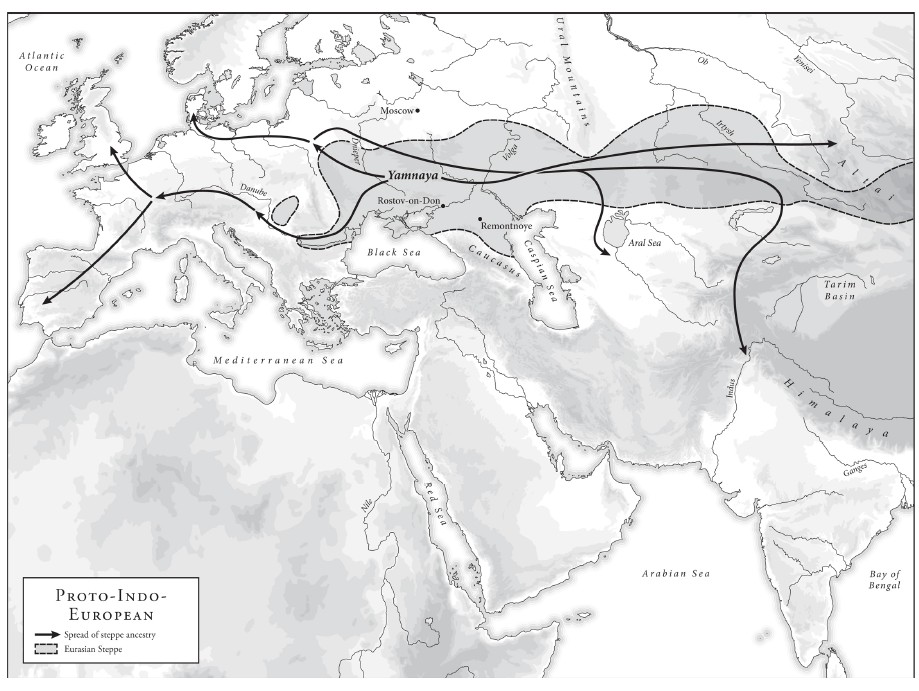
Proto has brought me up to date — and can I say “Wow?” Spinney’s book combines recent research from linguistics, archaeology, and genetics (DNA analysis) to illuminate what is known today about the origin of the Indo-European languages. Essentially, Proto-Indo-European — the common ancestor of the language family — spread east and west through the Eurasian steppe (grasslands), conveyed by cattle herders equipped with horses and wagons. The steppe was a natural environment in which such people could thrive and spread. Researchers call these steppe herders the Yamnaya, which means ‘pit grave’ in Russian, because of their burial practices.

The illustration below, from pp. 60-61 of Spinney’s book, shows the progression of Indo-European (black arrows) through the steppe (shaded area) and beyond. My vague memory wasn’t that far off, since the arrows show a specific point of origin in the steppe north of the Black Sea.

Genetic analysis of DNA from Yamnaya remains suggests an exciting possibility:

“The earliest Yamnaya males … carried a very narrow cluster of Y chromosomes. Later on, after the population had grown, other Y chromosomes entered the mix, but the first of their kind may have been closely related to each other on their father’s side. One way to interpret the evidence is to think of the Yamnaya as a single clan or brotherhood who distinguished themselves by their burial rite. They may have left a larger group, or been expelled from it, and having moved out of their ancestral valley became increasingly nomadic unril they vanished into the grasslands for good. If that is who they were it prompts an extraordinary reflection: fewer than a hundred people may have spoken the dialect that gave rise to all extant Indo-European languages.” (p. 69)

While Proto doesn’t have anything to say about Spanish specifically, it does include interesting speculation about the connection among Italic, Germanic, and Celtic languages:

Germanic, Celtic and Italic are related by common descent. This is evident from their grammar, their pronunciation and their core vocabulary (English – – father mother brother; Old Irish athir máthir bráthir ; Latin pater mter frter). But the relationships between them aren’t equal. Celtic and Italic are generally considered to be closer to each other than either is to Germanic, like twins with a third sibling.…Some linguists suspect that Italic and Celtic arose as a single, possibly short-lived language, Italo-Celtic, while Germanic arose separately.

As I had hoped, Proto provided me with the information I need to write about Indo-European origins. On other counts, as a linguist I especially enjoyed learning about Anatolian and Tocharian, two branches of the Indo-European family that had always flown under my cognitive radar. I think that many people interested in languages or history would find the book to be an informative and accessible read. It provides a dizzying overview of the early history of humanity around the Black Sea: a region that, like the Fertile Crescent, would be a springboard for widespread advances in civilization for millenia to come. I recommend it highly.

Plans for a third book

Now that I’m not planning to teach this fall, my longstanding idea for a third book about Hispanic linguistics has jumped off the back burner and into the front of my brain. My inspiration for this project is David Crystal’s The Story of English in 100 Words (St. Martin’s Press, 2011). Crystal’s book is 256 pages long, so you can do the math — he devotes two or three pages to each of one hundred words carefully chosen to represent the history of the English language.

I’m planning to do the same for Spanish — and to write the book simultaneously in English and Spanish, to reach a wider audience! The English title will probably be The Story of Spanish in 100 Words and the Spanish title either La historia del castellano en 100 palabras or La historia del español en 100 palabras.

“My” hundred words will include:

  • words that entered the language in every relevant century;
  • words from the many sources that Spanish vocabulary draws on, from Proto-Indo-European to American English;
  • words that reflect different aspects of Spanish and Latin American culture, and the cultures that they have interacted with;
  • words that illustrate the evolution of distinctive aspects of the Spanish language, such as the formal pronoun usted;
  • words that illustrate common linguistic processes, such as a word’s taking on a negative connotation over time, as in bárbaro ‘barbarian’, which in Latin had the more neutral meaning ‘foreigner’.

I already have a preliminary list of almost 100 words, many of which are placeholders like “something from Quechua.” My first task will be to flesh out this list with words from sources including:

  • David Crystal’s book, with the expectation that some of his 100 English words will suggest Spanish equivalents;
  • this blog;
  • my first two books;
  • The American Heritage Dictionary’s Spanish Word Histories and Mysteries, which focuses on Spanish words that English has borrowed;
  • Antonio Tello Argüello’s Historia particular de 100 palabras, in which this Argentinian poet traces the origins of his favorite words;
  • suggestions from you, my readers. Fire away in the comments!

Without a doubt the first word in the book will be yugo ‘yoke.’ I will start there because yugo so perfectly illustrates the Indo-European language family of which Spanish is an important member. Indeed, the Proto-Indo-European root of yugo, *yugóm, has descendants in every branch of the Indo-European language family! Besides yugo itself and English yoke, some examples are Greek ζυγός, Cornish yew, Hindi युग, and Czech jho. This wide dissemination is culturally significant because it shows that the original Indo-European people, who most likely lived in or near today’s Ukraine, had already learned to tame cattle and plow fields before they spread out to conquer most of Europe and South Asia. Yugo also has a fun connection with the word yoga; just as a yoke connects two oxen, the practice of yoga is supposed to forge a spiritual connection with a higher power or one’s better nature.

Another must-include word is canoa ‘canoe’, the first indigenous American word to enter the Spanish language. Christopher Columbus used this Taíno word in a letter to Luis de Santangel, dated 15 February 1493, about his first voyage to the New World. You can see it on the second page of this copy of the letter in the Rare Books collection of the New York Public Library, about two-thirds of the way down. (Click on the thumbnail of the second page, then one of the viewing options, preferably “2560 px.”) I’ve circled it in this screen clip:

Columbus wrote: Ellos tienen en todas las islas muy muchas canoas, a manera de fustas de remo, de ellas mayores, de ellas menores ‘On all the islands they have very many canoas, a kind of rowboat, some larger and some smaller.’ Note that Columbus took care to explain what a canoa was because he knew it was a new word.

I hope to reach a wide audience with this book, and so will seek a non-academic publisher, either directly or with the help of an agent. Any ideas for likely publishers or agents will be most welcome as I pursue this project.

¡Argentina!

In March I finally went to Argentina. “Finally” because I’ve wanted to go there for ages, partly for the usual touristic reasons — the country’s culture, natural beauty, and cuisine — but also, as you might guess, to enjoy Argentina’s special variety of Spanish. I’ll write about that in my next post.

I went with my friend Susan R., whom I met through this blog. She is a retired Spanish teacher and an experienced traveler. We hadn’t spent much time together before this trip, but turned out to be highly compatible travel buddies.

Here’s a slideshow about the trip.
I uploaded it as a PDF to sidestep some technical difficulties.

Argentina is a huge country! Since this was our first visit, Susan and I decided to limit our trip to Buenos Aires and the famous waterfalls of Iguazú, located at the meeting point of Paraguay, Brazil, and Argentina. In Buenos Aires we did the normal touristic things, like visiting the tomb of Eva Perón. We took a fantastic tango lesson that ended up with a few hours at a milonga, or dance hall, where porteños (residents of Buenos Aires) go to actually dance, not to just watch a show. We ate a lot of meat (“When in Rome…”), drank a lot of wine, and also enjoyed a lot of top-quality gelato, a testimony to Argentina’s animal husbandry and Italian heritage.

Besides our two-night trip to Iguazú, which was of course spectacular, we made two day trips from Buenos Aires, one to the Tigre Delta, where we enjoyed a boat ride and had lunch on an island, and one to the Uruguayan city of Colonia del Sacramento, on the other side of the Río de la Plata. I would recommend the former though not the latter. Colonia is a pleasant city but not special enough to justify the time it took to cross the river and go through customs in both directions.

Argentina has a perennially troubled economy. While we were there inflation was down somewhat, but there was no question that people were still suffering; we read that over half of Argentinians live below the poverty line. As tourists we were insulated from their hardship, and in fact reaped the silver lining of paying bargain prices for restaurants and lodging. At least we were helping out the economy with an infusion of our American dollars.

Speaking of which, a consequence of Argentinian’s economic chaos is that tourists have to think ahead about how to pay for goods and services. When traveling in Europe I normally pay by credit card almost everywhere, and withdraw cash from a local ATM if necessary. Everything we read and were told about traveling in Argentina told us to bring cash with us, because many businesses don’t take credit cards and ATMS give a terrible exchange rate.

In fact we were able to use our credit cards more than we expected. When in need of Argentinian pesos, to get the more favorable dólar azul rate we exchanged our crisp $100 U.S. bills at cuevas (informal money-changing shops) or Western Unions, or with private individuals we trusted. Our airbnb hostess in Buenos Aires vouched for a gentleman named Pedro, who could always be found outside the café across the street. I have to admit that this was something of a thrill.

The other complication of our trip was mosquitos. There had been a lot of rain before we arrived and mosquitos had multiplied alarmingly. We were forewarned to bring our own insect repellent, since little was left to buy in porteño shops. We gave our leftover repellent to friends of Susan’s as a going-away present.

The main surprise of the trip, at least for me, was how much Argentinians love mate. I knew that this herbal tea is popular in Argentina, but had no idea how omnipresent it is. It was common to see people carrying their mate y bombilla sets outside the home, not just while sharing a drink in a park, but when just walking around the city. Many people also carry a thermos of hot water to refresh their mate after drinking all the liquid. We also saw hot water dispensers for mate, like this one, in public places. There’s even an app you can use to find them.

Apparently the mate leaves release more caffeine every time you add water, so the drink becomes more and more addictive.

Language teachers talk about “Culture with a capital C,” like painting and literature, versus “culture with a little c,” meaning the everyday objects and customs that make life different depending on where you live. Mate is a great example of the latter.

Teaching preterite and imperfect (again)

This semester I have been in the odd situation (for a Spanish teacher) of teaching the crucial topic of preterite vs. imperfect (e.g. hablé vs. hablaba) after a multi-year gap. For the last few years I have only been teaching our introductory course, but for this semester I requested an higher-level class, which begins with a review of the past tense before launching into the subjunctive. So here I am.

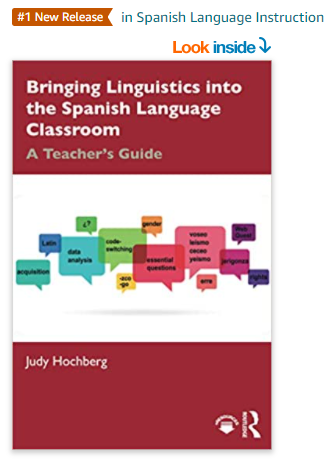
During this hiatus, Routledge published my second book, Bringing Linguistics into the Spanish Language Classroom: A Teacher’s Guide. This book obviously focuses on pedagogy, and comes with hundreds of PowerPoint slides that teachers can use in their classrooms. You can actually download these slides from the Routledge website without purchasing the book (click on “support materials”), but of course I recommend buying the book as well!

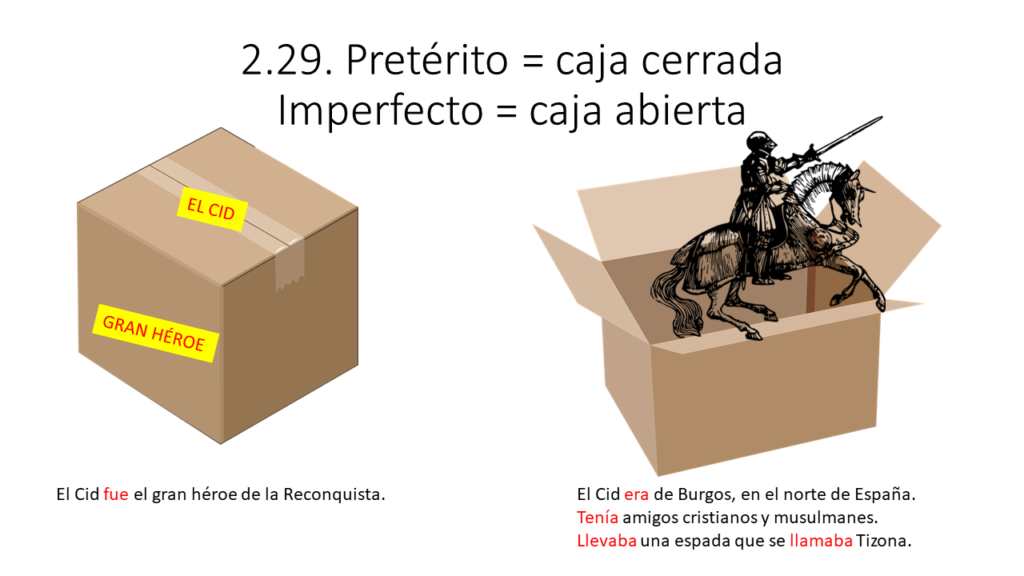
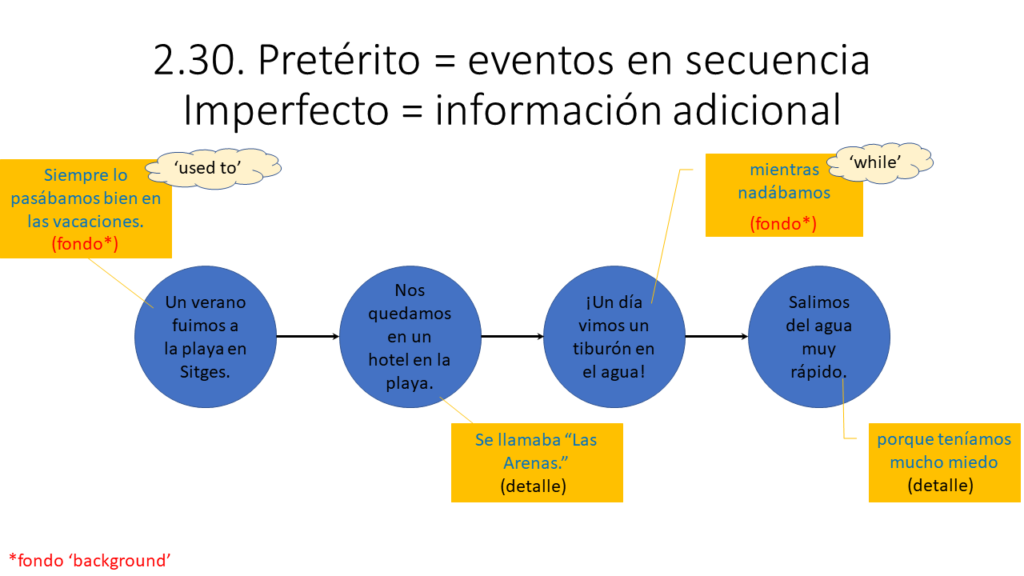
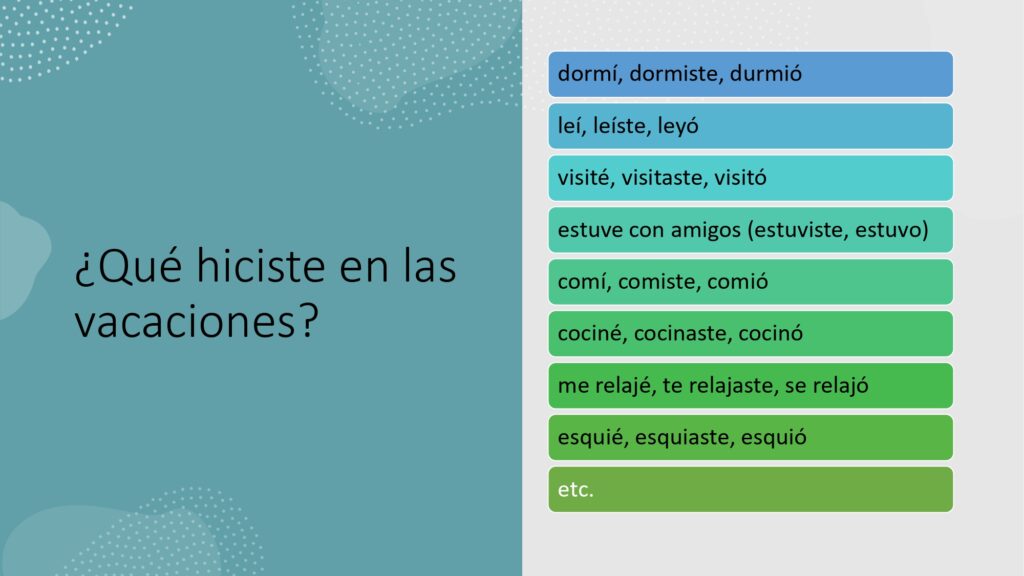
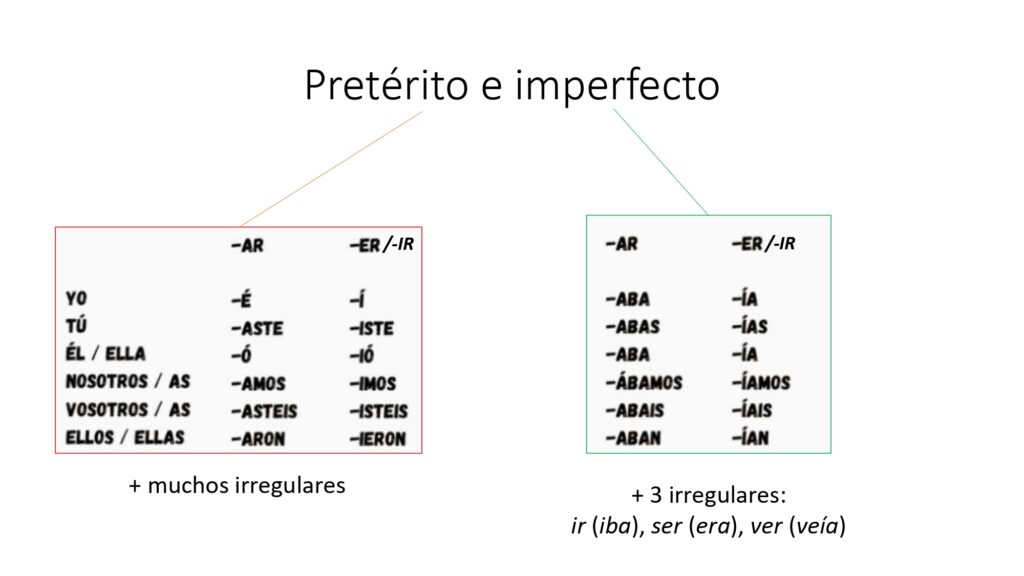
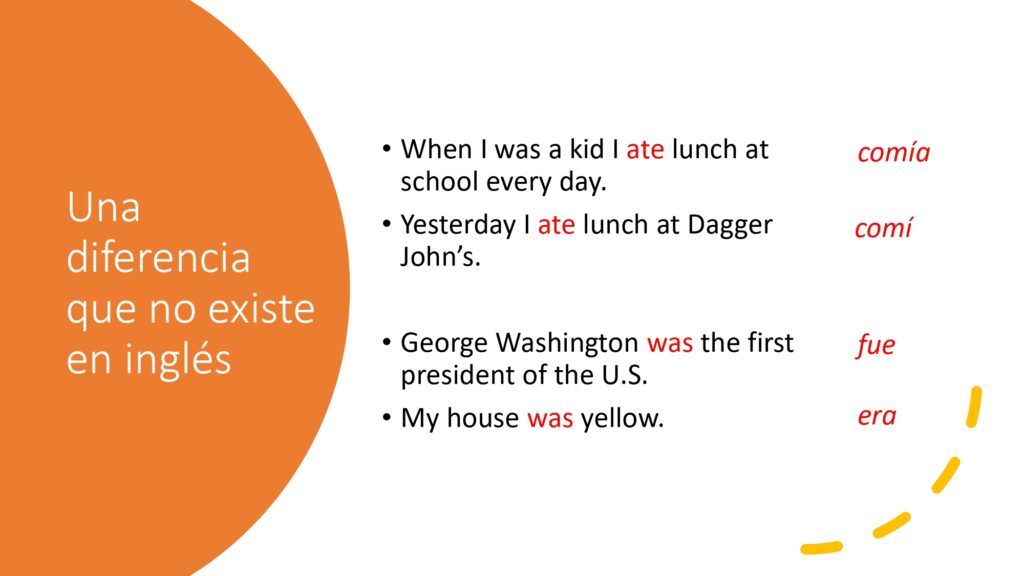
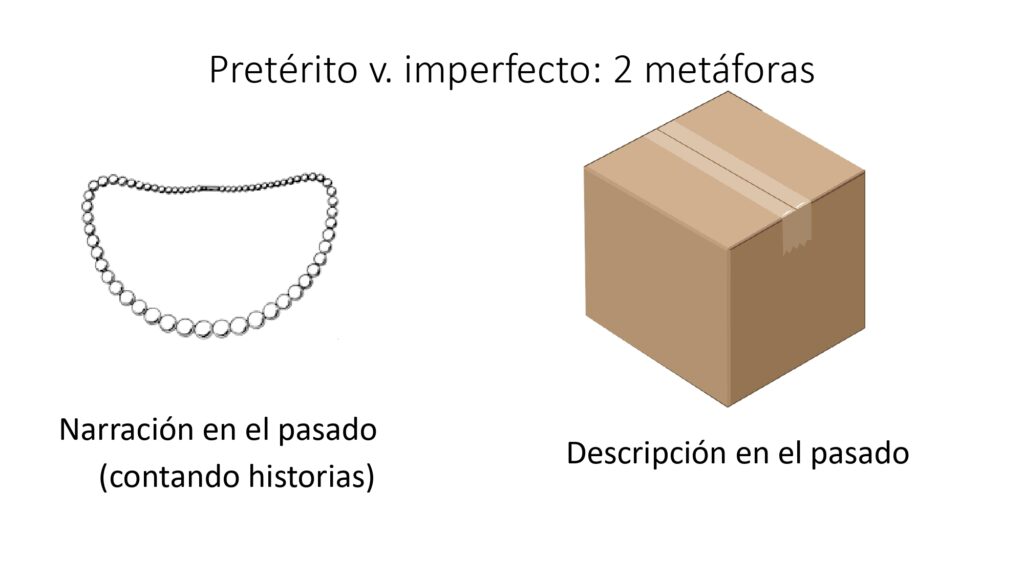
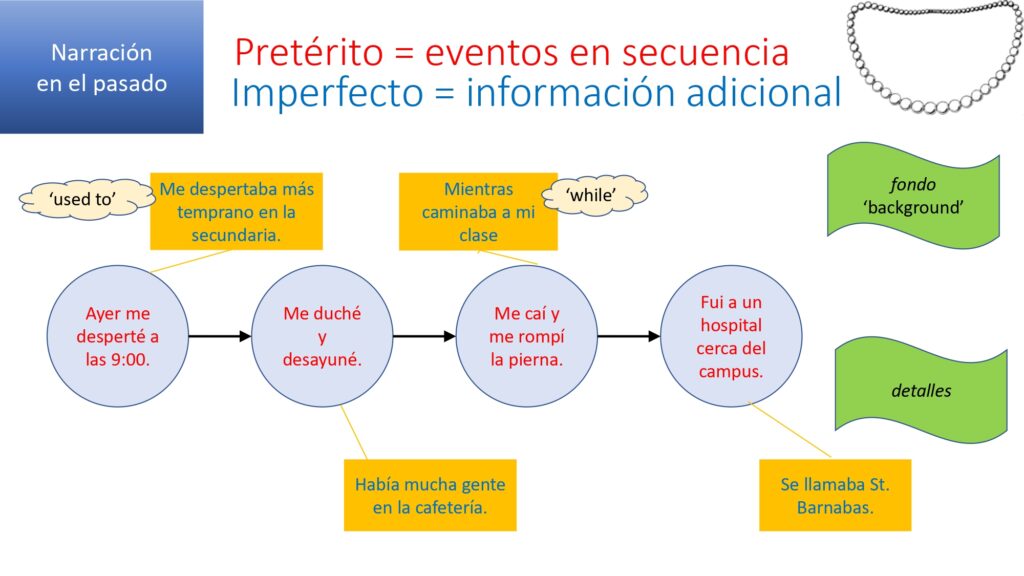
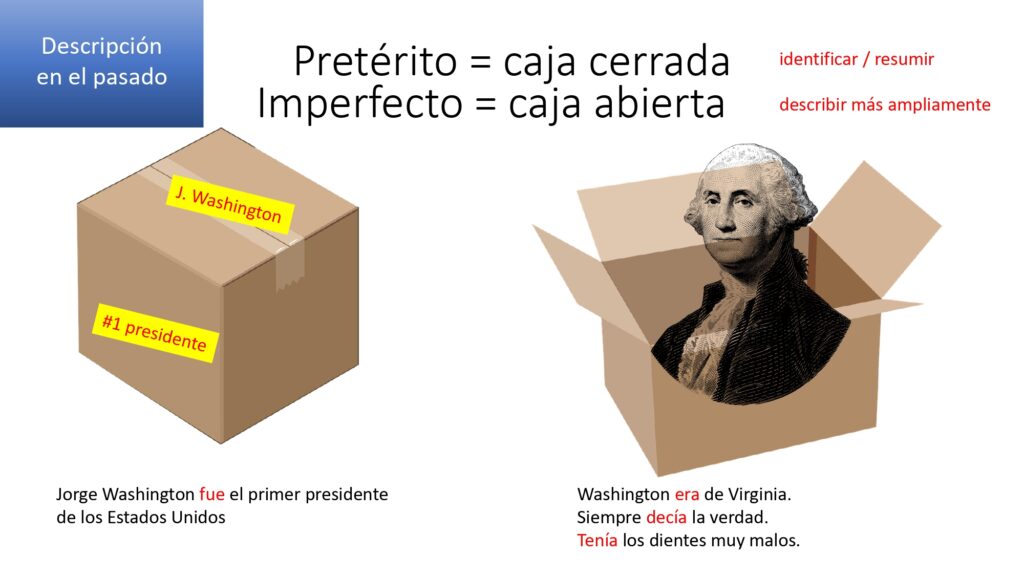
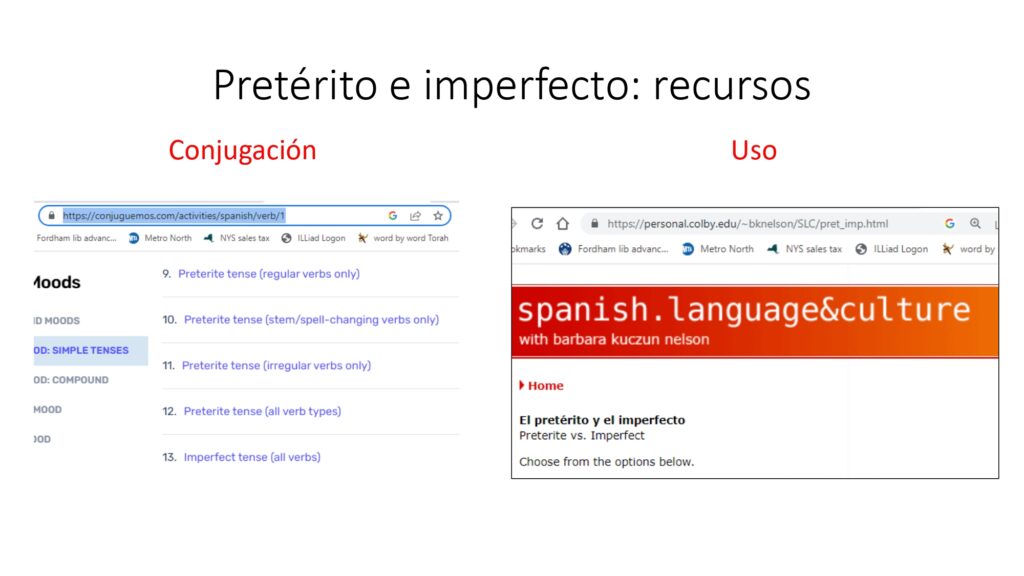
The book’s section on preterite and imperfect introduces two metaphors: beads on a string, and a closed versus open box. Here’s the relevant text from the book, followed by slides that illustrate the metaphors:

The distinction between completed and continuing events is simple in the abstract but elusive in practice. For this reason many teachers train their students to rely on various rules of thumb when deciding between preterite and imperfect. Some of these rules concern the type of past occurrence; for example, students may learn to use the preterite to describe beginnings and endings (e.g. empezó and terminó) and the imperfect to describe the weather (e.g. llovía). Other rules focus on contextual clues, such as specific timeframes for the preterite (e.g. todo el día) and mientras for the imperfect. While helpful, the former rules are fallible (e.g. El orador empezaba a hablar cuando el micrófono falló; Ayer llovió durante tres horas) and the latter are often absent in actual speech or writing. Sooner or later students have to grapple with the aspectual difference itself.

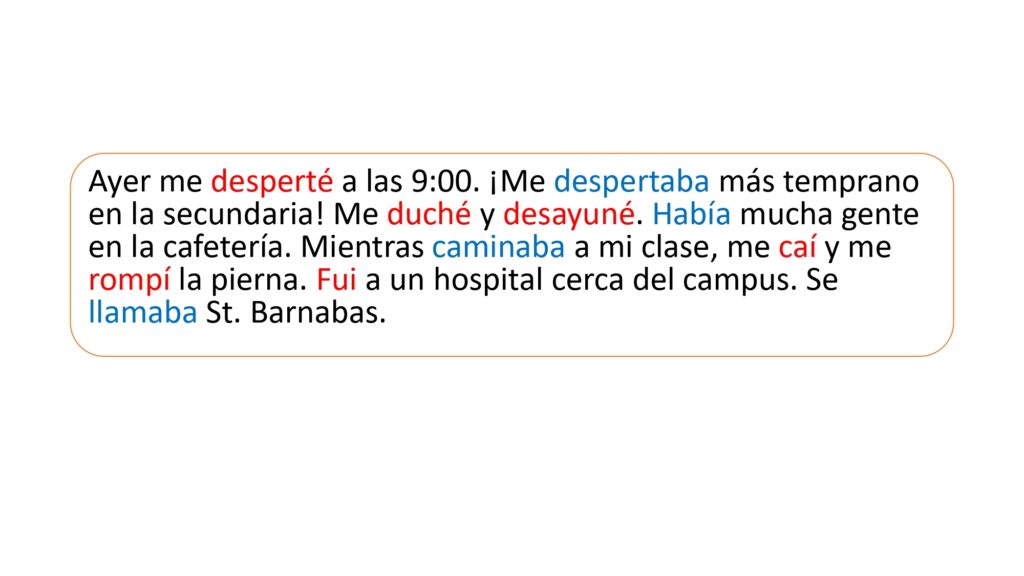
The visual metaphors in Slides 2.29 and 2.30 can help. Slide 2.29 depicts the preterite as a closed box containing a past occurrence (in this case the life of El Cid), and the imperfect as an open box that “unpacks” the occurrence, telling us more about it. This metaphor is particularly helpful when deciding between fue and era. Slide 2.30 depicts multiple preterite events as discrete and sequenceable, like beads on a string. This metaphor is particularly useful when teaching students to construct narratives. The animation in [the PowerPoint version of] Slide 2.30 shows how one can use the imperfect to add color to a bares-bones preterite narrative, an exercise described later in this section. Students may be interested in learning that children usually acquire the two tenses in this same order, i.e. preterite before imperfect (Slide 5.19).

In our first class meeting of the semester, I embedded the slides from my book into a mini-lesson in which I:

  1. elicited some preterites during a class-opening chat;
  2. briefly reviewed the two conjugations;
  3. contrasted Spanish with English to explain the challenge of this topic;
  4. presented the two metaphors at a high level;
  5. walked through the “beads in a string” (un collar de perlas) animation in an updated version of my book’s slide 2.30;
  6. showed the result: a natural switching back-and-forth between the two tenses;
  7. presented the open vs. closed box metaphor (again, with an updated version of the published slide);
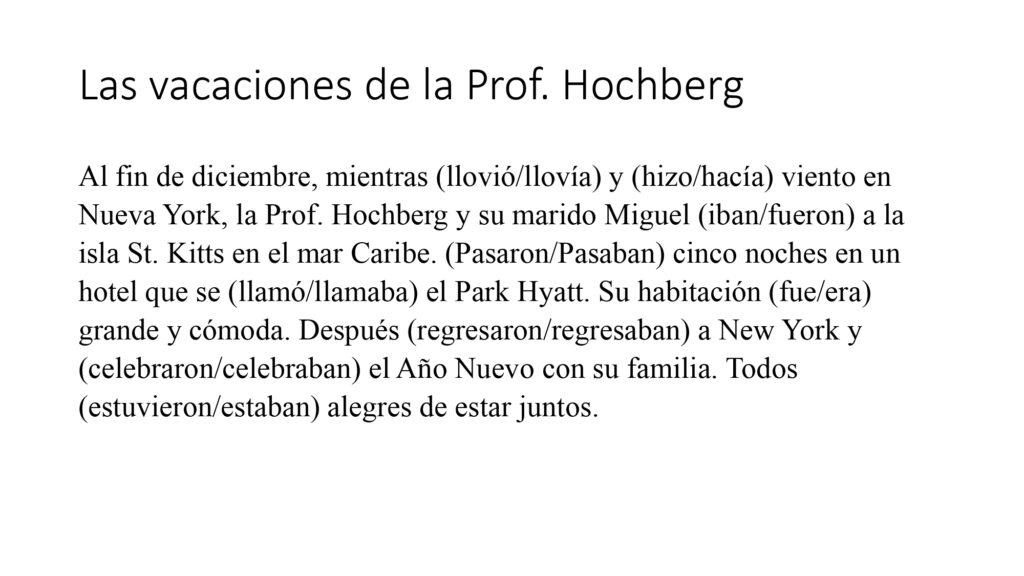
  8. had students choose between preterite and imperfect in a simple passage.

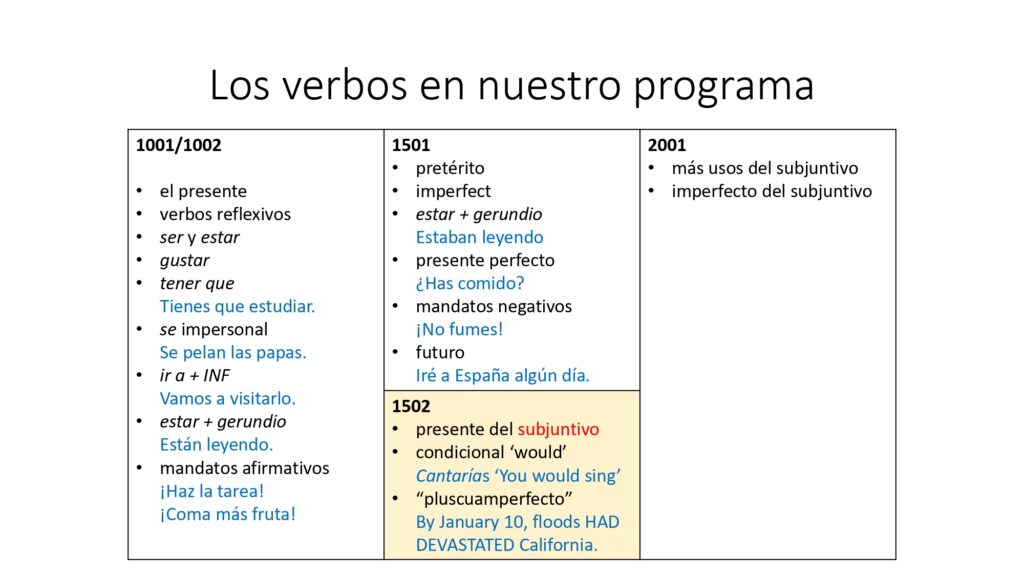
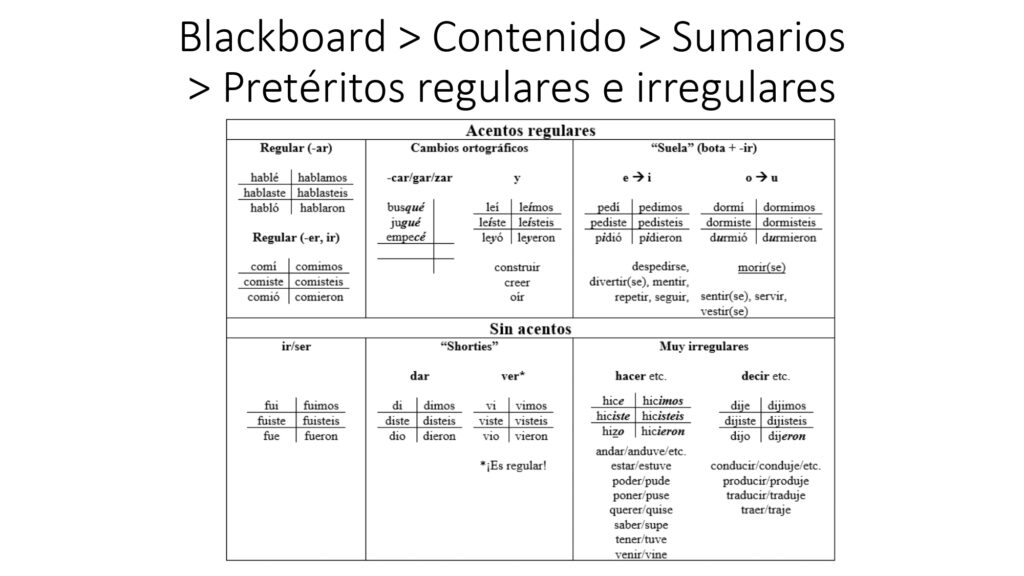
I also presented some favorite resources for students to pursue on their own, including my own divide-and-conquer, one-page summary of the preterite conjugation. A final slide showed them where we were, verb-wise, in our Spanish language sequence.

In the next class, I reviewed the use of preterite and imperfect via a group effort to tell the Cinderella story, then had pairs of students write short and simple narratives of their own, giving them a choice of well-known stories from Noah’s Ark to Avatar. Each pair received three pink index cards on which to write three key events on the preterite, and then white index cards, as needed, for them to add background information and details in the imperfect.

I had never had the chance to classroom-test these specific slides from my book, so it was exciting to finally put them into practice, especially since my students were receptive to the two metaphors. They did a decent job with their narratives; I’ll see how what they learned holds up as the semester rolls on.

Favorite fun facts about far-flung languages

I don’t know what inspired me to create the slideshow below. It popped into my head while I was driving home from the gym yesterday. I had a lot of fun fleshing it out last night and today. I hope you enjoy it, too.

The war in Ukraine and the Spanish Civil War

Today I taught a lesson that compared the current war in Ukraine to the Spanish Civil War. The lesson was built around a wonderful video from the good folks at Dreaming Spanish. (Be forewarned that the first few seconds are glitchy.) My PowerPoint for the lesson is available here.

https://www.youtube.com/watch?v=l16DRMvPoKY

Before starting the video, we talked about the war in Ukraine: how were the students following the situation, did they have Ukrainian friends, and the characteristics of the two sides in the war. We also previewed vocabulary that would appear in the video.

During the video, I hit the pause button often to check for comprehension, to highlight similarities between the two wars, and to enrich the presentation with further information regarding Hemingway’s The Sun Also Rises, the Abraham Lincoln Brigade, and Picasso’s Guernica.

The bottom line was that both conflicts involve a spirited democracy, fighting with a force that includes professional soldiers and ordinary citizens, against a better-armed autocracy (in the Spanish case, a future autocracy) that does not hesitate to take civilian lives. Unlike the Spanish Republicans, the Ukrainians are united behind a charismatic leader and have extensive international support.

The final part of the class focused on Spanish Civil War posters. I had prepared a Google Slides presentation with a number of posters from both the Republican and Nationalist sides. I had shared this presentation with my students ahead of time and had asked them to bring their laptops. Working in pairs, students chose one of the posters, did some quick research on it (mostly, looking up unfamiliar words), and then presented ‘their’ poster to the class.

Teachers: if you try this lesson, please let me know how it goes for you.

My new book is out — and selling briskly!

Although the Routledge website and Amazon still say that my new book won’t ship until next month, the copy that my father pre-ordered arrived last week, and my own copies a few days ago. So those of you who have been looking forward to reading the book shouldn’t hesitate to place an order, or to request that your library do so. According to Amazon many readers have already taken the plunge:

¡¡#1!!

I am very happy with the look of the book, including the cover. The crucial center illustration is hard to read in the screenshot above, though, so below please see a clearer version. The speech bubbles represent topics (e.g., acquisition), types of student activities and projects (e.g., WebQuest), and the overarching and organizing theme of essential questions.

The book is slender for its price, but of course half of the work on this project went into the 300+ accompanying PowerPoint slides which are available on the Routledge website. The slides are under copyright, and I do hope that anyone who finds them of value will show some respect for my time and effort by purchasing a copy of the book. Ahem.

What next? Besides teaching and blogging, I’ve had two book ideas on a far-back burner for some time. One is The Story of Spanish in 100 Words: a version, for Spanish, of David Crystal’s delightful book about English. I should be able to write that in my sleep, right? Another idea would be a major departure for me, though still language-related: a book about “grand-names,” meaning the names grandparents choose to be called — or their grandchildren choose to call them. This book would be timely as more and more Baby Boomers are becoming grandparents.

Or…I could decide to just spend a lot of time with my own grandchildren. Time will tell.

When verbs disagree

This morning I had an unexpected cross-linguistic learning experience.

When not obsessing about Spanish, one of my other passions is learning and chanting weekly portions of the Torah (Hebrew Bible) for a local Jewish prayer group. My Hebrew is nowhere near as good as my Spanish; I read Biblical Hebrew with language skills acquired in a one-year college course on Modern Hebrew in the early 1980s. Nevertheless, for my own pride and interest I always strive to understand the vocabulary and grammar of every portion I read.

This morning, as I was studying a passage from the book of Exodus for later this month, I was struck by a sentence that began

Vayomer Moshe v’Aharon… ‘Said Moses and Aaron…’

Verb-first word order was common in Biblical Hebrew, but I was surprised to see the singular verb vayomer accompanying the plural subject Moshe v’Aharon. The Spanish equivalent would be *Les dijo Moisés y Aaron (instead of dijeron).

To better understand this phenomenon I asked about the sentence on www.reddit.com/r/Hebrew, including the comparison with Spanish. A participant soon informed me that singular verbs with plural subjects are common in verb-first Biblical Hebrew sentences, and that in Standard Arabic (also a Semitic language) this is not just common, but actually mandatory. This “redditor” pointed out, somewhat snarkily, that “well Hebrew is not Spanish.”

As I thought about this response it occurred to me that Hebrew and Spanish aren’t as different in this regard as I had assumed. There are two common cases in which Spanish uses a singular verb with a plural subject. Can you think of what they are?

[Pause]

The first case involves the first gustar ‘to please,’ which Spanish uses (in a ‘backwards’ fashion) to mean ‘to like.’ If you like two or more activities, such as singing and dancing, you express this with singular gusta instead of plural gustan, which is used if you like two or more things:

  • Me gusta bailar y cantar.
  • Me gustan Star Wars, Harry Potter, y La casa de papel.

The second case is the existential hay, which means either singular ‘there is’ or plural ‘there are’ (depending on context), and its equivalents in other tenses. Some examples:

TenseSingularPlural
PresentHay una prueba mañana.
‘There is a quiz tomorrow.’
Hay muchas pruebas en esta clase.
‘There are many quizzes in this class.’
PastHubo un terremoto.
‘There was an earthquake.’
Había tres estudiantes en la clase.
‘There were 3 students in the class.’
FutureHabrá un baile en el zócalo.
‘There will be a dance in the square.’
Habrá nuevas elecciones en 2022.
‘There will be new elections in 2022.’

The literal bottom line, then, is that principled exceptions to verb agreement are another coincidental similarity between Spanish and Hebrew.

My favorite Quora answer turns 100

Back in 2017, looking for ways to build my “platform,” I started answering questions about Spanish on Quora. Since then I have answered almost five hundred questions and accumulated over a hundred followers. Mostly I have had fun; really, anything that resembles teaching and gives me the opportunity to share my knowledge appeals to me.

In terms of platform-building there is no doubt that Quora has spread my writing; my answers have accumulated over 330,000 views and over 1250 upvotes.

I wrote my favorite Quora answer in 2018 in response to the question “Should I learn French or Spanish? I don’t care which language is more spoken. My reasons for learning a language encapsulate things like grammar, culture, history, arts, etc.

Yesterday this answer received its 100th upvote. This makes me very happy because it was from the heart. I’ve copied it below, or you can read it on Quora here.

——————————————————————————————————————–

I feel passionate about this question because over the years, as a student and then teacher of Spanish, I’ve encountered so many prejudicial, knee-jerk, anti-Spanish attitudes. There was the high school classmate who told me that she chose French over Spanish because “only dirty people speak Spanish.”( She said this with a straight face and I believe she meant it.) There was my French-speaking (Swiss) cousin-in-law who was surprised when I told her that I considered Spanish art and literature to be on a par with, or superior than, their French counterparts. There was another French-speaking relative who thought it was funny that ¿Por qué?, the title of my book about Spanish, sounded, to him, like Porky. And then, of course, there is Donald Trump. While I haven’t heard him say anything good about French, he has been notoriously hostile to the Hispanic community, both abroad and in the United States.

I’d like to talk about a few of the topics that you mentioned in your question. In terms of culture, the outstanding thing about Spanish is that “Spanish culture” is more than Spanish — it is pan-Hispanic! While you “don’t care which language is more spoken”, the fact that Spanish is an official language in twenty-one countries, and is also widely spoken elsewhere (e.g. in the USA and Belize), means that the Spanish-speaking world is blessed with an enormous pool of potential talent. Thus great painters have come not only from Spain (think Velázquez) but also Mexico (Kahlo), Colombia (Botero), and the Hispanic community in the United States (Basquiat, whose mother was Puerto Rican). Nobel Prizes in literature have been won by writers from Spain, Chile, Guatemala, Peru, Chile, and Colombia.

I’m well-equipped to talk about Spanish grammar compared to French because I speak both languages and have, in fact, occasionally taught French even though Spanish is my “day job.” In my opinion Spanish grammar is more intellectually interesting than French. While the two languages share certain complexities compared to English, such as noun gender and multiple past tenses, Spanish has a more complex verb system — including, crucially, an actively used past tense subjunctive, whereas French only uses the present subjunctive — complications in its use of object pronouns, and the ser/estar contrast (both mean ‘to be’), which French lacks. It’s my impression that a lot of students sign up for Spanish because they think it’s easier than French but are sorely disappointed once they get past the early stages, in which the relatively straightforward spelling and pronunciation of Spanish do make Spanish somewhat simpler.

Finally, Spanish history rocks! It is essentially a series of conquests — the successive Roman, Germanic, Arabic, and Christian (re)conquests of Spain, followed by the Spanish conquests in the New World. Each of these has their own details and fascination, from Roman ruins to Arabic vocabulary to the fate of the indigenous peoples in the New World. (Did you know that even today, thirty million people in the Americas speak an indigenous language as their first language?)

So, if you are looking for a beautiful language spoken with pride, featuring a rich and varied culture, great books to read, and an intellectual linguistic challenge, you can’t go wrong with Spanish.

Latinx

I am working ferociously to finish correcting the page proofs for my new book, and to create an index (a painful task that I actually relish), so this is just a short post to say “hello” and share an interesting article I just read in the Washington Post about the word Latinx.

Latinx is an example of gender-neutral Spanish, one of several attempts to reduce or eliminate the use of -o and -os for masculine words and -a and -as for feminine word. In standard Spanish latino (note the lower-case l) is simultaneously masculine and neutral, so it can be used to identify either a Latino male or a Latino of unknown gender, as in La empresa espera contratar un latino para ese puesto ‘The company hopes to hire a Latino for that position.’ Likewise latinos refers to either a group of Latino males or a group of Latinos of mixed gender, male and female.

As in English, where the normative use of he has ceded ground to they, in today’s Spanish many speakers (and writers) try to avoid using gender-specific endings. In Spanish-speaking countries one often sees the @ character (called arroba in Spanish) used as a neuter vowel, as in this ‘Welcome refugees’ sign I saw in Valladolid a few years ago:

The x is also used as an alternative to the @; that’s the source of Latinx, which in my experience is found more often in the United States than in Spain, at least (I can’t generalize to other Spanish-speaking countries).

Anyway, the Washington Post just ran an op-ed, by their reporter José A. Del Real, asserting that “‘Latinx’ hasn’t even caught on among Latinos. It never will.” The article is behind a firewall, so here’s the key claim in case you can’t access the article:

“The label has not won wide adoption among the 61 million people of Latin American descent living in the United States. Only about 1 in 4 Latinos in the United States are familiar with the term, according to an August Pew Research Center survey. Just 3 percent identify themselves that way. Even politically liberal Latinos aligned with the broad cultural goals of the left are often reluctant to use it.”

The anti-Latinx reasons cited in the op-ed are its awkward pronunciation (especially in the plural), the preference among LGBTQ Latinos for Latine, and resistance to stamping a broad community with a single ethnic label. (The latter makes the term Hispano equally problematic.) The op-ed reports that “people of Latin American ancestry in the United States often prefer to describe themselves by referencing their specific countries of heritage, according to a 2019 Pew survey.”