Tag Archives: Argentina

Fun with “voseo” in Argentina: Part 2

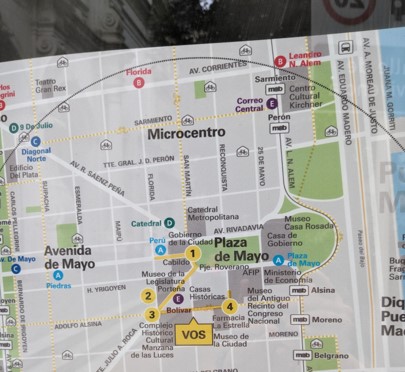
The street map below, which I saw on a downtown Buenos Aires signpost, captures the linguistic “Alice in Wonderland” vibe I experienced on my recent trip to Argentina. The VOS ‘you’ in the yellow box south of the Plaza de Mayo on the map was intended as a “You are here” location marker. However, as I explained in my previous post, voseo — the use of vos instead of standard Spanish — is a hallmark of Argentinian Spanish, as well as certain other Latin American dialects. So to me, this map told me that “I was here” linguistically — in the heartland of voseo — as well as geographically.
I was accustomed to seeing vos and its associated verb forms in Latin American novels, but spotting and hearing them ‘in the wild’ was a real thrill throughout my trip. As soon as I arrived at Buenos Aires’s Ezeiza airport I saw posters like the ones below, whose vos command forms tell the traveler to ‘connect yourself’ with WiFi, and ‘tempt yourself’ with the airport’s delicious food.

Later in my trip I was tickled pink to glimpse this large “VOS” featured on a branch office of the insurance company “La Segunda.” (I snapped this cell phone picture through a taxi window, hence the funny angle.) Its slogan Lo primero sos vos ‘You are first’ tells customers that they are the company’s top priority.

Although I’ve known about voseo forever, I had never had a good reason to actually learn the relevant forms. So before my trip I gave myself a crash course. I was surprised to see that in most cases, the only distinction between standard Spanish forms and their corresponding vos forms is stress. Specifically:

  • In standard Spanish, present tense forms like amas ‘you love’ and comes ‘you eat,’ as well as informal () command forms like ¡Ama! ‘Love!’ and ¡Come! ‘Eat,’ all stress the next-to-last syllable. Because this is the standard stress pattern for Spanish words that end in a vowel or s (think cuchara and cucharas), they are written without an accent mark.
  • Vos forms display the opposite pattern. As illustrated by present-tense amás and comés, and commands ¡Amá! and ¡Comé!, these words are stressed on the last syllable, and therefore require a written accent mark.

As soon as I saw the Conectate and Tentate posters illustrated above, I realized that the final stress on vos commands further complicates an already challenging topic in Spanish: the use of accent marks in command forms with pronouns.

  • In standard Spanish, the next-to-last stress of commands like ¡Ama! and ¡Come! is heard in formal and plural affirmative commands as well (¡Ame! ¡Amen! ¡Coma! ¡Coman!). In written Spanish, when you add a pronoun to any of these commands, you must also add an accent mark to maintain stress on what is now the third-to-last syllable. Some examples are informal ¡Cómelo! ‘Eat it!’, formal ¡Levántese! ‘Get (yourself) up!’, and plural ¡Escríbanles! ‘Write (to) them!’
  • In contrast, because vos commands are stressed on the last syllable (e.g. ¡Conectá!), adding a pronoun means that you can drop the accent mark, since the stressed syllable is now in the usual next-to-last position (¡Conectate!).
  • This means that Argentinians need to add an accent mark when adding pronouns to formal and plural commands like ¡Levántese! and ¡Escríbanles!, but remove an accent mark when adding a pronoun to informal (vos) commands like ¡Conectate!.

This situation is guaranteed to confuse anyone but a linguist! Not surprisingly, many Argentinians (incorrectly) omit the accent mark in formal commands with pronouns because they are used to doing this in informal commands. (I don’t know what the situation is with plural commands, which are less common.)

Below are two examples of such errors from our trip to Igauzú. The seatback airline safety instructions on the left omitted the accent mark on abróchese ‘buckle.’ (As you can see, I added it with a pen mid-flight, in the spirit of Deck and Herson’s self-righteous but inspirational The Great Typo Hunt.) Likewise, the informational panel on the right, from the Iguazú waterfall park, omitted the accent mark on acérquese ‘approach.’ Note that the safety instructions and the informational panel correctly accented cinturón, más, and información, implying that the missing accent marks on the commands were a sign of weakness in grammar rather than an overall spelling deficit. The missing accent mark on the subjunctive verb form esté (which I also wrote in myself) supports this conclusion.

Finally, I can’t help but ask: since verb forms, which are mostly used in the Northern hemisphere, have the opposite stress pattern from and vos forms, which are mostly used in the South, could this possibly have something to do with the Coriolis effect?

Just joking!

Fun with “voseo” in Argentina: Part 1

Dear reader: Once I sat down to write this post I realized that I had plenty to say about voseo as a linguistic phenomenon. So I’ve restricted myself to that topic here. In my next post I’ll actually tell you about my enjoyment of voseo while in Argentina.

My favorite aspect of Argentinian Spanish is voseo, the use of the pronoun vos instead of to mean ‘you’ in familiar settings. As a linguist, I appreciate voseo for three reasons.

First, voseo has an amazing history. Argentina, along with certain other regions in Central and South America, retained the archaic vos pronoun while the rest of Latin America followed Spain’s lead in settling on . The outcome of versus vos in each region depended on the degree of contact between it and Spain during the colonial period. Argentina could not be reached directly, via the Atlantic, because rampant piracy in the Atlantic forced Spain to restrict ocean travel. Spaniards could only reach Argentina by sailing to the Caribbean, crossing the Isthmus of Panama via mule train, sailing to a Pacific port such as Lima, and crossing the Andes. Argentina, like other effectively remote parts of the New World, was thus insulated from linguistic changes back in Spain.

I remember how excited I was to read about this connection between Latin American linguistic history and piracy (!!!) in Ralph Penny’s essential A History of the Spanish Language. It was the subject of my first blog post more than ten years ago, and was one of two linguistic insights that inspired me to write my first book. (The other was my spotting of Jespersen’s Cycle at work in the creation of Spanish negatives, both old and new.)

Second, voseo helps to illustrate that linguistic complexity begets variation. When English speakers begin to study Spanish, they are often taken aback to learn that our single pronoun you corresponds to at least three in Spanish: singular (informal) and usted (formal), and plural ustedes. Spain further divides plural ‘you’ into informal vosotros and formal ustedes. As is often the case, the complexity of this aspect of the language is paralleled by extensive dialectal variation: not just vosotros in Spain and vos in parts of Latin America, but also differences in how speakers around the world use and usted. For example, Spaniards favor over usted in all but the most formal of situations, and in parts of Columbia usted connotes intimacy.

(By the way, two other examples of complexity begetting variation in Spanish are (i) its inventory of seven third person direct and indirect object pronouns (lo, la, los, las, le, les, and se), which has spawned the variant usage patterns of leísmo, loísmo, and laísmo, and (ii) its relative abundance of consonants (17-19, depending on dialect), as opposed to vowels (5), with the result that most phonetic variation in Spanish dialects involves consonants.)

Third — I’m perhaps going out on a limb here — voseo is something that most Spanish speakers are aware of. As a result, you can start an interesting conversation about language differences by asking a Spanish speaker ¿En su país se usa o vos? Likewise, you can ask about usage of versus usted in their country. I can’t think of any aspect of English grammar that could inspire a parallel discussion. We’re stuck with matter-of-fact questions about vocabulary, such as “Do you say soda, pop, or coke?”

A linguistic “busman’s holiday” in Argentina

In case you aren’t familiar with the expression, a “busman’s holiday” is a vacation that closely mirrors a tourist’s everyday life. A “busman” (normally one would say “bus driver”) spends a lot of time on the road, so a vacation that involves a fair amount of travel would be more of the same.

Because I’m obsessed with Spanish, my recent trip to Argentina was very much a busman’s holiday. For one thing, during the trip I spoke very little English: only in phone calls home, and with Spanish speakers who wanted to practice their English. My travel buddy Susan and I spoke only Spanish with each other, and I had as many conversations as I could with Argentinians and other Spanish speakers. As a result, my Spanish improved perceptibly during the trip. Immersion works!

My most memorable such conversation took place at the Puerto Iguazú airport, on our way back from seeing the waterfalls. While waiting for our flight I met a Paraguayan civil engineer who was working on a new highway that would bring drivers to the new bridge to Brazil just north of Hito Tres Fronteras (pictured in my previous post). She said something along the lines that “once the bridge and highway are completed, there will be no more traffic.” For a New Yorker raised with the ghost of Robert Moses, the famed builder who never met a stretch of concrete he didn’t like, this was an extreme provocation. One theme of Robert Caro’s classic memoir The Power Builder is that the more roads and bridges Moses built, with the purported aim of decreasing traffic, the worse traffic got. My new friend had never heard of Robert Moses, so this was an exciting conversation for both of us. The Power Broker is now on her English reading list.

Besides the sheer joy of speaking Spanish, the other “busman’s holiday” aspect of my trip was relishing the dialectal features of Argentinian Spanish. As a warmup I devoted some of my free time before the trip to Argentinian fiction. I reread Guillermo Martínez’s La muerte lenta de Luciana B. (2008), which I had found an easy-to-read page-turner years ago. While it was still exciting the second time around, Martínez’s treatment of the title character now struck me as somewhat outdated and sexist. I also read Mariana Enriquez’s truly weird but wonderful novel Nuestra parte de noche (2021), about a sort-of-Satanic cult operating in exactly those parts of Argentina that we were about to visit, namely Buenos Aires and Corrientes province, including Iguazú. During our trip I reread Eduardo Sacheri’s La pregunta de sus ojos (2003), the novel that inspired the 2009 Argentinian movie El secreto de sus ojos and its 2015 English-language adaptation Secret in their eyes. I’ve seen both movies, and the novel is better.

These books reminded me of Argentinian vocabulary like remera for T-shirt and biro (or birome) for a pen. La pregunta de sus ojos in particular featured a near-constant stream of descriptors like boludo ‘imbecile’ and pibe ‘kid.’ Once I arrived in Argentina, local vocabulary was all around me. For example, while texting with our airbnb hostess during my short wait for Susan at the airport I learned to use departamento instead of apartamento and tránsito instead of tráfico.

By the way, these words exemplify a variety of well-known mechanisms of semantic change. Remera is an example of ‘broadening,’ since it originally referred to a shirt worn by a rower (remar means ‘to row’). Biro(me) is an ‘eponym’ that memorializes Ladislao José Biro, the Hungarian-Argentine inventor of the ballpoint pen. Boludo, like English ‘blockhead’, is a metaphorical extension from a shape (bola ’round’) to a personality trait, while pibe was borrowed from Catalan pevet, Portuguese pivete, or Italian pivetto.

As a further “by the way,” Corominas traces the history of pibe from peu (the Catalan word for ‘foot’) to a footed incense holder, to odorous incense, to something with a strong smell, to an infant, to a child. This is as wacky as the evolution of muñeca from ‘milestone’ to either ‘wrist’ or ‘doll,’ yet every step is plausible.

As for as the Argentinian accent, its most salient aspect is probably the lilting intonation that the language has absorbed from Italian (listen at 4:25 here). When I overhear this intonation in the speech of tourists in New York I’m often emboldened me to ask, with a fair rate of success, ¿Son ustedes de Argentina? I didn’t try to adopt this intonation on my trip, but did have fun replacing the usual Spanish glide in words like yo and calle with a harder /dʒ/ or just /ʒ/ consonant, as in ‘Joe’ or ‘pleasure,’ respectively. This is the feature that gave the Argentinian revolutionary Ernesto Guevara the nickname ‘Che.’

My next post will discuss the outstanding feature of Argentinian grammar: voseo.

¡Argentina!

In March I finally went to Argentina. “Finally” because I’ve wanted to go there for ages, partly for the usual touristic reasons — the country’s culture, natural beauty, and cuisine — but also, as you might guess, to enjoy Argentina’s special variety of Spanish. I’ll write about that in my next post.

I went with my friend Susan R., whom I met through this blog. She is a retired Spanish teacher and an experienced traveler. We hadn’t spent much time together before this trip, but turned out to be highly compatible travel buddies.

Here’s a slideshow about the trip.
I uploaded it as a PDF to sidestep some technical difficulties.

Argentina is a huge country! Since this was our first visit, Susan and I decided to limit our trip to Buenos Aires and the famous waterfalls of Iguazú, located at the meeting point of Paraguay, Brazil, and Argentina. In Buenos Aires we did the normal touristic things, like visiting the tomb of Eva Perón. We took a fantastic tango lesson that ended up with a few hours at a milonga, or dance hall, where porteños (residents of Buenos Aires) go to actually dance, not to just watch a show. We ate a lot of meat (“When in Rome…”), drank a lot of wine, and also enjoyed a lot of top-quality gelato, a testimony to Argentina’s animal husbandry and Italian heritage.

Besides our two-night trip to Iguazú, which was of course spectacular, we made two day trips from Buenos Aires, one to the Tigre Delta, where we enjoyed a boat ride and had lunch on an island, and one to the Uruguayan city of Colonia del Sacramento, on the other side of the Río de la Plata. I would recommend the former though not the latter. Colonia is a pleasant city but not special enough to justify the time it took to cross the river and go through customs in both directions.

Argentina has a perennially troubled economy. While we were there inflation was down somewhat, but there was no question that people were still suffering; we read that over half of Argentinians live below the poverty line. As tourists we were insulated from their hardship, and in fact reaped the silver lining of paying bargain prices for restaurants and lodging. At least we were helping out the economy with an infusion of our American dollars.

Speaking of which, a consequence of Argentinian’s economic chaos is that tourists have to think ahead about how to pay for goods and services. When traveling in Europe I normally pay by credit card almost everywhere, and withdraw cash from a local ATM if necessary. Everything we read and were told about traveling in Argentina told us to bring cash with us, because many businesses don’t take credit cards and ATMS give a terrible exchange rate.

In fact we were able to use our credit cards more than we expected. When in need of Argentinian pesos, to get the more favorable dólar azul rate we exchanged our crisp $100 U.S. bills at cuevas (informal money-changing shops) or Western Unions, or with private individuals we trusted. Our airbnb hostess in Buenos Aires vouched for a gentleman named Pedro, who could always be found outside the café across the street. I have to admit that this was something of a thrill.

The other complication of our trip was mosquitos. There had been a lot of rain before we arrived and mosquitos had multiplied alarmingly. We were forewarned to bring our own insect repellent, since little was left to buy in porteño shops. We gave our leftover repellent to friends of Susan’s as a going-away present.

The main surprise of the trip, at least for me, was how much Argentinians love mate. I knew that this herbal tea is popular in Argentina, but had no idea how omnipresent it is. It was common to see people carrying their mate y bombilla sets outside the home, not just while sharing a drink in a park, but when just walking around the city. Many people also carry a thermos of hot water to refresh their mate after drinking all the liquid. We also saw hot water dispensers for mate, like this one, in public places. There’s even an app you can use to find them.

Apparently the mate leaves release more caffeine every time you add water, so the drink becomes more and more addictive.

Language teachers talk about “Culture with a capital C,” like painting and literature, versus “culture with a little c,” meaning the everyday objects and customs that make life different depending on where you live. Mate is a great example of the latter.

NECTFL report

On Friday and Saturday I had a wonderful time at the annual NECTFL conference here in New York. NECTFL stands for the NorthEast Conference on the Teaching of Foreign Languages. It started as an independent conference, but is now the largest of the regional conferences under the umbrella of ACTFL, the American Council on the Teaching of Foreign Languages. I’ve attended NECTFL several times, and this year, for the first time, presented a talk.

The talk was based, not surprisingly, on my book, but with an appropriately pedagogical twist, to focus on how foreign language teachers can bring linguistics into the classroom. The conference theme was standards for foreign language teaching, so I shaped my talk around two of ACTFL’s official standards: Comparisons (with other languages) and Connections (to other disciplines). In the talk I managed to work in two other standards: Cultural comparisons and — the big one! — Communication. The abstract is below.

temp

My talk had a decent turnout, especially since there were more than a dozen concurrent talks for attendees to choose from, and was well received. I had some promising follow-up conversations, including an offer of collaboration and an invitation to speak at another conference. I’m also planning to write up my talk and submit it to one of the ACTFL journals.

Bloomsbury Linguistics had rented a table in the conference’s book exhibit, and sold every copy of my book that they had with them, in addition to taking advance orders. This made me very happy. I figured that if I couldn’t sell my book at a conference for language teachers, I was in big trouble.

As in previous years I learned a lot from the talks I attended. My chore today is to go over my notes and the handouts I accumulated, and digest the specific techniques that I can implement (i) immediately and (ii) later in my own teaching. In many talks I was struck afresh by the dramatic differences between K-12 and college teaching. Most attendees, and all the presenters I heard, are K-12 teachers. They have lots of time to work with their students, and usually have a classroom to call their own. As a college Spanish teacher I have less time to cover more material, and share an anonymous classroom. On the other hand, my students are more mature who are strongly motivated to do the work and earn good grades. These environmental differences will play a large role in how I adapt the techniques I learned in the conference.

I had a final dose of Spanish after the conference, when I struck up a conversation with an Argentinian family at an excellent taquería where I stopped for a bite on my way to the train station. (It isn’t hard to recognize Argentinian Spanish, but of course I was pleased, and these tourists somewhat surprised, when I guessed their nationality.) We chatted a bit about my two idiosyncratic Argentinian obsessions: pato, the gaucho version of polo originally played with a live duck, and the linguistic isolation of Argentinian Spanish during the formative colonial period, which was the subject of my first blog post back in 2013. Now I have friends to see when I eventually visit Buenos Aires!


The geography of voseo

When I was relatively new to Spanish, one of my teachers explained to our class that voseo was a special feature of Argentinian Spanish. Voseo is the use of vos, with its associated verb forms, instead of standard Spanish tú, as an informal pronoun meaning “you”. So “you speak” is vos hablás instead of tú hablas, “you are” is vos sos instead of tú eres, and so on.

Years later I learned that voseo isn’t limited to Argentina, nor to its neighboring countries in South America. It’s found in several countries in South America, and also in parts of Central America, including El Salvador. (I seem to be running into a lot of vos-using salvadoreños lately, both at home and out of town.) Below is a map showing where vos is used in Latin America.

Reproduced by Creative Commons license. Medium (or dark) blue indicates spoken (and written) voseo.  Light blue indicates tu/vos alternation. Grey indicates tú only.

By the way, this is my second-favorite voseo map. My favorite is on p. 156 of Christopher Pountain’s Exploring the Spanish Language; do a “Search inside this book” with the phrase “distribution of voseo” to find it. It’s under copyright so I can’t reproduce it here.

As you can see in either map, the distribution of voseo doesn’t tidily follow country borders, or even continental borders. The controlling factor is, rather, historical. As I explained in my very first post on this blog, travel between Spain and Latin American was restricted during the colonial period because of rampant piracy on the Atlantic Ocean. Therefore, settlements close to the two colonial capitals of Mexico City and Lima, or to the major ports of call en route such as Veracruz and Portobelo, had much more exposure to the latest linguistic developments from Spain than those in the “boondocks”.

For your convenience, here is the map of colonial trade routes I included in that first post.

Colonial trade patterns

Adapted from Sagredo 2007 under the GNU Free Documentation License

Voseo is a perfect illustration of this phenomenon. At the beginning of the Colonial period,  and vos were both current in Spain. Eventually, of course,  won, but only those parts of Latin American that were in regular contact with Spain followed its lead. That’s why, if you compare the two maps, the all- areas (grey on the voseo map) roughly correspond to the colonial trade routes (red on the second map). Argentina was about as boondock-y as you could get since it could only be reached by crossing the Andes, by foot and/or by mule, from Lima. That’s why its voseo is the strongest in the continent.

¿Vos entendés?

Multilingualism in Latin America

We all know that the conquest of Latin America was a disaster for its indigenous peoples and languages. Between war, slavery, and disease, the native population was reduced, absorbed, or eliminated in much of Latin America. At the same time, the native languages gave way to Spanish.

Argentina is an extreme example of this tragic pattern. According to the CIA World Factbook, only 3% of Argentina’s population is indigenous or mestizo (mixed). Mapudungun and Quechua are still spoken, but less than Spanish, Italian, English, German, and even French.

Bolivia, Ecuador, Guatemala, Paraguay, and Peru are at the other end of the demographic and linguistic spectrum. Their populations are largely indigenous or mestizo, and their indigenous languages are still widely spoken, and in many cases recognized as co-official with Spanish. I’ve put together a summary table (below) using data from the CIA Factbook and, where indicated, the U.S. Department of State.

Latin American countries with widely spoken indigenous languages
(Source: CIA Factbook unless otherwise indicated)

Country

Ethnicity

*indicates data from U.S. Dept. of State

Indigenous languages

Linguistic status

Official status

Bolivia 85% indigenous or mestizo Only 60.7% of the population speaks Spanish. Quechua and Aymara are co-official with Spanish.
Ecuador 90% indigenous or mestizo* Quichua and Shuar are widely spoken. Spanish is the only official language.
Guatemala Majority indigenous or mestizo* Only 60% of the population speaks Spanish. 23 indigenous languages are co-official with Spanish.
Paraguay 95% mestizo Most of the population is bilingual in Spanish and Guaraní. Guaraní is co-official with Spanish.
Perú 82% indigenous or mestizo 15% of the population speaks Quechua, Aymara, or another indigenous language. Quechua is co-official with Spanish.

Piracy and Latin American Spanish

Colonial trade patterns

Adapted from Sagredo 2007 under the GNU Free Documentation License

My blogging guru, Tris Hussey, warns that a blog’s first post is always terrible. Nevertheless, I can’t resist devoting this post to the most interesting tidbit I know about the history of Spanish: the relationship between piracy during the Spanish colonial period and today’s Latin American dialect patterns. The following is based on Ralph Penny‘s discussion of the topic in his Variation and Change in Spanish (Cambridge University Press, 2000).

Continue reading