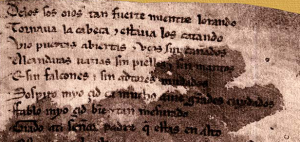
 In a previous post, I explained that Latin’s long nn turned into the ñ sound of Spanish, which resembles the ni in onion. For example, Latin annus “year” became Spanish año. This development is also the source of the letter ñ itself. The squiggly tilde ~ over the n started as a shorthand form of the letter n, so that ñ stood for a double n, i.e. n over n. Once the symbol was established, it came to be used for instances of the ñ sound that had other origins, including:
- n before i or e (Hispania > España, aranea > araña “spider”)
- n after g (signalis > señal “sign”)
- mn (damnum > daño “harm”)
The ñ was already in use by medieval times. In fact, you can see it in the earliest known example of written Spanish, a 14th-century transcription (in Spain’s Biblioteca Nacional) of the oral epic poem El Cid. In the excerpt above, from the first page of the poem, there’s a visible tilde in the word señor, the third word in the last line. (This is the eighth line from the top if you click the image to see the full page.)
Pingback: Tildes in logos | Spanish Linguist
Pingback: Catching some z’s | Spanish Linguist