Tag Archives: writing

I rewrote my previous blog post twice

I love to write. Decades after I learned to read, it still amazes me that the written word can cross miles and millenia to transmit a writer’s thoughts to his or her readers. In high school, a series of excellent teachers taught me that writing is an expression of thinking, so that if you’re having trouble writing something, chances are you haven’t thought it through thoroughly enough.

I started this blog in 2013 in part to research and think through topics that I would later include in my first book. It was a helpful exercise and kept me motivated. It was also interesting to me at a meta level. To my surprise, when I eventually converted blog posts to book sections I often inverted them. My blog posts, which were discursive in nature, often ended with a twist. My book sections, which were expository, often turned that twist into an introductory hook.

Now that I’m working on a third book I’m again finding it useful to post as I carry out my research. It’s highly motivating to be thinking, as I read and take notes, “Is there anything here interesting enough to blog about?” As with my first book, I expect that many of these posts will make it into my book in some form. And the craft of writing has continued to surprise me.

My most recent post, “Coriander, Cilantro, Culantro“, which I published two weeks ago, is a case in point. I wasn’t thrilled with it at the time but was anxious to post something. It had been almost two weeks since my previous post, which wasn’t even related to my book research. However, afterwards I found that I couldn’t move on in my research, but instead kept coming back to the “Cilantro” post. It was like compulsively probing a sore tooth. The more I reread it, the more I was convinced that it was boring. I had presented the three herbs through the prism of my own life experience (who cares?), and only in the second half of the post had I explained why the three words were of linguistic interest. And the post didn’t explain why, seemingly out of the blue, I was writing about herbs.

So a week later I completely revised the post. This second version added the necessary context, and explicitly addressed the linguistic interest of this triplet of words, but did so clunkily, as a series of bullet points.

As a result I found myself stuck again, and finally, today, posted a revision that satisfies me. It’s the one you’ll see on this blog now. It puts the linguistic information up front, but with, I think, a good structure and flow. It adds my personal perspective, but does so lightly. And I worked in a twist at the end.

I’ve memorialized the first two versions of my “cilantro” post here and here. Have a look if you like, and let me know if you agree that the current one is really superior. Now I can finally move on. Unfortunately, the next word in Histories and Mysteries is…COCKROACH!!!

El contraste b/v — Spanish words with b or v

Today is Spanish Friday so this post is in Spanish. ¡Scroll down for English translation!

En español las letras b y v tienen la misma pronunciación, una situación que les molesta a hispanohablantes y a estudiantes de español. Es difícil argumentar a favor de la retención de las dos letras distintas porque hay pocas palabras para las cuales les importa la diferencia. Conozco los siguientes “pares mínimos” (un término que normalmente se aplica a los sonidos, no a la escritura):

  • baca vs. vaca
  • bacilo vs. vacilo
  • bate vs. vate
  • bello vs. vello
  • botar vs. votar

¿Conocen Uds. otros?

—————————————————————————————————————-

In Spanish, the letters b and v have the same pronunciation, a situation that causes problems for both Spanish speakers and Spanish students. It’s hard to argue in favor of keeping both letters in the alphabet because there are few words where the difference matters. I’m aware of the following “minimal pairs” (a term usually used for differences in pronunciation, not spelling):

  • baca “automobile roof-rack” vs. vaca “cow”
  • bacilo “bacillus” vs. vacilo “I vacillate”
  • bate “[baseball] bat, he/she/you beats” vs. vate “bard, poet”
  • bello “beautiful” vs. vello “down, fuzz”
  • botar “to throw” vs. votar “to vote”

Do you know any others?

Whence Spanish ¡ and ¿

¡I love the Spanish upside-down exclamation and question marks! ¿Don’t you?

I’m serious. In fact, when taking notes or otherwise writing by hand (pretty rare these days), I use ¡ and ¿ in my English. Both marks give the reader a useful heads-up that a text is about to depart from simple declarative prose. It’s surprising that ¡ and ¿ haven’t caught on beyond Spanish — not even in Catalan or Portuguese.

Continue reading →

Spanish doesn’t have apostrophes

I’d been speaking Spanish for a couple of decades (well, maybe more) and teaching Spanish for a couple of years when it finally struck me, after red-inking yet another student paper with an abominable construction of the Paco’s libro ilk, that Spanish doesn’t use apostrophes at all.

Continue reading →

Whence the Spanish tilde

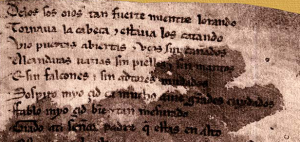
El CidIn a previous post, I explained that Latin’s long nn turned into the ñ sound of Spanish, which resembles the ni in onion. For example, Latin annus “year” became Spanish año. This development is also the source of the letter ñ itself. The squiggly tilde ~ over the n started as a shorthand form of the letter n, so that ñ stood for a double n, i.e. n over n. Once the symbol was established, it came to be used for instances of the ñ sound that had other origins, including:

  • n before i or e (Hispania > España, aranea > araña “spider”)
  • n after g (signalis > señal “sign”)
  • mn (damnum > daño “harm”)

The ñ was already in use by medieval times. In fact, you can see it in the earliest known example of written Spanish, a 14th-century transcription (in Spain’s Biblioteca Nacional) of the oral epic poem El Cid. In the excerpt above, from the first page of the poem, there’s a visible tilde in the word señor, the third word in the last line. (This is the eighth line from the top if you click the image to see the full page.)