Slogging through the letter C in Spanish Word Histories and Mysteries and taking notes for my third book, I was interested to learn that a single Greek word, koriandron, gave rise to the English and Spanish words for the three different culinary flavorings pictured below: coriander seeds, which are sold both whole and ground, and two leafy herbs: cilantro and culantro. Cilantro is the herb that grows from coriander seeds, and culantro is a botanical cousin. Like cilantro, it is a member of the apiaceae family, which also includes carrots, celery, and parsley.
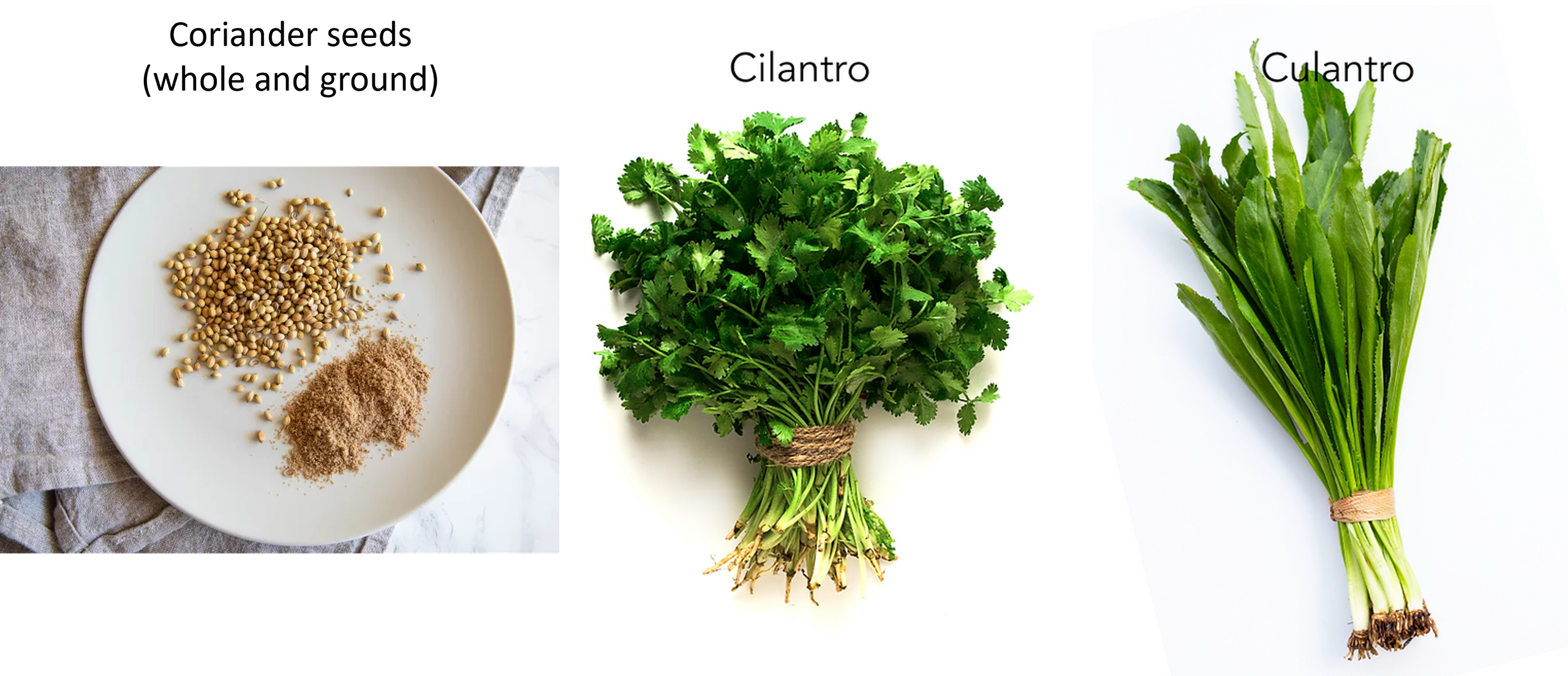
By the way, I use all three of these flavorings in my own cooking. I prefer to grind coriander seeds myself, as needed, for Indian recipes (Madhur Jaffrey is my guru). I use cilantro constantly. And recently I have been using culantro, which I buy at H-Mart, in Costa Rican recipes from The Blue Zones Kitchen. And now, back to linguistics…
Greek words are most common in technical domains, such as science (e.g. cometa) and medicine (e.g. epilepsia), as well as religion (e.g. biblia). In the kitchen, French and Italian borrowings predominate for obvious reasons. However, according to Histories and Mysteries, Greek is the source of many names of herbs. This makes sense because herbs straddle the boundary between food and medicine
Latin borrowed Greek koriandron as coriandrum. In French coriandrum developed into coriandre, which is the source of English coriander. In Spanish coriandrum developed into culantro. This word was first attested in 1385; cilantro (first attested in 1680) developed as a variant pronunciation but eclipsed culantro in frequency in the 20th century (see Google ngram analysis below). Perhaps this is when culantro became associated with the less common herb. At any rate, English borrowed both cilantro and culantro from Spanish to complete its herbal trio.

According to the authoritative Spanish etymologist Joan Corominas, the transitions from coriandrum to culantro, and from culantro to cilantro, were both noteworthy.
- In the first phase, the change of the first /r/ in coriandrum to an /l/ is an example of ‘dissimilation’: a sporadic process whereby nearby sounds became more different from each other in order to make a word easier to pronounce. A similar change occurred in the evolution of Vulgar Latin robore into Spanish roble ‘oak’, and of Latin peregrinus into French pélerin. (The other changes, such as final -um becoming -o, happened across the board as Spanish evolved.)
- Regarding the second phase, Corominas writes that the vowel change from the /u/ of culantro to the /i/ of cilantro was unique. Since /i/ and /e/ are similar vowels, he suggests that the cilantro variant might have been influenced by another botanical name: celidonia (celandine in English, botanically Chelidonium majus), a plant whose leaves are toxic if ingested, and whose sap has been used as a folk remedy for warts.
You say cilantro, I say culantro — let’s cook!