By now I’m well into the “c” section of Spanish Word Histories and Mysteries. This is decent progress, since in my previous post inspired by this book I was only in the “b’s”. However, my perusal ground to a halt yesterday when I read about the English word cedilla, which is a straight borrowing of the Spanish word cedilla. The cedilla is the little hook that some languages use under a letter, most often the letter c, to represent certain pronunciations. In French the cedilla softens a c to a /s/ before a or o, as in français ‘French’ or garçon ‘waiter’. A plain (no-cedilla) French c is pronounced /k/ before these vowels, as in carte ‘menu’ or couper ‘to cut’.
The cedilla is not used in Modern Spanish, but in Old Spanish ç was pronounced /ts/, as in the middle of pizza. As in French, ç was only used before a or o, for example in Old Spanish caçar ‘to hunt’ (now cazar) and alço ‘I raise’ (now alzo). As Old Spanish became Modern, the sound /ts/ disappeared, and words previously written with a ç switched to a z, as shown above, that was (and is) pronounced either s or th, depending on one’s dialect.
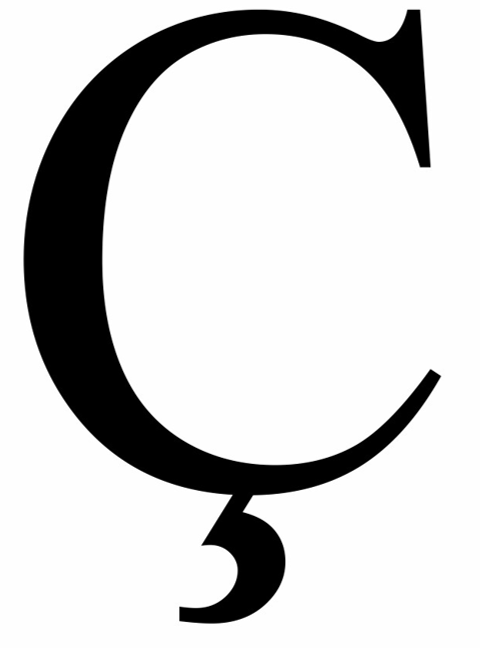
Histories and Mysteries explains that the cedilla under ç originated as a miniature letter z. This is apparent if you look at a large ç (below). In Spanish, ceda is a variant spelling of zeta, the name of the letter z, so cedilla, with the diminutive -illa suffix, simply means ‘little z‘.
I never knew this! and it makes me enormously happy because the tilde (~) over the beloved Spanish ñ originated as a small letter n. What an awesome parallel! But it also made me realize, for the first time, the irony of zeta, the Spanish word for the letter z.
Why ironic? Because one of the rules of Spanish spelling is that z is only used before a, o, and u, and is replaced by c before e or i. You can see this in the Spanish spelling of cebra and cero (below), and in spelling alternations like empezar ‘to begin’ and empiezo ‘I begin’, versus ¡Empiece! ‘Begin!’ and empecé ‘I began’. Most words that violate this rule are recent borrowings like zepelín ‘zeppelin’, zenit ‘zenith’, zig-zag, zinc (the metal) and zigoto ‘zygote’. Ironically, the word zeta is another exception.

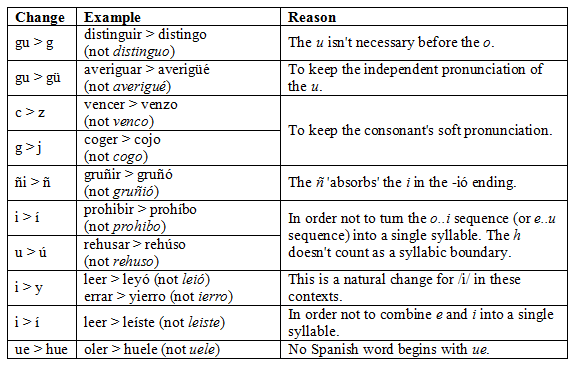
As far as I know, this rule lacks a logical explanation, since the pronunciation of the letter z isn’t affected by the vowel that follows it. The c/z alternation is thus different from the language’s other spelling alternations, which are well motivated. For example, adding a u to a g in verb forms like pagué ‘I paid’ preserves the hard /g/ sound of the verb pagar. For this reason I’m afraid I used to tell my students that it was “a stupid rule of Spanish” to always use c, not z, before e and i. Honestly, I’ve looked for explanations, but have never found one that satisfies me.
So the “irony of zeta“, alluded to above, is simply that its spelling violates the Spanish spelling rule for the letter z. To put it another way, you can’t state the rule “Don’t use the letter z before e or i” without breaking it: No se usa la letra zeta antes de e o i.” What an oxymoron! I don’t know if cedilla will be one of my 100 words, but I must mention this irony.
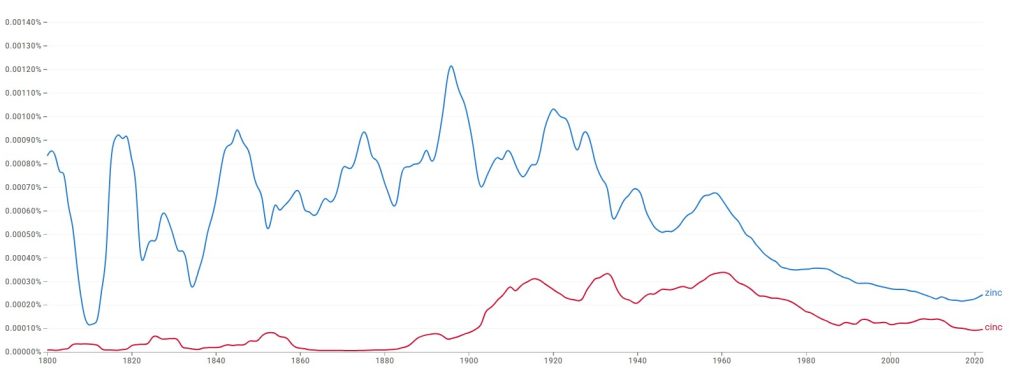
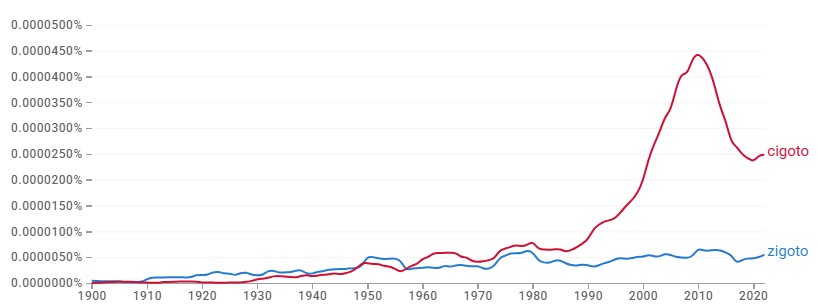
By the way, although zepelín and zig-zag seem to be maintaining their alien z spellings, the hispanized spellings cinc and cigoto have threatened or surpassed the originals, as shown in the Google ngram results in the slideshow below. This shows that the c/z spelling rule, motivated or not, maintains its force in modern Spanish.