[Note to the reader: I wrote this post two weeks ago but apparently forgot to publish it! So here you go — better late than never.]
It’s been so long since I’ve worked on my new book (my current excuse is excessive travel) that when I finally sat down yesterday to get back to work, I couldn’t find my copy of David Crystal’s The Story of English of 100 Words, which I’ve been taking notes on for ages. I found it later in the day, but in the meantime spent my allotted work time taking notes on the first several pages of Spanish Word Histories and Mysteries, which I have in mind as my next resource. While this book is really about English, it also serves as an approachable and well-written introduction to Spanish word origins. It discusses 150 Spanish words, from A to Z, that have made their way into English.
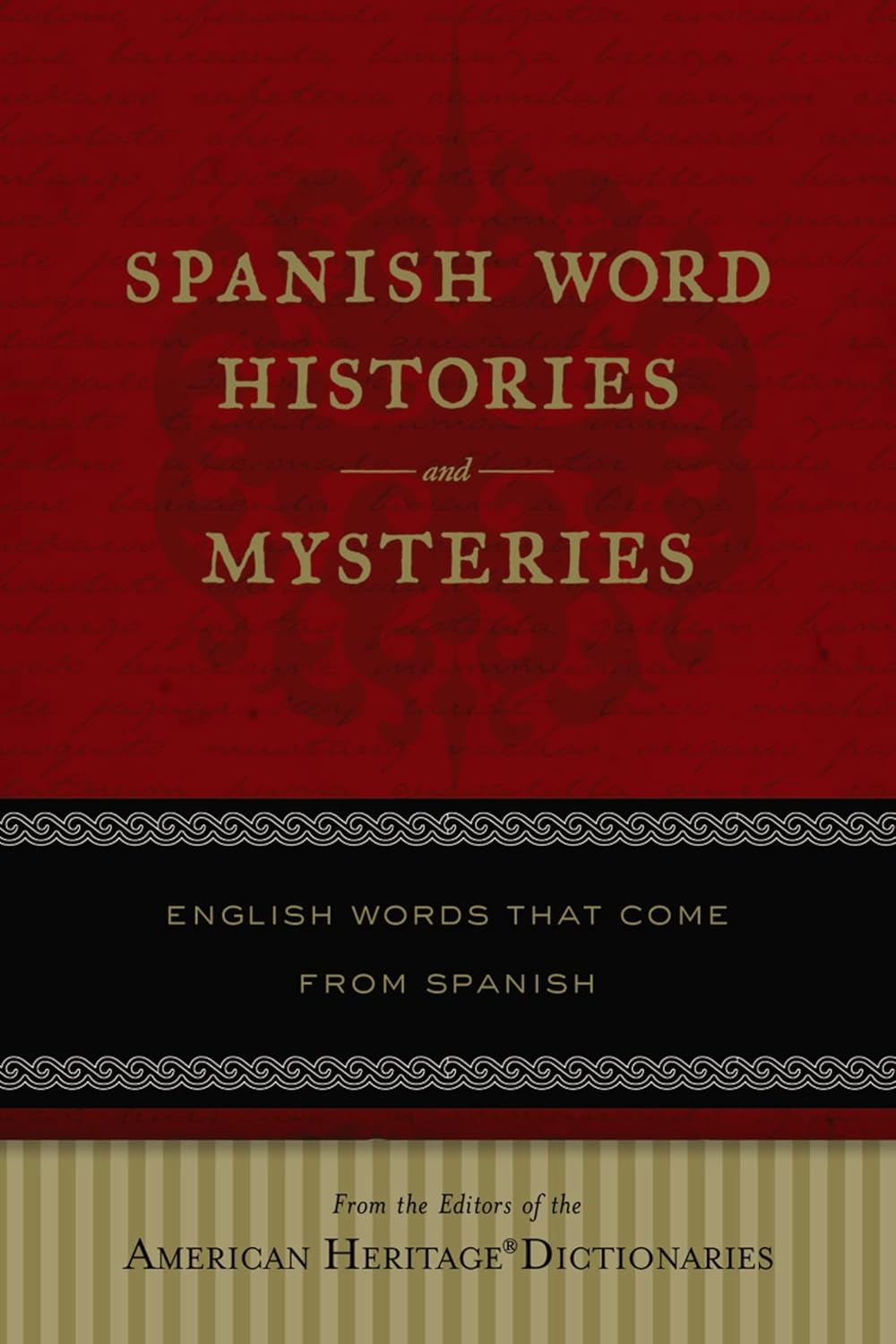
Yesterday I only worked through the book’s Introduction, and the beginning of the section devoted to the letter “A”, but this short detour immediately bore fruit. For one thing, what I read broadened my thinking about the origin of Spanish words for indigenous American flora, fauna, and so on. I knew that Spanish borrowed many words from the languages of South American, Central America, and Mexico, but I hadn’t given much thought to the languages spoken in what is today the United States. Yesterday I learned that the English word abalone comes from the Spanish word abulón, itself derived from aulun, the word for abalone in Rumsen, a now-extinct Ohlone language spoken in today’s Monterey County. Abalone was an important part of the Rumsen diet.
Spanish Word Histories and Mysteries dates this borrowing to the middle of the 1700s, when Spain became an active presence in the San Francisco Bay Area, building Franciscan missions and civilian settlements. I already knew that Spain successively borrowed words from each region of the Americas as they conquered it: first the Caribbean, then Mexico and the Pacific Coast of South America, and finally the South American interior. (See Table 4.1 from my first book, copied below). Learning about abalone/abulón/aulun reminded me to include Ohlone and other languages spoken in today’s United States in the latter group.

Not all Spanish words for American flora and fauna (etc.) come from indigenous American languages. The Introduction to Spanish Word Histories and Mysteries uses a fun pair of words to illustrate this point. While chocolate comes from Nahuatl (see again Table 4.1), vainilla is pure Spanish, the diminutive of vaina ‘sheath’. Spaniards used this word to name this unfamiliar plant because of the shape of the vanilla pod or vanilla bean.
Many words in the book’s “A” section are nouns borrowed from Arabic with the article al ‘the’ prefixed to the noun root. Adobe, from Arabic at-tûba ‘brick’ (here the l of al assimilated to the following t), is an example of an Arabic word that itself was borrowed from another language. Tûba comes from Coptic, a late form of the Egyptian language, which is only distantly related to Arabic. (It’s an Afro-Asiatic language, but not in the Semitic branch of the family). I’m familiar with other examples of Arabic borrowings that come from other languages, such as alambique ‘still for making alcohol’, from Greek, and aduana ‘customs officer’, from Persian.
Finally, spending time with yesterday’s words reminded me that vocabulary is as interesting as the world it describes. Despite living in the Bay Area for several years, I hadn’t heard of the Ohlone people. Nor did I know that the orange color of cheddar cheese normally comes from annatto, a pigment derived from achiote (originally a Nahuatl word). On a personal level, because I am Jewish it was satisfying to learn that adobe has Egyptian roots; every year at the Passover seder we remember that the Egyptians forced their Jewish slaves to build cities for Pharaoh “with harsh labor at mortar and bricks”. (However, the Hebrew word for brick used in the Book of Exodus (le’vey’nah) doesn’t appear to be related to tûba.)
Reading about the word albatross, from Spanish alcatraz, inspired me to learn about these amazing birds, long-lived and monogamous, who normally live in the air, where they can soar for hours on end, and on the water, where they find their food. They only land on the ground to mate, which happens annually or less often — every other year for the Great (or “wandering”) albatross. It was also interesting to learn that the negative meanings of albatross (the bird) and Alcatraz (the prison) are confined to English. (The former is attributable to Coleridge’s Rime of the Ancient Mariner.) For this reason English albatross is more interesting than Spanish alcatraz, which is unlikely to make the cut for my book.
I will continue with Crystal’s book, now that I’ve relocated it, but will look forward to returning to Mysteries and Histories next — hopefully, not too long from now.