Tag Archives: Arabic

A detour into a new resource

It’s been so long since I’ve worked on my new book (my current excuse is excessive travel) that when I finally sat down yesterday to get back to work, I couldn’t find my copy of David Crystal’s The Story of English of 100 Words, which I’ve been taking notes on for ages. I found it later in the day, but in the meantime spent my allotted work time taking notes on the first several pages of Spanish Word Histories and Mysteries, which I have in mind as my next resource. While this book is really about English, it also serves as an approachable and well-written introduction to Spanish word origins. It discusses 150 Spanish words, from A to Z, that have made their way into English.
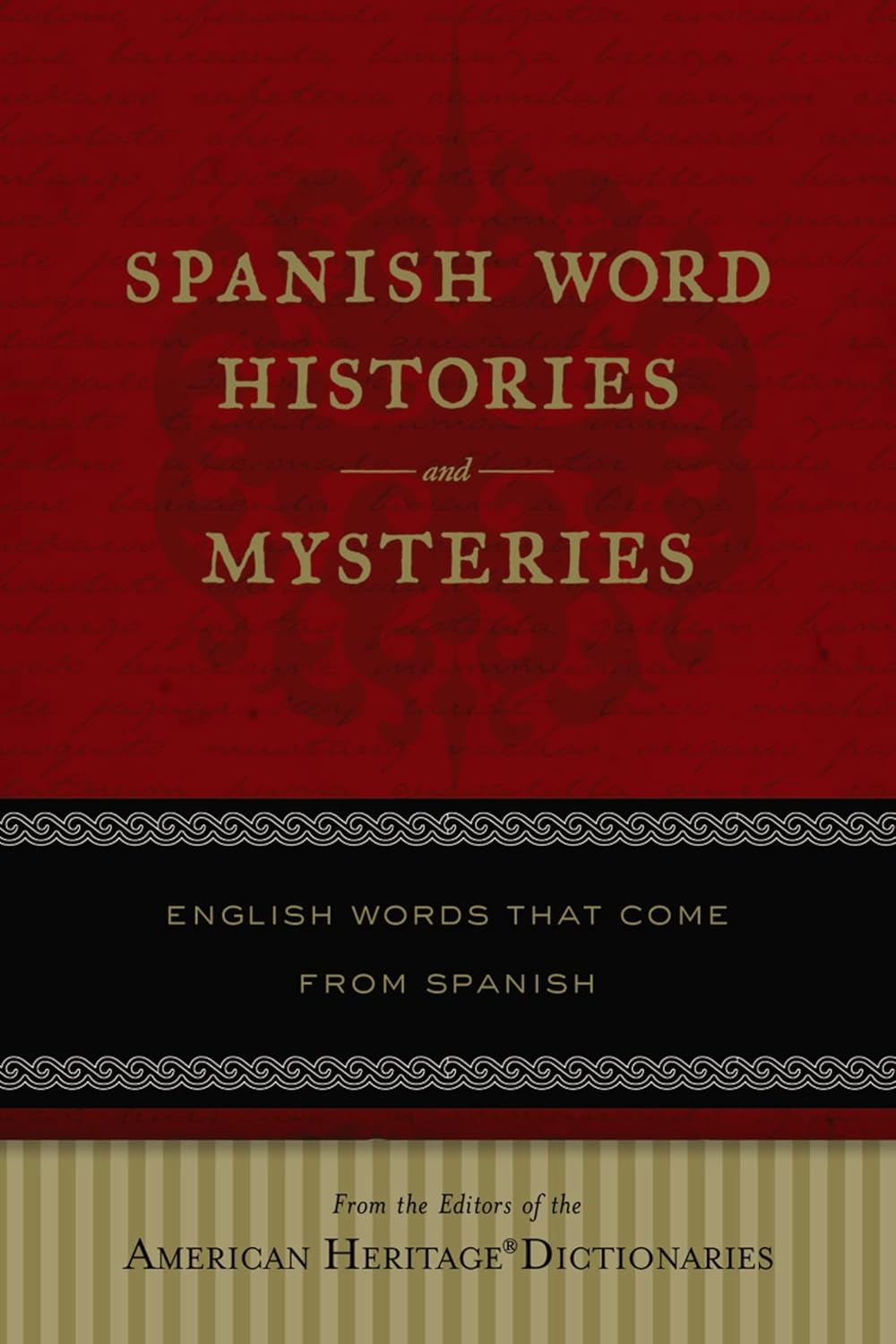
Yesterday I only worked through the book’s Introduction, and the beginning of the section devoted to the letter “A”, but this short detour immediately bore fruit. For one thing, what I read broadened my thinking about the origin of Spanish words for indigenous American flora, fauna, and so on. I knew that Spanish borrowed many words from the languages of South American, Central America, and Mexico, but I hadn’t given much thought to the languages spoken in what is today the United States. Yesterday I learned that the English word abalone comes from the Spanish word abulón, itself derived from aulun, the word for abalone in Rumsen, a now-extinct Ohlone language spoken in today’s Monterey County. Abalone was an important part of the Rumsen diet.

Spanish Word Histories and Mysteries dates this borrowing to the middle of the 1700s, when Spain became an active presence in the San Francisco Bay Area, building Franciscan missions and civilian settlements. I already knew that Spain successively borrowed words from each region of the Americas as they conquered it: first the Caribbean, then Mexico and the Pacific Coast of South America, and finally the South American interior. (See Table 4.1 from my first book, copied below). Learning about abalone/abulón/aulun reminded me to include Ohlone and other languages spoken in today’s United States in the latter group.

Not all Spanish words for American flora and fauna (etc.) come from indigenous American languages. The Introduction to Spanish Word Histories and Mysteries uses a fun pair of words to illustrate this point. While chocolate comes from Nahuatl (see again Table 4.1), vainilla is pure Spanish, the diminutive of vaina ‘sheath’. Spaniards used this word to name this unfamiliar plant because of the shape of the vanilla pod or vanilla bean.

Many words in the book’s “A” section are nouns borrowed from Arabic with the article al ‘the’ prefixed to the noun root. Adobe, from Arabic at-tûba ‘brick’ (here the l of al assimilated to the following t), is an example of an Arabic word that itself was borrowed from another language. Tûba comes from Coptic, a late form of the Egyptian language, which is only distantly related to Arabic. (It’s an Afro-Asiatic language, but not in the Semitic branch of the family). I’m familiar with other examples of Arabic borrowings that come from other languages, such as alambique ‘still for making alcohol’, from Greek, and aduana ‘customs officer’, from Persian.

Finally, spending time with yesterday’s words reminded me that vocabulary is as interesting as the world it describes. Despite living in the Bay Area for several years, I hadn’t heard of the Ohlone people. Nor did I know that the orange color of cheddar cheese normally comes from annatto, a pigment derived from achiote (originally a Nahuatl word). On a personal level, because I am Jewish it was satisfying to learn that adobe has Egyptian roots; every year at the Passover seder we remember that the Egyptians forced their Jewish slaves to build cities for Pharaoh “with harsh labor at mortar and bricks”. (However, the Hebrew word for brick used in the Book of Exodus (le’vey’nah) doesn’t appear to be related to tûba.)

Reading about the word albatross, from Spanish alcatraz, inspired me to learn about these amazing birds, long-lived and monogamous, who normally live in the air, where they can soar for hours on end, and on the water, where they find their food. They only land on the ground to mate, which happens annually or less often — every other year for the Great (or “wandering”) albatross. It was also interesting to learn that the negative meanings of albatross (the bird) and Alcatraz (the prison) are confined to English. (The former is attributable to Coleridge’s Rime of the Ancient Mariner.) For this reason English albatross is more interesting than Spanish alcatraz, which is unlikely to make the cut for my book.

I will continue with Crystal’s book, now that I’ve relocated it, but will look forward to returning to Mysteries and Histories next — hopefully, not too long from now.
Great reads re: Arabic, Icelandic

Of course this blog is about Spanish, but I couldn’t resist sharing with you two recent articles about Arabic and Icelandic. Any linguistically-minded reader will find them fascinating.

The first article, from the New Yorker, is simultaneously a tale of language learning, a profile of an inspired (but anguished) language teacher, and a source of information about the current state of Egyptian Arabic. I already knew that there was a split between written, “Modern Standard” Arabic, which is homogeneous across the Arabic-speaking region, and the spoken Arabic of the different countries in the region. (For this reason, Arabic students in the United States typically start with Modern Standard Arabic, then spend some time in the country of their choice to learn the relevant spoken version.) But I didn’t know it had come to the point where educated Egyptians now use English or French as a written language instead of Arabic. It’s as if Spanish speakers had continued to write in Latin, but now, given widespread knowledge of English, found it easier to use English as a written language while maintaining Spanish as a means of oral communication. Mind-blowing.

The second article, from the Associated Press, describes the perilous state of Icelandic. The enemy here is English, spoken as a second language throughout Iceland, and used extensively in tourism and business. Apparently young people are speaking English among themselves, a dangerous sign. English is also required for anyone who interacts with technology, since modern devices don’t ‘speak’ Icelandic. Languages die out all the time, unfortunately, but these are mostly minority languages, like Native American languages with only a few hundred speakers. It’s startling to see such concerns raised about a language with hundreds of thousands of speakers, Nobel Prize-winning literature, and official support and recognition: “an army and a navy,” to use Max Weinreich’s classic formulation.


Forgotten Spanish

As much as I love Spanish, there have been a few periods in my life when I didn’t speak it much, or at all. Because I’m a compulsively analytic linguist, it’s been interesting to see what I’ve forgotten, or remembered, after a break from the language.

My longest break was the dozen or so years that I worked as a computational linguist. For most of this time I lived in New Mexico, where, as I previously described, it was hard to find people to speak Spanish with because I was an outsider — an Anglo (or Angla).

What did I forget during that time? Mostly, vocabulary, on what a computer scientist would call a LIFO basis — Last In, First Out. That is, the words I forgot tended to be the ones I’d learned most recently.

Last in, first out

I discovered one such loss when my husband’s cousin came to dinner with his family. His wife Claudia is Mexican and it was pure joy to speak Spanish with her and their multilingual children (Spanish, French, some Hebrew, some English). At one point I groped for the word for “struggle” and came up with esdrújulo. Claudia looked puzzled. Clearly the word didn’t mean what I thought it did; in fact, she told me she had never heard it!

A trip to the dictionary solved the mystery: esdrújulo is a reasonably obscure linguistic term that I had learned while writing my dissertation on children’s acquisition of the Spanish word stress system. It refers to stress three syllables from the end of a word — the antepenultimate syllable. Some examples are teléfonohelicóptero, and, of course, esdrújulo itself, which means that the word is “autological“, i.e. an example of what it defines. (Sesquipedalian, meaning “having many syllables”, is another famous autology.) Esdrújulo and struggle are phonetically similar: sdru maps to stru, j maps to g, and l maps to l. This undoubtedly explains why my memory had reinterpreted the word during those years of disuse.

Needless to say, I have never since forgotten it!

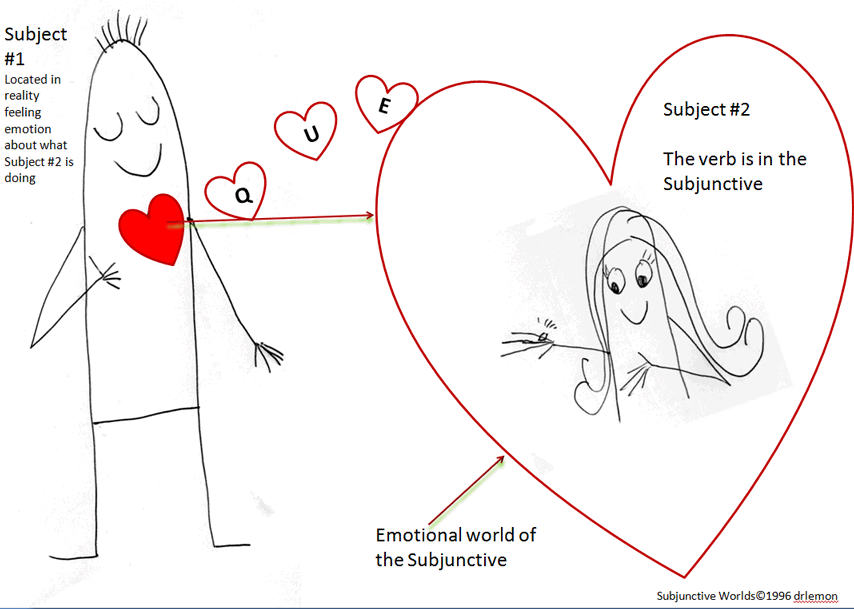
I retained Spanish grammar more completely, which again makes sense for a linguist. Grammar is our bread and butter, the pond we choose to swim in. In fact, when I decided to make a career transition to teaching Spanish, and spent some time in Mexico refreshing my skills, I found that the only significant chunk of grammar I’d forgotten was the use of the subjunctive after expressions of emotion, as in Me alegro de que Pablo ESTÉ aquí (I’m happy Pablo’s here). It’s an odd usage, when you think about it, because there’s no doubt about Pablo’s location; compare, for example, Espero que Pablo ESTÉ aquí (I hope Pablo’s here). Losing and recovering this use of the subjunctive has made me more sensitive, as a teacher, to the challenge it poses for students.

How cute is this cartoon about the subjunctive, from drlemon.com?

If losing a bit of Spanish is frustrating, there’s pure joy in having one come back to you. As a college student I put Spanish on the back burner for a few semesters to work on my French, then spent a summer in Madrid. I’ll never forget the day our group was walking down a street and stopped to admire a beautiful tile. Like a long-lost friend, the word azulejo floated into my active memory after a few scary moments of mental groping. It felt like a divine signal from the Spanish gods, if you will, that they’d forgiven my temporary apostasy.

Unos azulejos de Madrid

Since then, azulejo has been one of my favorite Spanish words (along with esdrújulo, I guess). Many people assume it comes from the word azul, since so many tiles are blue, but the Real Academia assures us that it comes from Arabic azzuláyga. It’s a gorgeous word no matter where it comes from.

Spanish vs. Catalan vocabulary

It’s dangerously tempting to think of Catalan as a “melting pot” of Spanish, French, and Italian. Tempting, because Catalan has aspects of all three languages, and is spoken in their geographical midpoint (see map below). Dangerous, because the “melting pot” metaphor implies that the other three languages came together to form Catalan. In fact, all four are the product of slightly different versions of Vulgar Latin.

As long as we don’t fall for the “melting pot” fallacy, it’s fun to pick out the similarities between Catalan and its sister Romance languages. For example, Catalan has a letter ç, like French (e.g. Cat. abraçada “hug”), a /ts/ sound, like Italian (e.g. Cat. potser “maybe”), and two verbs for “to be”, like Spanish (Cat. esser and estar).

The most interesting differences between Catalan and Spanish have to do with vocabulary. Many Catalan and Spanish words come from two different Latin sources, such as Catalan voler “to want” (from Lat. volo, the source of French vouloir and Italian volere) versus Spanish querer (from Lat. quaerĕre), or Catalan nebot “nephew” (from Lat. nepote, the source of French neveu and Italian nipote) versus Spanish sobrino (from Lat. sobrīnus). As Ralph Penny explains in his awesome A History of the Spanish Language, the Spanish words usually reflect the older, more classical, variety of Latin that was spoken when Rome first conquered the Iberian Peninsula (between 200 and 17 BCE, relatively early in Roman history), while the Catalan words are more innovative. Because Catalonia is closer to Rome than the rest of the Peninsula, it kept up better with ongoing changes in Latin vocabulary.

Other vocabulary differences reflect the geographical realities of the post-Roman world. When Rome fell, the Visigoths invaded the Iberian peninsula from the north. Later (711 C.E.), the Moors invaded from the south. Germanic vocabulary therefore affected Catalan more than it did Spanish (e.g. guarir vs. sanar for “heal”, lleig vs. feo for “ugly”) while the Arabic impact was greater for Spanish than for Catalan (e.g. coixí vs. almohada for “pillow”, llogar vs. alquilar for “rent”). The two influences met in the middle for the word “blue”: Catalan’s Germanic blau and Spanish’s Arabic azul both displaced Latin caeruleus, the source of the the sophisticated English color term cerulean.

Follow the link below to download a table with a more substantial listing of vocabulary differences, including etymologies and French and/or Italian cognates.

Spanish vs. Catalan Vocabulary