Category Archives: Latin American Spanish

Fun with “voseo” in Argentina: Part 2

The street map below, which I saw on a downtown Buenos Aires signpost, captures the linguistic “Alice in Wonderland” vibe I experienced on my recent trip to Argentina. The VOS ‘you’ in the yellow box south of the Plaza de Mayo on the map was intended as a “You are here” location marker. However, as I explained in my previous post, voseo — the use of vos instead of standard Spanish — is a hallmark of Argentinian Spanish, as well as certain other Latin American dialects. So to me, this map told me that “I was here” linguistically — in the heartland of voseo — as well as geographically.
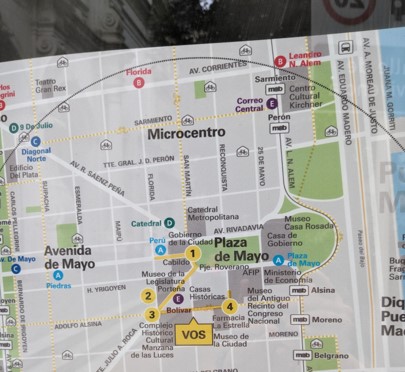
I was accustomed to seeing vos and its associated verb forms in Latin American novels, but spotting and hearing them ‘in the wild’ was a real thrill throughout my trip. As soon as I arrived at Buenos Aires’s Ezeiza airport I saw posters like the ones below, whose vos command forms tell the traveler to ‘connect yourself’ with WiFi, and ‘tempt yourself’ with the airport’s delicious food.

Later in my trip I was tickled pink to glimpse this large “VOS” featured on a branch office of the insurance company “La Segunda.” (I snapped this cell phone picture through a taxi window, hence the funny angle.) Its slogan Lo primero sos vos ‘You are first’ tells customers that they are the company’s top priority.

Although I’ve known about voseo forever, I had never had a good reason to actually learn the relevant forms. So before my trip I gave myself a crash course. I was surprised to see that in most cases, the only distinction between standard Spanish forms and their corresponding vos forms is stress. Specifically:

  • In standard Spanish, present tense forms like amas ‘you love’ and comes ‘you eat,’ as well as informal () command forms like ¡Ama! ‘Love!’ and ¡Come! ‘Eat,’ all stress the next-to-last syllable. Because this is the standard stress pattern for Spanish words that end in a vowel or s (think cuchara and cucharas), they are written without an accent mark.
  • Vos forms display the opposite pattern. As illustrated by present-tense amás and comés, and commands ¡Amá! and ¡Comé!, these words are stressed on the last syllable, and therefore require a written accent mark.

As soon as I saw the Conectate and Tentate posters illustrated above, I realized that the final stress on vos commands further complicates an already challenging topic in Spanish: the use of accent marks in command forms with pronouns.

  • In standard Spanish, the next-to-last stress of commands like ¡Ama! and ¡Come! is heard in formal and plural affirmative commands as well (¡Ame! ¡Amen! ¡Coma! ¡Coman!). In written Spanish, when you add a pronoun to any of these commands, you must also add an accent mark to maintain stress on what is now the third-to-last syllable. Some examples are informal ¡Cómelo! ‘Eat it!’, formal ¡Levántese! ‘Get (yourself) up!’, and plural ¡Escríbanles! ‘Write (to) them!’
  • In contrast, because vos commands are stressed on the last syllable (e.g. ¡Conectá!), adding a pronoun means that you can drop the accent mark, since the stressed syllable is now in the usual next-to-last position (¡Conectate!).
  • This means that Argentinians need to add an accent mark when adding pronouns to formal and plural commands like ¡Levántese! and ¡Escríbanles!, but remove an accent mark when adding a pronoun to informal (vos) commands like ¡Conectate!.

This situation is guaranteed to confuse anyone but a linguist! Not surprisingly, many Argentinians (incorrectly) omit the accent mark in formal commands with pronouns because they are used to doing this in informal commands. (I don’t know what the situation is with plural commands, which are less common.)

Below are two examples of such errors from our trip to Igauzú. The seatback airline safety instructions on the left omitted the accent mark on abróchese ‘buckle.’ (As you can see, I added it with a pen mid-flight, in the spirit of Deck and Herson’s self-righteous but inspirational The Great Typo Hunt.) Likewise, the informational panel on the right, from the Iguazú waterfall park, omitted the accent mark on acérquese ‘approach.’ Note that the safety instructions and the informational panel correctly accented cinturón, más, and información, implying that the missing accent marks on the commands were a sign of weakness in grammar rather than an overall spelling deficit. The missing accent mark on the subjunctive verb form esté (which I also wrote in myself) supports this conclusion.

Finally, I can’t help but ask: since verb forms, which are mostly used in the Northern hemisphere, have the opposite stress pattern from and vos forms, which are mostly used in the South, could this possibly have something to do with the Coriolis effect?

Just joking!

Fun with “voseo” in Argentina: Part 1

Dear reader: Once I sat down to write this post I realized that I had plenty to say about voseo as a linguistic phenomenon. So I’ve restricted myself to that topic here. In my next post I’ll actually tell you about my enjoyment of voseo while in Argentina.

My favorite aspect of Argentinian Spanish is voseo, the use of the pronoun vos instead of to mean ‘you’ in familiar settings. As a linguist, I appreciate voseo for three reasons.

First, voseo has an amazing history. Argentina, along with certain other regions in Central and South America, retained the archaic vos pronoun while the rest of Latin America followed Spain’s lead in settling on . The outcome of versus vos in each region depended on the degree of contact between it and Spain during the colonial period. Argentina could not be reached directly, via the Atlantic, because rampant piracy in the Atlantic forced Spain to restrict ocean travel. Spaniards could only reach Argentina by sailing to the Caribbean, crossing the Isthmus of Panama via mule train, sailing to a Pacific port such as Lima, and crossing the Andes. Argentina, like other effectively remote parts of the New World, was thus insulated from linguistic changes back in Spain.

I remember how excited I was to read about this connection between Latin American linguistic history and piracy (!!!) in Ralph Penny’s essential A History of the Spanish Language. It was the subject of my first blog post more than ten years ago, and was one of two linguistic insights that inspired me to write my first book. (The other was my spotting of Jespersen’s Cycle at work in the creation of Spanish negatives, both old and new.)

Second, voseo helps to illustrate that linguistic complexity begets variation. When English speakers begin to study Spanish, they are often taken aback to learn that our single pronoun you corresponds to at least three in Spanish: singular (informal) and usted (formal), and plural ustedes. Spain further divides plural ‘you’ into informal vosotros and formal ustedes. As is often the case, the complexity of this aspect of the language is paralleled by extensive dialectal variation: not just vosotros in Spain and vos in parts of Latin America, but also differences in how speakers around the world use and usted. For example, Spaniards favor over usted in all but the most formal of situations, and in parts of Columbia usted connotes intimacy.

(By the way, two other examples of complexity begetting variation in Spanish are (i) its inventory of seven third person direct and indirect object pronouns (lo, la, los, las, le, les, and se), which has spawned the variant usage patterns of leísmo, loísmo, and laísmo, and (ii) its relative abundance of consonants (17-19, depending on dialect), as opposed to vowels (5), with the result that most phonetic variation in Spanish dialects involves consonants.)

Third — I’m perhaps going out on a limb here — voseo is something that most Spanish speakers are aware of. As a result, you can start an interesting conversation about language differences by asking a Spanish speaker ¿En su país se usa o vos? Likewise, you can ask about usage of versus usted in their country. I can’t think of any aspect of English grammar that could inspire a parallel discussion. We’re stuck with matter-of-fact questions about vocabulary, such as “Do you say soda, pop, or coke?”

A linguistic “busman’s holiday” in Argentina

In case you aren’t familiar with the expression, a “busman’s holiday” is a vacation that closely mirrors a tourist’s everyday life. A “busman” (normally one would say “bus driver”) spends a lot of time on the road, so a vacation that involves a fair amount of travel would be more of the same.

Because I’m obsessed with Spanish, my recent trip to Argentina was very much a busman’s holiday. For one thing, during the trip I spoke very little English: only in phone calls home, and with Spanish speakers who wanted to practice their English. My travel buddy Susan and I spoke only Spanish with each other, and I had as many conversations as I could with Argentinians and other Spanish speakers. As a result, my Spanish improved perceptibly during the trip. Immersion works!

My most memorable such conversation took place at the Puerto Iguazú airport, on our way back from seeing the waterfalls. While waiting for our flight I met a Paraguayan civil engineer who was working on a new highway that would bring drivers to the new bridge to Brazil just north of Hito Tres Fronteras (pictured in my previous post). She said something along the lines that “once the bridge and highway are completed, there will be no more traffic.” For a New Yorker raised with the ghost of Robert Moses, the famed builder who never met a stretch of concrete he didn’t like, this was an extreme provocation. One theme of Robert Caro’s classic memoir The Power Builder is that the more roads and bridges Moses built, with the purported aim of decreasing traffic, the worse traffic got. My new friend had never heard of Robert Moses, so this was an exciting conversation for both of us. The Power Broker is now on her English reading list.

Besides the sheer joy of speaking Spanish, the other “busman’s holiday” aspect of my trip was relishing the dialectal features of Argentinian Spanish. As a warmup I devoted some of my free time before the trip to Argentinian fiction. I reread Guillermo Martínez’s La muerte lenta de Luciana B. (2008), which I had found an easy-to-read page-turner years ago. While it was still exciting the second time around, Martínez’s treatment of the title character now struck me as somewhat outdated and sexist. I also read Mariana Enriquez’s truly weird but wonderful novel Nuestra parte de noche (2021), about a sort-of-Satanic cult operating in exactly those parts of Argentina that we were about to visit, namely Buenos Aires and Corrientes province, including Iguazú. During our trip I reread Eduardo Sacheri’s La pregunta de sus ojos (2003), the novel that inspired the 2009 Argentinian movie El secreto de sus ojos and its 2015 English-language adaptation Secret in their eyes. I’ve seen both movies, and the novel is better.

These books reminded me of Argentinian vocabulary like remera for T-shirt and biro (or birome) for a pen. La pregunta de sus ojos in particular featured a near-constant stream of descriptors like boludo ‘imbecile’ and pibe ‘kid.’ Once I arrived in Argentina, local vocabulary was all around me. For example, while texting with our airbnb hostess during my short wait for Susan at the airport I learned to use departamento instead of apartamento and tránsito instead of tráfico.

By the way, these words exemplify a variety of well-known mechanisms of semantic change. Remera is an example of ‘broadening,’ since it originally referred to a shirt worn by a rower (remar means ‘to row’). Biro(me) is an ‘eponym’ that memorializes Ladislao José Biro, the Hungarian-Argentine inventor of the ballpoint pen. Boludo, like English ‘blockhead’, is a metaphorical extension from a shape (bola ’round’) to a personality trait, while pibe was borrowed from Catalan pevet, Portuguese pivete, or Italian pivetto.

As a further “by the way,” Corominas traces the history of pibe from peu (the Catalan word for ‘foot’) to a footed incense holder, to odorous incense, to something with a strong smell, to an infant, to a child. This is as wacky as the evolution of muñeca from ‘milestone’ to either ‘wrist’ or ‘doll,’ yet every step is plausible.

As for as the Argentinian accent, its most salient aspect is probably the lilting intonation that the language has absorbed from Italian (listen at 4:25 here). When I overhear this intonation in the speech of tourists in New York I’m often emboldened me to ask, with a fair rate of success, ¿Son ustedes de Argentina? I didn’t try to adopt this intonation on my trip, but did have fun replacing the usual Spanish glide in words like yo and calle with a harder /dʒ/ or just /ʒ/ consonant, as in ‘Joe’ or ‘pleasure,’ respectively. This is the feature that gave the Argentinian revolutionary Ernesto Guevara the nickname ‘Che.’

My next post will discuss the outstanding feature of Argentinian grammar: voseo.

¡Argentina!

In March I finally went to Argentina. “Finally” because I’ve wanted to go there for ages, partly for the usual touristic reasons — the country’s culture, natural beauty, and cuisine — but also, as you might guess, to enjoy Argentina’s special variety of Spanish. I’ll write about that in my next post.

I went with my friend Susan R., whom I met through this blog. She is a retired Spanish teacher and an experienced traveler. We hadn’t spent much time together before this trip, but turned out to be highly compatible travel buddies.

Here’s a slideshow about the trip.
I uploaded it as a PDF to sidestep some technical difficulties.

Argentina is a huge country! Since this was our first visit, Susan and I decided to limit our trip to Buenos Aires and the famous waterfalls of Iguazú, located at the meeting point of Paraguay, Brazil, and Argentina. In Buenos Aires we did the normal touristic things, like visiting the tomb of Eva Perón. We took a fantastic tango lesson that ended up with a few hours at a milonga, or dance hall, where porteños (residents of Buenos Aires) go to actually dance, not to just watch a show. We ate a lot of meat (“When in Rome…”), drank a lot of wine, and also enjoyed a lot of top-quality gelato, a testimony to Argentina’s animal husbandry and Italian heritage.

Besides our two-night trip to Iguazú, which was of course spectacular, we made two day trips from Buenos Aires, one to the Tigre Delta, where we enjoyed a boat ride and had lunch on an island, and one to the Uruguayan city of Colonia del Sacramento, on the other side of the Río de la Plata. I would recommend the former though not the latter. Colonia is a pleasant city but not special enough to justify the time it took to cross the river and go through customs in both directions.

Argentina has a perennially troubled economy. While we were there inflation was down somewhat, but there was no question that people were still suffering; we read that over half of Argentinians live below the poverty line. As tourists we were insulated from their hardship, and in fact reaped the silver lining of paying bargain prices for restaurants and lodging. At least we were helping out the economy with an infusion of our American dollars.

Speaking of which, a consequence of Argentinian’s economic chaos is that tourists have to think ahead about how to pay for goods and services. When traveling in Europe I normally pay by credit card almost everywhere, and withdraw cash from a local ATM if necessary. Everything we read and were told about traveling in Argentina told us to bring cash with us, because many businesses don’t take credit cards and ATMS give a terrible exchange rate.

In fact we were able to use our credit cards more than we expected. When in need of Argentinian pesos, to get the more favorable dólar azul rate we exchanged our crisp $100 U.S. bills at cuevas (informal money-changing shops) or Western Unions, or with private individuals we trusted. Our airbnb hostess in Buenos Aires vouched for a gentleman named Pedro, who could always be found outside the café across the street. I have to admit that this was something of a thrill.

The other complication of our trip was mosquitos. There had been a lot of rain before we arrived and mosquitos had multiplied alarmingly. We were forewarned to bring our own insect repellent, since little was left to buy in porteño shops. We gave our leftover repellent to friends of Susan’s as a going-away present.

The main surprise of the trip, at least for me, was how much Argentinians love mate. I knew that this herbal tea is popular in Argentina, but had no idea how omnipresent it is. It was common to see people carrying their mate y bombilla sets outside the home, not just while sharing a drink in a park, but when just walking around the city. Many people also carry a thermos of hot water to refresh their mate after drinking all the liquid. We also saw hot water dispensers for mate, like this one, in public places. There’s even an app you can use to find them.

Apparently the mate leaves release more caffeine every time you add water, so the drink becomes more and more addictive.

Language teachers talk about “Culture with a capital C,” like painting and literature, versus “culture with a little c,” meaning the everyday objects and customs that make life different depending on where you live. Mate is a great example of the latter.

La esclava blanca

For years I’ve intended to watch a telenovela, or Spanish-language soap opera. Like many people who learned Spanish as a second language, I find that listening is my weakest skill. I figured that sitting through hours of Spanish dialogue would help me.

A few months ago I finally took the plunge and watched La esclava blanca (‘The White Slave’) on Netflix. It was so much fun that I ended up binge-watching all sixty-two episodes.* This was bad for my physical health except for those episodes I watched while exercising. It also wasn’t as good for my listening skills as I had hoped, since I watched it with Spanish subtitles. Now that I know the plot perhaps I should rewatch it without subtitles…but I’d rather move on to a different series.

There was much to admire in La esclava blanca. The cast was terrific, especially the villain, who was played by a handsome Spanish actor with the improbable but delightful name Miguel de Miguel. His character was vile yet undeniably charming. The star-crossed lovers at the center of the plot were brave and bold. Over the course of the series the side characters became more compelling and interesting as they grew and changed, often in surprising ways. Finally, the story’s setting, in Colombia toward the end of that country’s slavery era, was engrossing. The show made it abundantly clear that slavery was a poison in Colombian society, harming not only the enslaved Blacks (obviously) but also their legal owners. As the show progressed, and the slave owners became more and more desperate to protect their way of life, they descended deeper and deeper into pure evil. The ultimate fate of Miguel de Miguel’s character illustrates this path most graphically. You’ll have to watch the show to find out more. Really, his last scene is a doozy.

The one thing that bothered me about the series is that the white heroine and the mixed-race hero, rather than the enslaved people of pure African descent, drove the movement toward liberation. This is an example of what is known as the “white savior” trope in which a white person leads or rescues a minority. Other examples are the movie Glory, which stars Matthew Broderick as the white commander of a Black regiment on the Union side in the Civil War, and Avatar, in which only a brave white human (an ex-Marine played by Sam Worthington) can rescue the blue Na’vi humanoids and their homeland on a verdant moon.

My complaint is not original. A Google search for “esclava blanca white savior” will find many other critiques along these lines.

So while I truly enjoyed this telenovela, the “white savior” issue stops me from recommending it with full enthusiasm.

Of course, I found much of linguistic interest in the series. I don’t know to what extent the features noted below are specific to Colombian Spanish.

  • First and foremost, I am convinced that I heard some instances of words whose initial h was aspirated rather than silent. Two I wrote down, both in episode 33, were Qué va, hombre (shortly after 17:00) and Hola, Jesús (after 36:30). I’ve searched but haven’t found this described anywhere as a feature of Colombian Spanish.
  • As with the n-word in English, the white and Black characters in La esclava blanca use negro/negra differently. For the whites it is an insulting noun, often followed by the adjective asqueroso ‘disgusting.’ For the Blacks it is affect-free, like man or bro in English.
  • Speaking of man, the Black characters also use hombre when talking with pals. (I don’t remember whether the white characters do this too.) At 29:20 in episode 57, Julián even calls his girlfriend hombre, which amused me.
  • The actors frequently drop the word a in sentences like Miguel va a comer ‘Miguel is going to eat,’ saying instead Miguel va comer. This makes perfect sense: the adjacent a vowels in va and a have simply blended. A is retained with other verb forms, as in Miguel y Elena van a comer.
  • At 13:20 in episode 59 a character says Usted verá que no es lejos. I noticed other uses of ser instead of estar to describe location.
  • At 43:45 in episode 61 I learned a new verb, engatusar, meaning ‘to con, deceive.’ According to Juan Corominas it has an unusual etymology that blends three roots: encantusar ‘to deceive with witchcraft,’ engatar (from gato) ‘to deceive with affection,’ and engaratusar ‘to deceive with praise.’
  • Finally, while I have yet to realize my ambition of visiting a voseísta country like Colombia (i.e. one whose speakers use the pronoun vos instead of (or along with) ), I really enjoy hearing voseo! In La esclava blanca I especially relished commands followed by pronouns, since these are identical to their equivalents except for the stressed syllable. Some examples are perdoname (instead of perdóname) and tranquilizate (instead of tranquilízate), whose te threw me for a loop until I checked the conjugation.

As always, I welcome comments. I would especially appreciate hearing from anyone who is familiar with Colombian Spanish.

——————————————-

*When I started watching the show I had no idea that it was so long. At first I figured that it would be fairly short because an important wedding was scheduled to take place in a few days. When the wedding kept being postponed I checked and saw that I still had dozens of episodes to go. By then it was too late to stop watching: I was thoroughly hooked.

One fish two fish pez pescado

Never having caught a fish in my life, I certainly didn’t imagine that I would ever write a blog post about our aquatic pals, let alone two. Nevertheless this is my second post on the topic. I guess everything is more interesting in Spanish.

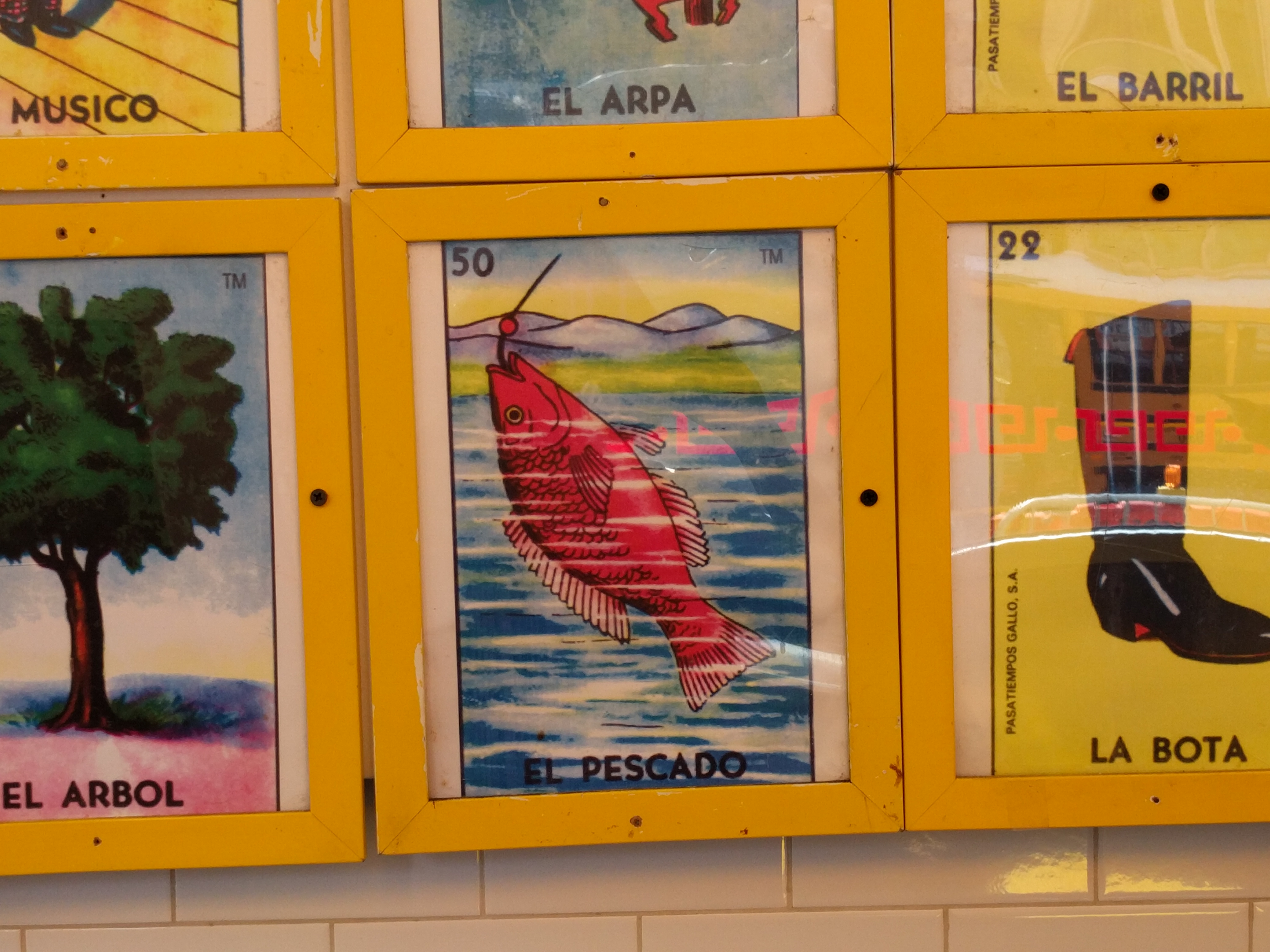
As I explained in my first fish post back in 2016, Spanish has two words for fish: pez for a live fish and pescado for one that you see in a pescadería (fish store), supermarket, or restaurant. The verb pescar means ‘to fish’ and pescado is its past participle. So a pescado is simply a pez that has been fished, or caught.

Pez and pescado were at the root of an amusing incident that took place while I was visiting my grandkids in May. This was during the first wave of COVID-19 in the Northeast and my grandsons’ classes had gone online. My younger grandson’s Montessori kindergarten had a weekly Spanish lesson via Zoom and we both thought it would be fun for me to sit in. I have to confess that I stayed out of camera range and fed Zachary answers to the teacher’s questions. (Wouldn’t you?) As you can imagine he was the star of the lesson, getting everything right and amazing the teacher…UNTIL the class started to go through a set of animal words and they got to ‘fish.’

The teacher showed a picture of a pet fish in a bowl and asked if anyone knew ¿Qué es esto? Zachary was the only student to raise his hand. The teacher called on him and he said, correctly, Es un pez, to which the teacher replied No, es un pescado. They went back and forth a few times and the teacher held her ground.

Es un pez


During the rest of the lesson I noticed other mistakes in the teacher’s Spanish. She said that a ‘kangaroo’ was a cangarú, which is basically a Spanish rendering of the English word instead of the proper Spanish word canguro. She also made a gender mistake, saying el serpiente instead of la. Given the teacher’s impeccable accent I concluded that she was a heritage speaker, meaning someone who grew up speaking Spanish at home but never had a formal education in the subject. Such speakers can have gaps in their knowledge.

According to Prof. Zyzik’s comment on this blog, heritage speakers are more prone to gender errors when using words such as serpiente, which lack a telltale -a or -o ending. Kids make such errors as well.

When I was back home in New York the next week, my daughter told me that Zachary had tried to answer el pez again during Spanish class and was again shot down. At this point I decided to do some research, looking up pescado on the Real Academia Española’s online Diccionario de americanismos. The first bullet in the entry read:

MxGuHoESNiPaCuPRCoVeEcPeBoPy. Pez, ya esté dentro o fuera del agua, sea comestible o no.

That is, in a number of Latin American countries pescado can mean a fish ‘in or out of the water, and edible or not.” So now I know.

In retrospect this dialectal variation might also explain the restaurant painting that inspired my first pez/pescado post, which showed a so-called pescado that was in the water (though hooked on a line). Chances are it was painted by someone with a similar background to Zachary’s teacher.

Stay tuned for my next fish post, four years from now.

A Rotary talk on Spanish in the United States

I recently gave a talk to my local Rotary Club about Spanish in the United States, as part of my ongoing effort to promote my book. It was fun in multiple ways. First, I didn’t know anything about the Rotary organization beforehand, so I got to learn a bit about what they do. The group included local business people, the chief of police, a judge, and other upstanding citizens. Second, I picked the topic of “Spanish in the United States” because I figured it would be of general interest, and it was — most gratifying. Third, this was the first time I’ve tried speaking to a group that knew nothing about either linguistics or Spanish, and it went fine. This bodes well for hypothetical future speaking gigs.

Here is a rough outline of my talk. Note that it was organized in reverse chronological order.

  1. Predicting the future
    1. General pattern of immigrant languages being lost (Yiddish, Italian, German, etc.)
    2. Researchers concur that Spanish fits the same pattern, despite large numbers of Spanish speakers
      1. previous waves of immigration had huge numbers, too
    3. Specific prediction: Spanish will be gone in a few generations unless new immigrants continue to replenish population of speakers
      1. anecdotal evidence from my students: “I wish my parents had insisted that I speak Spanish with them”.
  2. Describing the present
    1. Features that show loss in progress
      1. U.S.-born Hispanics speaking more basic form of language
        1. keeping fundamental parts, e.g.
          1. gender
          2. preterite/imperfect
        2. loss of
          1. sophisticated structures, e.g. complex If..then structures (‘If I hadn’t spent all my money yesterday I wouldn’t have had to borrow more this morning’)
          2. some verb tenses
          3. some irregular verbs
      2. English influence
        1. borrowing, e.g. registración for inscripciónflu for gripe
          1. excursus on borrowing of Spanish vocab into English (plug for Spanish Word Histories and Mysteries)
        2. grammar (examples from Silva-Corvalán and Lipski)
          1. possessives for body parts (Me pegó en mi brazo)
          2. superfluous subject pronouns (Yo creo)
          3. noun-adjective order (machucado español ‘chopped-up Spanish’)
        3. code switching
    2. Most important characteristic unrelated to language loss = variety
      1. No such thing as “United States Spanish”; plug for Lipski’s Varieties of Spanish in the United States)
      2. Main concentrations are PR/DR in NE, Mexican in SW, Cuban in SE
      3. Interesting research on dialects in contact: linguistic accommodation, leveling
  3. A little history
    1. Modern migration from other countries is second phase of Spanish in the U.S.
      1. First phase = Spanish colonial period
      2. Relics still in New Mexico and Colorado (norteños), Louisiana
        1. another plug for Varieties of Spanish in the United States (ch. 12)
    2. What kind of Spanish? Andalusian
      1. no th sound (cerveza)
      2. final -s deletion (lo libro)
      3. ustedes but not vosotros

Report on ANLE event with Francisco Moreno Fernández

On Wednesday I had the pleasure of attending the induction of Francisco Moreno Fernández, the Executive Director of the Instituto Cervantes at Harvard University, as the newest member of the Academia Norteamericana de la Lengua Española (ANLE).  Moreno Fernández’s specialty is sociolinguistics, and he is currently focusing on Spanish in the United States.

The main point of Moreno Fernández’s inaugural lecture was that United States Spanish has two manifestations. The first is “Spanglish”, the casual form of speech characterized by frequent code-switching, or alternation, between Spanish and English. The second, used in more formal contexts, is an American* version of Spanish (español estadounidense) that has borrowed hundreds of English words, in many cases crowding out their normal Spanish counterparts.

My favorite part of the talk was the data that Moreno Fernández showed on the degree of penetration of specific English borrowings in different parts of the United States. He walked us through three examples: registración, which has mostly replaced inscripciónflu, which is threatening gripe, and dil (a Spanish spelling of deal), which hasn’t obtained much of a foothold.

As in the previous ANLE induction I attended, it was a pleasure to immerse myself in the beautiful Spanish of all the evening’s speakers: not just Moreno Fernández but the scholars who introduced him, formally responded to his talk, and officially inducted him. Coincidentally, two of these presenters were native speakers not of Spanish, but of other Romance languages (Italian and Romanian). As a non-native speaker myself, I was heartened to see them accepted as full colleagues and participating in the Spanish academy system.

[Later edit: Here is ANLE’s press release about the event.]

*Since I’m writing in English I’ve used the word American here to mean ‘of the United States’. This usage is problematic from a Hispanic perspective, since América, of course, includes all of North, South, and Central America, not just the United States. When speaking Spanish I would therefore never say americano to mean ‘American’ in the more limited sense, but always estadounidense. It would be helpful to have a more neutral English word like “United Statesian”. Wikipedia has an interesting discussion on this topic here.

Linguistic gems from recent reading

Ages ago I discovered the joys of reading Spanish novels for fun. It helps to keep up my fluency and build my vocabulary, while adding bits of cultural knowledge. Of course, I always keep my linguistics hat on in case I find anything particularly interesting. This post describes two such findings.

The first is from La carta esférica, a novel about a sailor who joins a mysterious woman on a treasure hunt for a sunken ship carrying a priceless cargo of Jesuit emeralds. It’s by one of my favorite Spanish authors, Arturo Pérez-Reverte, best known for the Capitán Alatriste series. Besides its pleasantly page-turning plot, this novel features the best example I’ve ever seen of the stylistic exploitation of the two different versions of the Spanish imperfect subjunctive. Here, the narrator alternates between -ra and -se subjunctives as he waits for the mysterious lady of the emeralds to stop him from walking out. This alternation adds an extra back-and-forth rhythm to the parallel structure of the successive que clauses.

Todo el rato, hasta que cerró [la puerta] detrás de sí, estuvo esperando que fuese hasta él y lo agarrara por el brazo, que lo obligase a mirarla a los ojos, que contara cualquier cosa para retenerlo.

“The whole time, until the door closed behind him, he hoped that she would go to him, take him by the arm, make him look her in the eye, and say anything to keep him there.

Right now I’m reading Magali García Ramis’s memoir of growing up in Puerto Rico, Felices Días Tío Sergio. I first learned about García Ramis when she was inducted into the Academia Puertorriqueña de la Lengua Española (basically, the Puerto Rican branch of the Real Academia Española). In a previous post I described her inaugural lecture, on the Puerto Rican /r/. I bought a copy of Felices Días back then but only recently got around to reading it. It is absolutely delightful, written in simple Spanish that would make it a good first novel for a student to read.

The passage that caught my linguistic eye has to do with another cardinal aspect of Puerto Rican pronunciation, the aspiration of final -s. Here the protagonist, a young girl, is asking her mother to make cat-shaped cookies for the funeral in absentia of their lost cat, Daruel. It’s an interesting passage from a sociolinguistic perspective because it shows the two speakers’ awareness that this is a stigmatized feature. In the first line, Ramis uses the letter j to show the aspirated /h/ pronunciation of the /s/ of los.

— ¿Ah Mami? ¿Ah, nos laj haces? [Mom, will you make them for us?]
– Nos lassss hacesss – corrigió Mami [Will you make them for us? – Mom corrected]
– Bueno, nosss lass hacesss ¿Sí? [OK, will you make them for us?]

I love the exaggeration of the multiple ssss and the way the daughter extends them to nos, which she seems to have pronounced correctly from the start.

Latin versus Spanish verb tenses

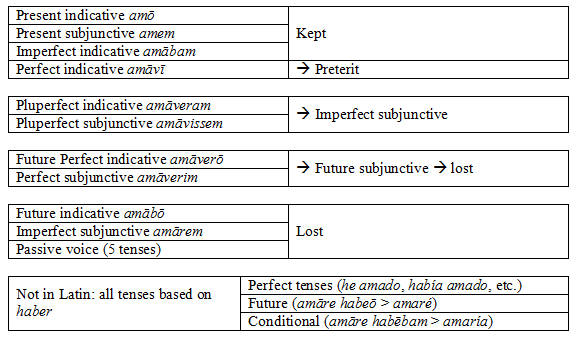
Believe it or not, after my last post about the subjunctive I had resolved to take a long break from writing about verbs. But as part of my research I just performed the following summary analysis, which I found so useful that I couldn’t resist sharing it.

The series of tables below summarizes the fate of the many Latin tenses in Spanish. What’s most interesting is that although Latin had a rich verb system, and Spanish does too, there’s very little direct overlap. The present indicative and subjunctive, and the two simple past tenses (imperfect and perfect), are the only four tenses to survive more or less “as is” in Spanish, though the perfect became a more general past tense (the pretérito). Two Latin pluperfect tenses were adapted as the two versions of the Spanish imperfect subjunctive, and two others as the now-defunct future subjunctive (thereby hangs a future blog post). Seven other tenses were lost.

Latin tensesWhile losing 9 Latin tenses in total, Spanish added ALL the perfect tenses (haber + past participle), and also the future and conditional, which are likewise based on haber.

Now I promise to stay away from verbs for a while.