Category Archives: Latin American Spanish

The geography of voseo

When I was relatively new to Spanish, one of my teachers explained to our class that voseo was a special feature of Argentinian Spanish. Voseo is the use of vos, with its associated verb forms, instead of standard Spanish tú, as an informal pronoun meaning “you”. So “you speak” is vos hablás instead of tú hablas, “you are” is vos sos instead of tú eres, and so on.

Years later I learned that voseo isn’t limited to Argentina, nor to its neighboring countries in South America. It’s found in several countries in South America, and also in parts of Central America, including El Salvador. (I seem to be running into a lot of vos-using salvadoreños lately, both at home and out of town.) Below is a map showing where vos is used in Latin America.

Reproduced by Creative Commons license. Medium (or dark) blue indicates spoken (and written) voseo.  Light blue indicates tu/vos alternation. Grey indicates tú only.

By the way, this is my second-favorite voseo map. My favorite is on p. 156 of Christopher Pountain’s Exploring the Spanish Language; do a “Search inside this book” with the phrase “distribution of voseo” to find it. It’s under copyright so I can’t reproduce it here.

As you can see in either map, the distribution of voseo doesn’t tidily follow country borders, or even continental borders. The controlling factor is, rather, historical. As I explained in my very first post on this blog, travel between Spain and Latin American was restricted during the colonial period because of rampant piracy on the Atlantic Ocean. Therefore, settlements close to the two colonial capitals of Mexico City and Lima, or to the major ports of call en route such as Veracruz and Portobelo, had much more exposure to the latest linguistic developments from Spain than those in the “boondocks”.

For your convenience, here is the map of colonial trade routes I included in that first post.

Colonial trade patterns

Adapted from Sagredo 2007 under the GNU Free Documentation License

Voseo is a perfect illustration of this phenomenon. At the beginning of the Colonial period,  and vos were both current in Spain. Eventually, of course,  won, but only those parts of Latin American that were in regular contact with Spain followed its lead. That’s why, if you compare the two maps, the all- areas (grey on the voseo map) roughly correspond to the colonial trade routes (red on the second map). Argentina was about as boondock-y as you could get since it could only be reached by crossing the Andes, by foot and/or by mule, from Lima. That’s why its voseo is the strongest in the continent.

¿Vos entendés?

Platicando sobre pronombres en el parque

[Today is Spanish Friday so this post is in Spanish. ¡Scroll down for English translation!]

Al comienzo del mes tuve el gran placer de visitar a mi hija en California. Durante la visita jugué con mi nietecito Óscar, preparé y congelé comida como una cocinera maníaca, y, claro, hablé español. No con mi hija, quien por lástima escogió estudiar francés hace años, sino con varias abuelas, madres y niñeras que conocí en el parque adonde llevaba a Óscar todos los días. (También hablé un poco de alemán pero muy mal.)

Muchas de mis nuevas conocidas eran salvadoreñas y tuve varias conversaciones interesantes con ellas sobre el voseo en El Salvador. Una niñera me explicó con muchos detalles con quiénes se usan vos, y usted, las situaciones y las implicaciones sociológicas.

Después pensé en lo improbable que sería tener una tal conversación sobre el inglés. No solo de mi parte (la verdad es que no me interesa mucho mi propio idioma), sino porque creo que a los hispanohablantes les importa más su idioma que a los angloparlantes. El vocabulario inglés (“coke” versus “soda” versus “pop”) sí discutiríamos, pero ¿la gramática? ¿LOS PRONOMBRES? ¡Ni posibilidad!

Pero en español, sí. El idioma es una parte fundamental de la identidad hispana y apasiona a la gente normal, no solo a los lingüistas. Esto les da un elemento de emoción a mis investigaciones sobre el español y a mi enseñanza que les faltaría en inglés.

————————————————————————————————————————–

At the beginning of the month I had the great pleasure of visiting my daughter in California. During the visit I played with my little grandson Oscar, I prepared and froze food like a mad chef, and, of course, I spoke Spanish. Not with my daughter, who unfortunately chose to study French years ago, but with various grandmothers, mothers, and babysitters whom I met in the park where I took Oscar every day. (I also spoke a little German, but very badly.)

Many of my new acquaintances were from El Salvador and I had various interesting conversations with them about voseo (the informal word for “you”) in their country. One babysitter explained to me with great detail when it is appropriate to use vos, and usted, and their various sociological implications.

Afterwards, I thought of how unlikely it would be to have a similar conversation about English. Not just because of my own inclinations (I’m not that into my own language), but because I believe that Spanish speakers care more about their language than English speakers do. One might talk about English vocabulary (e.g. “coke” vs. “Soda” vs. “pop”), but — grammar? PRONOUNS? No way!

But in Spanish, yes. Language is a fundamental part of Hispanic identity that sparks passion in normal people, not just linguists. This imparts an element of emotion to my research and my teaching that would be lacking in English.

Speaking Spanish in New Mexico — NOT!

As I described in an earlier post, when we lived in New Mexico I used to enjoy chatting in Spanish with our neighbors from Argentina. Remarkably, despite my passion for the Spanish language, this was practically the only opportunity I had to speak Spanish during our ten years living in this substantially Spanish-speaking area. Why?

It wasn’t for lack of trying. Especially in the first few years, I would occasionally try to engage Spanish speakers in conversation. The inevitable response: English.

It wasn’t for lack of skill. My Spanish was a bit rusty at the time, but still proficient.

The problem was, rather, culture. New Mexico bills itself as a land of three cultures: Hispanic, Native American, and “Anglo”. The local Hispanics call themselves norteños, meaning “people of the North” (as opposed to the South, i.e. Mexico), and are proud that many can trace their ancestry directly to Spain. A substantial minority have Basque roots, which makes sense if you keep in mind the importance of sheep farming in both areas.

The Native American population of New Mexico belongs either to the various Pueblo tribes or to the Navajo Nation. And “Anglo”? Well, that basically means “none of the above”, whether you’re a white Jewish girl from New York, a graduate student from France, or an African American.
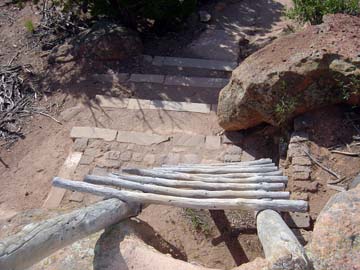
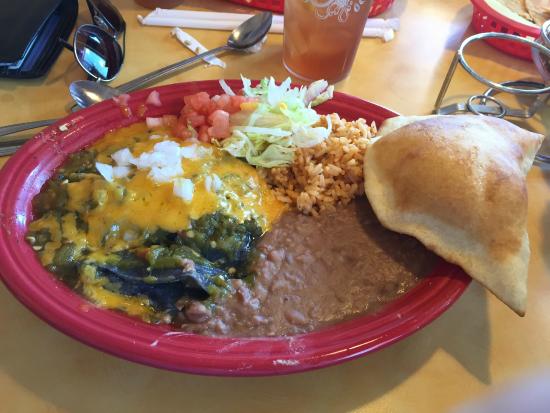
For the most part, this three-culture mix was a positive aspect of our life in New Mexico. We enjoyed visiting pueblos and exploring ancient Anasazi ruins (especially Tsankawi), eating northern New Mexican food, especially breakfast burritos and blue corn chicken enchiladas with green chile, and just living in a part of the country that, like San Antonio or New Orleans, didn’t feel like the garden-variety American melting pot.

Tsankawi (the non-touristy part of Bandelier Natl. Monument)

Blue corn enchiladas with green chile and a sopaipilla on the side. I order mine without the cheese.

But culture was also a barrier. Nobody would speak Spanish with me simply because I was an Anglo (or angla, I guess). Every time I tried, I was crossing a forbidden line.

The only time I managed to speak Spanish with actual norteños was when a colleague who had married into a local Hispanic family invited us to his annual Christmas party. His entire extended family of in-laws was there, and we feasted on dishes like posole (fortunately, this was before I was trying to live as a strict vegan):

Thanks to my colleague’s imprimatur I was allowed to storm the cultural barriers for that one night, and happily chatted in Spanish with several of his in-laws. Qué gusto — y ¡qué feliz Navidad!


Multilingualism in Latin America

We all know that the conquest of Latin America was a disaster for its indigenous peoples and languages. Between war, slavery, and disease, the native population was reduced, absorbed, or eliminated in much of Latin America. At the same time, the native languages gave way to Spanish.

Argentina is an extreme example of this tragic pattern. According to the CIA World Factbook, only 3% of Argentina’s population is indigenous or mestizo (mixed). Mapudungun and Quechua are still spoken, but less than Spanish, Italian, English, German, and even French.

Bolivia, Ecuador, Guatemala, Paraguay, and Peru are at the other end of the demographic and linguistic spectrum. Their populations are largely indigenous or mestizo, and their indigenous languages are still widely spoken, and in many cases recognized as co-official with Spanish. I’ve put together a summary table (below) using data from the CIA Factbook and, where indicated, the U.S. Department of State.

Latin American countries with widely spoken indigenous languages
(Source: CIA Factbook unless otherwise indicated)

Country

Ethnicity

*indicates data from U.S. Dept. of State

Indigenous languages

Linguistic status

Official status

Bolivia 85% indigenous or mestizo Only 60.7% of the population speaks Spanish. Quechua and Aymara are co-official with Spanish.
Ecuador 90% indigenous or mestizo* Quichua and Shuar are widely spoken. Spanish is the only official language.
Guatemala Majority indigenous or mestizo* Only 60% of the population speaks Spanish. 23 indigenous languages are co-official with Spanish.
Paraguay 95% mestizo Most of the population is bilingual in Spanish and Guaraní. Guaraní is co-official with Spanish.
Perú 82% indigenous or mestizo 15% of the population speaks Quechua, Aymara, or another indigenous language. Quechua is co-official with Spanish.

Latin American country names as historical shorthand

When we lived in New Mexico, back in the 1990’s, our kids used to get a kick out of the names of some of the local towns. There was Truth or Consequences, the town that voted to change its name from Hot Springs in 1950 to win the privilege of hosting the radio show’s 10th anniversary special (the TV show came later). Elephant Butte was named for a volcanic rock formation that looks like you-know-what (the whole beast, not just its tuchis). Santa Fe’s Amtrak station was located out of town in Lamy, named for an early local archbishop, and pronounced “lay me”. You can imagine how that went over with our pre-teen boys.

Little did they realize that toponyms, or place names, can be a serious object of study. Like fossils, toponyms are revealing artifacts, vestigial clues to history. This is certainly true in Latin America, where the various country names are practically a mnemonic shorthand for the key aspects of the colonial period: Continue reading

Puerto Rican r

[This is the English version of an earlier post in Spanish (in celebration of “Spanish Friday”).]

I’ve previously written about several aspects of the Spanish r sound: its pronunciation and linguistic identifyits origin, and the difficulties that some adults (and many kids) have pronouncing it. Today we’ll consider a dialectal variation, the r of Puerto Rico.


In parts of Puerto Rico, it’s common to hear a French-style, back-of-the tongue, unusually long r in place of the normal Spanish trill. Puerto Ricans see this pronunciation as a distinctive marker of island identity, and therefore a source of either shame or pride — or both. Author Magali García Ramis described this love/hate relationship in her essay “My Father’s R”. This was her inaugural lecture when she was inducted into the Academia Puertorriqueña de la Lengua Española in 2009, and is also the title essay of her 2011 book:


Continue reading

La erre de Puerto Rico (Puerto Rican r)

En celebración de “Spanish Friday” este aporte es en español. [In celebration of “Spanish Friday”, this post is in Spanish (English translation will be posted separately)].

Les presento hoy un aporte más sobre la erre española. Ya colgué un aporte sobre su pronunciación e identidad, uno sobre su origen latino, y uno sobre las dificultades que tienen unas personas pronunciándola. Hoy consideramos una variación dialectal, la erre de Puerto Rico.

Continue reading

Piracy and Latin American Spanish

Colonial trade patterns

Adapted from Sagredo 2007 under the GNU Free Documentation License

My blogging guru, Tris Hussey, warns that a blog’s first post is always terrible. Nevertheless, I can’t resist devoting this post to the most interesting tidbit I know about the history of Spanish: the relationship between piracy during the Spanish colonial period and today’s Latin American dialect patterns. The following is based on Ralph Penny‘s discussion of the topic in his Variation and Change in Spanish (Cambridge University Press, 2000).

Continue reading