Tag Archives: history of Spanish

Fun with “voseo” in Argentina: Part 1

Dear reader: Once I sat down to write this post I realized that I had plenty to say about voseo as a linguistic phenomenon. So I’ve restricted myself to that topic here. In my next post I’ll actually tell you about my enjoyment of voseo while in Argentina.

My favorite aspect of Argentinian Spanish is voseo, the use of the pronoun vos instead of to mean ‘you’ in familiar settings. As a linguist, I appreciate voseo for three reasons.

First, voseo has an amazing history. Argentina, along with certain other regions in Central and South America, retained the archaic vos pronoun while the rest of Latin America followed Spain’s lead in settling on . The outcome of versus vos in each region depended on the degree of contact between it and Spain during the colonial period. Argentina could not be reached directly, via the Atlantic, because rampant piracy in the Atlantic forced Spain to restrict ocean travel. Spaniards could only reach Argentina by sailing to the Caribbean, crossing the Isthmus of Panama via mule train, sailing to a Pacific port such as Lima, and crossing the Andes. Argentina, like other effectively remote parts of the New World, was thus insulated from linguistic changes back in Spain.

I remember how excited I was to read about this connection between Latin American linguistic history and piracy (!!!) in Ralph Penny’s essential A History of the Spanish Language. It was the subject of my first blog post more than ten years ago, and was one of two linguistic insights that inspired me to write my first book. (The other was my spotting of Jespersen’s Cycle at work in the creation of Spanish negatives, both old and new.)

Second, voseo helps to illustrate that linguistic complexity begets variation. When English speakers begin to study Spanish, they are often taken aback to learn that our single pronoun you corresponds to at least three in Spanish: singular (informal) and usted (formal), and plural ustedes. Spain further divides plural ‘you’ into informal vosotros and formal ustedes. As is often the case, the complexity of this aspect of the language is paralleled by extensive dialectal variation: not just vosotros in Spain and vos in parts of Latin America, but also differences in how speakers around the world use and usted. For example, Spaniards favor over usted in all but the most formal of situations, and in parts of Columbia usted connotes intimacy.

(By the way, two other examples of complexity begetting variation in Spanish are (i) its inventory of seven third person direct and indirect object pronouns (lo, la, los, las, le, les, and se), which has spawned the variant usage patterns of leísmo, loísmo, and laísmo, and (ii) its relative abundance of consonants (17-19, depending on dialect), as opposed to vowels (5), with the result that most phonetic variation in Spanish dialects involves consonants.)

Third — I’m perhaps going out on a limb here — voseo is something that most Spanish speakers are aware of. As a result, you can start an interesting conversation about language differences by asking a Spanish speaker ¿En su país se usa o vos? Likewise, you can ask about usage of versus usted in their country. I can’t think of any aspect of English grammar that could inspire a parallel discussion. We’re stuck with matter-of-fact questions about vocabulary, such as “Do you say soda, pop, or coke?”
Graphing the takeover of the -ra subjunctive

Regular readers of this blog know that I’m obsessed with the two different versions of the Spanish imperfect subjunctive. This is the verb form that you see in sentences like Quería que Miguel estudiara más ‘I wanted Michael to study more’. This -ra form is more common in general, but it’s equally acceptable to use forms with -se, in this case estudiase. The -ra and –se imperfect subjunctives are both understood around the Spanish-speaking world; their relative frequency varies according to dialect.
This aspect of Spanish is interesting for two different reasons. First of all, it’s extraordinarily unusual for a language to have such “twin” forms in the heart of their grammar. I haven’t been able to find a single other example after searching the linguistics literature for over five years. Second, neither of these forms is a direct descendant of Latin’s own imperfect subjunctive. Rather, two other existing conjugations were “repurposed” as imperfect subjunctives: the -se version in Old Spanish, and the -ra form more recently, in the time of Cervantes.

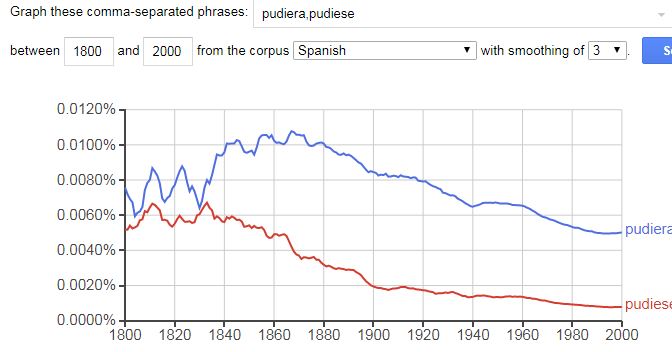
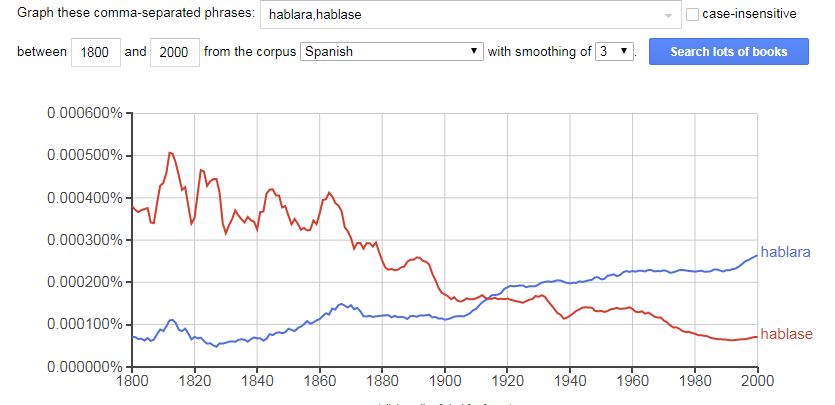
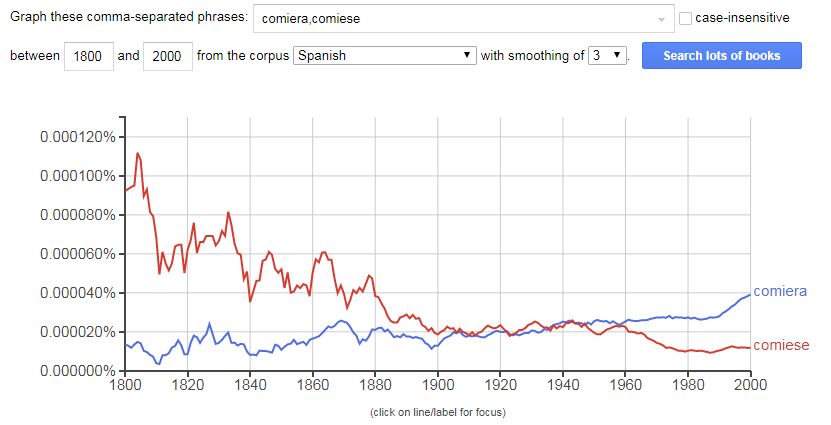
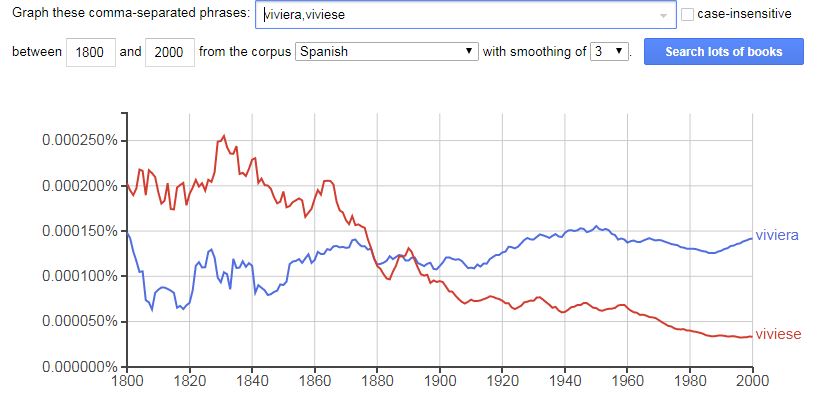
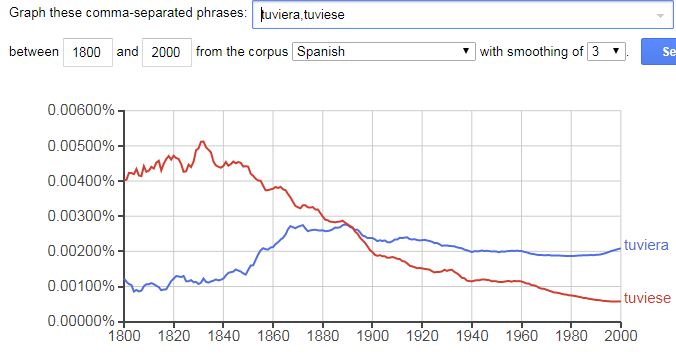
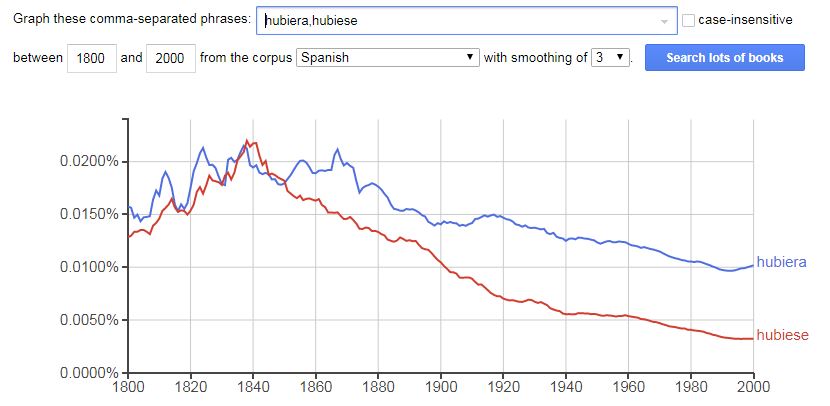
Google Books’ “Ngram Viewer” provides an easy way to see the newer -ra subjunctives overtaking the older -se forms. Google has digitized over 25 million books in English, Spanish, and other languages. Their free “Ngram Viewer” tool analyzes word frequencies in this corpus, making it easy to compare frequencies of two or more words over time.

In this post I’ve reproduced six graphs comparing -ra and -se subjunctive frequencies over the last two centuries. The first three graphs (one above, two below) show historical frequencies for the two forms of the imperfect subjunctive for the common irregulars tenerhaber, and poder. The remaining three graphs show frequencies for the three regular verbs often used to illustrate Spanish’s -ar-er, and -ir noun classes: hablarcomer, and vivir. In every case you can see the innovative -ar forms come from behind — or, less often, from parity — to overtake their -se twins. This happened earlier for the irregular verbs than the regulars; I don’t have a theory about why.

Keep in mind that written language is relatively conservative, so it’s safe to assume that -ar actually made its move somewhat earlier than shown in these graphs.


Why ser and ir are so irregular

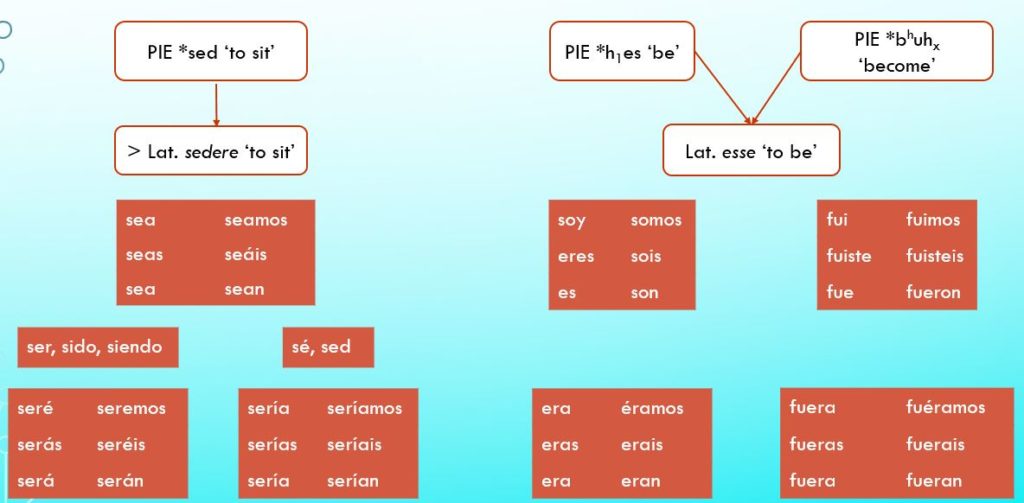
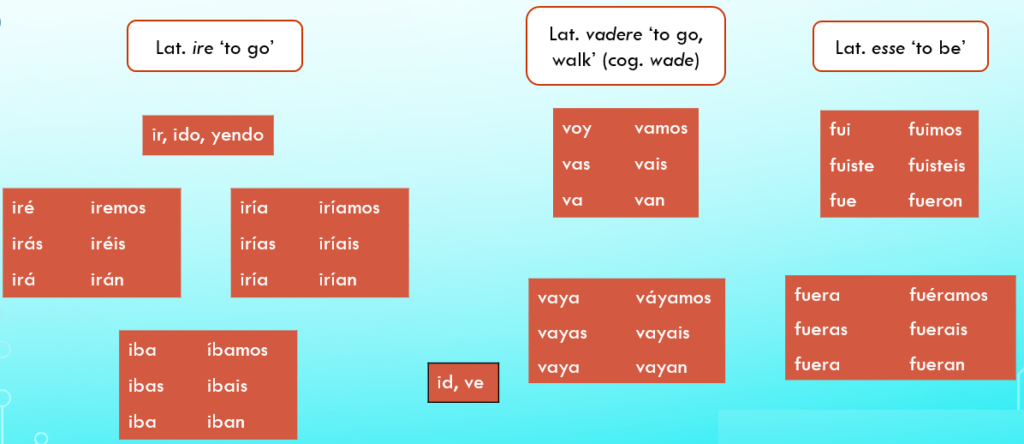
The purpose of this post is to share two of my favorite slides from the PowerPoint I prepared for my recent talk at the NECTFL conference. The slides summarize the history of the two most irregular Spanish verbs, ser ‘to be’ and ir ‘to go’. It turns out that each of these verbs is a historical merger of three distinct verbs. Ser merged the Latin verbs sedere ‘to sit’ and esse ‘to be’, which itself combined Proto-Indo-European verbs meaning ‘to be’ and ‘to become’. Ir merged the Latin verbs ire ‘to go’, vadere ‘to go, walk’ (a cognate of English ‘to wade’), and esse ‘to be’. As you can see from the slides, each root is responsible for a subset of each verb’s modern forms.

Capture

The history of “ser” (‘to be’). The asterisks indicate reconstructed (hypothesized) Proto-Indo-European roots.

temp

The history of “ir” (‘to go’). My favorite detail here is that the singular command ‘ve’ and the plural command ‘id’ come from different Latin roots.

This type of historical process, in which one verb does a “hostile takeover” of part of another verb’s conjugation, is common enough to have its own name: suppletion. You can see suppletion in the English verb ‘to go’, whose past tense form went comes from the semantically related verb ‘to wend’. The various cases of suppletion in the histories of ser and ir are likewise plausible:

  • for sedereesse: ‘to sit’ is connected to ‘to be’ because it expresses location
  • for *hes*buh: ‘be’ and ‘become’ are obviously related
  • for irevadere: ‘walking’ is a kind of ‘going’
  • for ireesse: if you ‘are’ somewhere, it follows that you ‘went’ there. For example, you can say “I’ve never been to Barcelona” instead of “I’ve never gone to Barcelona”.

I will have to save these charts for the second edition of my book!

Some nice press from the UK!

Times Higher Education, the British equivalent of The Chronicle of Higher Education, has cited ¿Por qué? as one of its “Best new books of the week”. It would be tons more exciting if it were the year instead, but I’ll settle for the week!

Screen clip below, link here.

View post on imgur.com

It’s funny that both this review and the one in El diario mention the “la la rule”, which is one of the myths I debunk in the book rather than an actual rule of Spanish. Hopefully readers will get the point.