Tag Archives: etymology

Recent gleanings from David Crystal

As a first step in research for my new book I have continued to work my way through David Crystal’s inspirational The Story of English in 100 Words. I hit the 25-word mark yesterday, and thought this would be a good time to blog about what I’ve learned since my previous post, which covered Crystal’s Introduction and his first few words.

To begin with, I’ve learned lots of fun facts about my own language! Here are a few:

  • The word out serves as a verb, adverb, exclamation, preposition, adjective, and noun. Wow!
  • The word street was one of the first borrowings into English from Latin. It was applied to the paved, straight roads that the Romans built, while the earlier Anglo-Saxon word weg (now ‘way’) was relegated to older paths.
  • The groom of bridegroom was originally guma, a somewhat poetic Old English word for ‘man’. Speakers substituted the similar-sounding groom when guma dropped out of normal usage. Groom originally meant ‘boy’ but had acquired its current equestrian meaning by the time of this substitution.
  • The only cookery words that come from Old English, not French, are grind and dough. Who knew?
  • Many legal expressions like goods and chattels, fit and proper, and will and testament, originally combined Germanic and Latin words so that they would be widely understood.
  • The game of Monopoly caused American jail (apparently descended from Parisian French) to overtake the (apparently Norman) gaol outside of the U.S.
  • Middle English didn’t have separate words for ‘spring’ and ‘summer’, but merged them both into sumer, as in the famous English round (song) Sumer is icumen in, Lhude sing cuccu.
  • We think of wee as Scottish, but it originated in Northern England, not over the border in Scotland.

—————–

As I’d hoped, Crystal’s book is giving me interesting ideas for my own book about Spanish, or at least questions:

  • Does Spanish have phrases with deliberately bilingual origins, like goods and chattels in English?
  • What word can I discuss that is only found in legal Spanish? (Maybe the future subjunctive…)
  • Crystal includes the title dame. What Spanish title should I discuss?
  • I should definitely include some Spanish word pairs that consist of a newer word and an earlier one from a different source (as in street and way). Some possibilities are abarca/sandalia, simiente/semilla, vianda/comida, and/or hostal/hotel. Of course, sometimes a new borrowing completely overwrites an earlier word, for example French té, which ousted Portuguese cha (itself borrowed from Mandarin).
  • Apparently pork meant ‘penis’ in American slang of the 1930s. Are any Spanish slang words for body parts worth discussing?
  • Speaking of slang words for body parts, Crystal points out that cunt is taboo enough to sometimes be referred to as “the c-word”, which can also mean ‘cancer’. English also has the “f-word” and the “n-word”. Does Spanish have any such words that, like Voldemort, must not be named? I will include some taboo words in any case.
  • The lack of separate words for ‘spring’ and ‘summer’ in early English reminds me of the lack of modern Spanish words for ‘evening’ and ‘night’. Were there earlier Spanish uber-terms that eventually split into two words? (And what can I call them instead of “uber-terms”, which I just invented? Portmanteau means something else, doesn’t it?) Did this happen, in recorded history, with color terms, which tend to proliferate as languages evolve? (See e.g. Guy Deutcher’s Through the Language Glass, one of my favorite linguistics books written for a general audience.)
  • English slang frequently uses negative words as positives, e.g. wicked, mad, insane, crazy, and of course bad. Is there anything like this in Spanish?
  • Crystal’s discussion of phrasal verbs like take out and take away, which are distinctively English (perhaps Germanic, more generally?) reminded me that I should definitely discuss pronominal verbs (reflexive and otherwise), which are distinctively Spanish.
  • Crystal says out that the word count, as opposed to countess, was initially avoided because its earlier pronunciation was similar to that of cunt. This reminded me of Tom Lathrop’s assertion that the verb jugar, originally jogar, ‘evolved’ its u to make the verb sound less like joder. Is this assertion taken seriously? Are there other examples of this avoidance process in the history of Spanish?

Unrelated to Crystal’s book, I’ve also made notes to myself to include

  • Words that illustrate spelling changes, like saqué or empecemos. Maybe the best way to do this is with a word like cero or cebra.
  • Diminutives, aggrandatives, and so on. Spanish has a wealth of derivational suffixes! Likewise I should include interesting prefixes such as re- prefix, which can be an intensifier (rebueno) or a repeater (rehacer).
  • The full range of parts of speech.
  • Words from a broad range of semantic categories such as the 24 used in the WOLD project.

On a final note, the New York Times “Connections” game, which I play every morning — my current streak is 69! — recently included the word loanword. Many commenters on the Connections blog complained that this word was too obscure. So did my husband. NOT ME!!!

A shout-out to David Crystal

As I explained in my first blog post about my planned third book, David Crystal’s book The Story of English in 100 Words inspired me to tackle this project, and studying his book is the first item on my research to-do list. Since then, I’ve gotten to work.

So far, reading The Story of English has been both discouraging and encouraging. Discouraging, because David Crystal knows more about English than I will ever know about Spanish. Each entry in the book is rich with information and presented in a most engaging manner. For example, the entry for the word and:

  • quotes the first written example of the word;
  • talks about the importance of “little words”;
  • explains the origin of the ampersand (&);
  • reveals an earlier abbreviation for and: a symbol that resembles the number 7 but that dips below the line of writing (like a j, q, or p) — this came as a complete surprise to me!
  • thoroughly debunks the shibboleth against beginning sentences with and and other conjunctions, quoting grammarians both past and present and citing a host of authors who followed this practice.

I doubt that I’ll be able to do as good a job for Spanish as Crystal did for English, but I’ll try. In the meantime, I recommend The Story of English to any of my readers who are interested in languages in general, not just Spanish.

At the same time, reading The Story of English is encouraging. For one thing, I see how good a book of this type can be. Additionally, while I am still in the book’s early pages, it has already given me several ideas for my own book. For example, Crystal’s discussion of and suggests the following:

  • I should include early written examples of the words when they are available and interesting. (See canoa in my earlier post.)
  • I should include “little words”. Conmigo is on my list for sure — it’s a fascinating double compound, since both con- and -go came from Latin cum ‘with’, but centuries apart. I will probably mention mas when I talk about accent marks. Accented más, which means ‘more’, has eclipsed it in the last century and a half, as shown by the Google ngrams graph below. Por and para are also likely: para began as por + a ‘to’, which is why so many of its uses have a directional meaning.
Más overtakes mas (generated using books.google.com/ngrams). Y axis shows how often each word has occurred in Google’s corpus of Spanish books.
  • Regarding abbreviations, I’ll definitely cover the tilde’s origin as a shorthand for n (perhaps in an entry for año?), and the sexual politics of the arroba (@), an English abbreviation borrowed into politically correct Spanish. You can see the former in the letter from Christopher Columbus in my June 23 post, for example corazõ for corazón (two lines above canoas) and bãcos for bancos (one line below).
  • The most obvious Spanish shibboleth is the shifting guidance either in favor of or against leísmo. Le is sure to be one of my 100 words.

As I mentioned above I’m still at the beginning of Cyrstal’s book, which is why this post is mostly about and. The book’s Introduction, besides providing a broad chronology of English and its principal lexical contributors, raises other useful points, all of which I will hope to cover in Spanish:

  • Besides native words and borrowings, Crystal mentions several other sources of English words: de novo invention, slang and vulgar vocabulary, onomatopoeia, idioms, criminal jargon, and regionalisms.
  • He also touches on vocabulary topics including standardization, the impact of printing, specific authors, biblical translations (including shibboleth, which is probably why it was on my mind), prescriptive grammar, and spelling reform — each topic grounded by one or words on his list.
  • He covers different mechanisms of word formation that have come into play in the history of English, such as reduplication (dilly-dally), shortening, compounding, and proper nouns like valentine or Watergate becoming common nouns, for which the obvious Spanish example is biro.

Overall, Crystal characterizes English as “a playful and innovative language, whose speakers love to use their imaginations in creating new vocabulary.” I’m not ready to provide any parallel insight for Spanish, but I hope that soon I will be.

Plans for a third book

Now that I’m not planning to teach this fall, my longstanding idea for a third book about Hispanic linguistics has jumped off the back burner and into the front of my brain. My inspiration for this project is David Crystal’s The Story of English in 100 Words (St. Martin’s Press, 2011). Crystal’s book is 256 pages long, so you can do the math — he devotes two or three pages to each of one hundred words carefully chosen to represent the history of the English language.

I’m planning to do the same for Spanish — and to write the book simultaneously in English and Spanish, to reach a wider audience! The English title will probably be The Story of Spanish in 100 Words and the Spanish title either La historia del castellano en 100 palabras or La historia del español en 100 palabras.

“My” hundred words will include:

  • words that entered the language in every relevant century;
  • words from the many sources that Spanish vocabulary draws on, from Proto-Indo-European to American English;
  • words that reflect different aspects of Spanish and Latin American culture, and the cultures that they have interacted with;
  • words that illustrate the evolution of distinctive aspects of the Spanish language, such as the formal pronoun usted;
  • words that illustrate common linguistic processes, such as a word’s taking on a negative connotation over time, as in bárbaro ‘barbarian’, which in Latin had the more neutral meaning ‘foreigner’.

I already have a preliminary list of almost 100 words, many of which are placeholders like “something from Quechua.” My first task will be to flesh out this list with words from sources including:

  • David Crystal’s book, with the expectation that some of his 100 English words will suggest Spanish equivalents;
  • this blog;
  • my first two books;
  • The American Heritage Dictionary’s Spanish Word Histories and Mysteries, which focuses on Spanish words that English has borrowed;
  • Antonio Tello Argüello’s Historia particular de 100 palabras, in which this Argentinian poet traces the origins of his favorite words;
  • suggestions from you, my readers. Fire away in the comments!

Without a doubt the first word in the book will be yugo ‘yoke.’ I will start there because yugo so perfectly illustrates the Indo-European language family of which Spanish is an important member. Indeed, the Proto-Indo-European root of yugo, *yugóm, has descendants in every branch of the Indo-European language family! Besides yugo itself and English yoke, some examples are Greek ζυγός, Cornish yew, Hindi युग, and Czech jho. This wide dissemination is culturally significant because it shows that the original Indo-European people, who most likely lived in or near today’s Ukraine, had already learned to tame cattle and plow fields before they spread out to conquer most of Europe and South Asia. Yugo also has a fun connection with the word yoga; just as a yoke connects two oxen, the practice of yoga is supposed to forge a spiritual connection with a higher power or one’s better nature.

Another must-include word is canoa ‘canoe’, the first indigenous American word to enter the Spanish language. Christopher Columbus used this Taíno word in a letter to Luis de Santangel, dated 15 February 1493, about his first voyage to the New World. You can see it on the second page of this copy of the letter in the Rare Books collection of the New York Public Library, about two-thirds of the way down. (Click on the thumbnail of the second page, then one of the viewing options, preferably “2560 px.”) I’ve circled it in this screen clip:

Columbus wrote: Ellos tienen en todas las islas muy muchas canoas, a manera de fustas de remo, de ellas mayores, de ellas menores ‘On all the islands they have very many canoas, a kind of rowboat, some larger and some smaller.’ Note that Columbus took care to explain what a canoa was because he knew it was a new word.

I hope to reach a wide audience with this book, and so will seek a non-academic publisher, either directly or with the help of an agent. Any ideas for likely publishers or agents will be most welcome as I pursue this project.

Septiembre, octubre, noviembre, diciembre

If you are reading this blog you must be interested in languages, so you may already be familiar with the etymology of the last four months of the year in Spanish, English, and many other languages. They come from the Latin words for seven, eight, nine, and ten, and were thus named because the Roman calendar began in March, making September the seventh month and so on.

Despite being fascinated by languages since I was a girl, speaking at least three languages that use these words, and knowing the relevant numerical prefixes, I somehow never made the connection between the numbers and the months until recently, when I started to study Italian in preparation for an upcoming trip. I had made some progress in Italian before but have now zoomed ahead using Language Transfer, a method developed by linguist and humanitarian Mihalis Eleftheriou. In his free courses, Mr. Eleftheriou likes to draw connections between the target language and English (and sometimes other languages), and in the process points out interesting etymologies such as these.

I recommend Language Transfer’s “Complete Spanish” as a first course in Spanish (or a refresher) to anyone who reads this blog. And if Mr. Eleftheriou comes across this blog post, I encourage him to contact me. I would be delighted to send him a copy of my first book (¿Por qué?) in thanks for his help with Italian.

For the sake of completeness, the etymology of the remaining months of the year is as follows:

eneroJanus, Roman god of beginnings and gates
febreroLatin februa ‘purification’. Since February was the last month of the Roman calendar, the Romans held a feast of purification on the ides of the month (February 15).
marzoMars, god of war
abrilunknown / disputed
mayoMaia, earth goddess and wife of Vulcan
junioJuno, goddess of marriage and wife of Jupiter
julioJulius Caesar
agostoAugustus Caesar

Something borrowed, something blue

For the last few years I’ve had a research project about Spanish word origins on the back burner. This summer I’ve resurrected the project, and it is simmering nicely: I have now finished the first major stage.

The focus of the project is Spanish borrowings, or loanwords: words in Spanish that originated in other languages. The project applies to Spanish the methodology from Martin Haspelmath and Uri Tadmor’s World Loanword Database (WOLD) project. Beginning in 2004, Haspelmath and Tadmor organized a team of linguists to collect data on loanwords in forty-one languages around the world. In 2009 they published their results in a book, Loanwords in the World’s Languages: A Comparative Handbook (De Gruyter), and the contributing linguists shared their data on the WOLD website.

My goals in this project are:

  1. To compare Spanish to the forty-one languages in the WOLD project, in terms of (i) its percentage of loanwords, and (ii) these words’ characteristics, such as their part of speech.
  2. To quantify the relative contributions of different source languages to Spanish vocabulary. I already did this for my first book, using a random sampling of five hundred words from a standard Spanish etymological dictionary. But that sample may have skewed toward more recherché vocabulary.
  3. To address various issues involved in etymological research, in Spanish and in general.

More about the WOLD project

In order to obtain comparable results across the WOLD languages, all participating linguists started with the same list of 1460 core meanings: ‘house,’ ‘mother,’ ‘go,’ and so on. Each linguist identified ‘their’ language’s words for these meanings, then traced the origins of those words using a standardized set of guidelines. I have now completed the first of these two steps for Spanish. It raised all sorts of interesting issues, which I will discuss in my next blog post.

One goal of the WOLD project was to compare the frequency of borrowing in different languages. In other words, of the core meanings, how many were expressed in each language by loanwords? As shown in the table below, borrowing rates ranged from 1.2% for Mandarin Chinese to 62.7% for Selice Romani. Yaron Matras’s review of the WOLD Handbook in the journal Language points out that these two languages are spoken in diametrically different environments. Speakers of Mandarin “show little or no bilingualism”; the language has “a status as a majority language, a powerful standard, and a sociopolitically dominant population.” In contrast, Selice Romani is associated with “universal multilingualism, a minority language status, the absence of a written standard, and sociopolitical marginalization.”

Romanian, the only Romance language in the project, fell into the “high borrowers” category (25.9% to 45.6%), as did English. My previous research (see above) placed Spanish in the “very high borrowers” category, with roughly one-third “native” vocabulary (from Vulgar Latin), one-third later borrowings from Latin, and one-third words from other languages. It will be interested to see whether this holds up for a WOLD-based lexicon.

Borrowing typeLanguages (in increasing order of % loanwords)
“Low borrowers”
(1.2 – 9.7%)
Mandarin Chinese, Old High German, Manange, Ket
“Average borrowers”
(10.7 – 22.4%)
Otomi, Seychelles Creole, Gawwada, Hug, Oroqen, Hawaiian, Kali’na, Iraqw, Q’eqchi’, Wichí, Zinacantán Tzotzil, Malagasy, Dutch, Kanuri, White Hmong, Mapudungun, Hausa, Lower Sorbian
“High borrowers”
(25.9 – 45.6%)
Takia, Thai, Yaqui, Swahili, Vietnamese, Sakha, Archi, Imbabura Quechua, Kildin Saami, Bezhta, Indonesian, Japanese, Ceq Wong, Sarmaccan, English, Romanian, Gurindji
“Very high borrowers”
(51.7 – 62.7%)
Tarifyt Berber, Selice Romani

Another goal of the WOLD project was to learn more about borrowing in general. The research confirmed several generally accepted principles about borrowings:

  • Function words were borrowed less than content words (nouns, verbs, adjectives, and adverbs). Overall, 12% of function words were borrowed, compared to 25% of content words.
  • Nouns were more likely to be borrowed (31%) than other types of content words (14-15%).
  • Borrowing was most common for cultural vocabulary, such as religion, clothing, housing, law, social and political relations, agriculture, food, and warfare; and least common for personal vocabulary, such as sense perception, spatial relations, body parts, and kinship.

Motivation

My interest in the WOLD methodology dates from 2018, when I was starting to work on my second book, Bringing Linguistics into the Spanish Language Classroom. The book is organized around five themes, or “essential questions,” including “How is Spanish different from other languages?” and “How is Spanish similar to other languages?” I thought it would be interesting to compare Spanish to the WOLD languages so that I could say either “Spanish has borrowed more words than most other languages” or “Spanish has borrowed a typical amount of words.” (I was confident that Spanish would be a “low borrower.”)

I originally imagined that I could research this topic in a couple of weeks, but soon ran into methodological issues such as:

  • Should word pairs like hijo and hija (‘son/daughter’) be counted as two separate words, even though they are just masculine and feminine forms of the same word?
  • WOLD linguists could identify multiple words for a single meaning. How far should this be taken for Spanish? How does one draw the line between synonyms and dialectal variants?
  • When looking up word origins, the WOLD guidelines count a word as borrowed if it entered the language at any point in the language’s history. This would include, for instance, words borrowed into Classical or Vulgar Latin, such as gato ‘cat.’ (Vulgar Latin cattus is believed to be Afro-Asiatic in origin, and replaced the original Latin feles.) This guideline rubbed me the wrong way. Shouldn’t Spanish begin with Vulgar Latin?

After three months of a futile quick-and-dirty run at these issues, I decided to put the project on my back burner and eventually do a more thorough job that would hopefully yield publishable results. So…here we are.

57 words with eñe

I’ve had the wonderful Spanish ñ on my mind lately (see e.g. here), and today decided to make a list of reasonably common Spanish words that use this characteristic letter. This started as a plain list of 57 words. Then I added translations. Then I couldn’t resist going back in time: I knew that the ñ sound had several different origins, but was curious to see how this worked out statistically.

The results are below, in tabular form so you can play with the words yourself if you like. The table is sorted by Type, meaning the type of the word’s origin; within each type, words are listed in alphabetical order. The types themselves are ordered by frequency.

  • The most common origin is therefore the first one you see in the table: a Latin ne or ni. When followed by another vowel, the e or i turned into a y sound, which in turn had a transformative effect on the n.  An example is España, from Latin Hispania. (The y sound had a similar effect on other consonants, not just n, and the resulting changes are referred to as palatalization.)
  • The next most common origin is a Latin double nn; this is the source of the tilde (~) itself. An example is año, from Latin annus. Pleasingly, the suffix -eño has a dual origin, with one derivational path of the ne/ni type (seen in words like isleño) and another of the nn type (seen in pequeño).
  • The third group is a Latin gn or ng sequence as in enseñar from Latin insignare. I knew that some ñ‘s came from gn, but the ng words were a surprise.
  • Next are words borrowed from other languages. Here we find words that begin with an ñ, from languages as disparate as Quechua (chuño), Dutch (ñu), and Italian (tacaño).
  • The mn group could really be collapsed under nn, because these words passed through an nn stage before emerging with an ñ. An example is sueño, from Latin somnus.
  • Some words on the list were internally derived from other Spanish words. For example, caña ‘reed’ gave rise to both cañón and cañada.
  • Finally, one word (rebaño) is of unknown origin — too bad I missed it when writing this recent post — and one (cariño) has a known origin that doesn’t seem likely to produce an ñ.
Word Translation Origin Type
1.           araña spider Lat. aranea ne/ni
2.           baño bathroom Lat. balneum ne/ni
3.           campaña field, campaign Lat. campania ne/ni
4.           compañero companion Lat. compania ne/ni
5.           emponzoñar to poison Lat. potiniare ne/ni
6.           España/español Spain/Spanish Lat. Hispania ne/ni
7.           huraño shy Lat. foraneus ne/ni
8.           isleño islander -eño suffix from Lat. ‑ineus ne/ni
9.           jalapeño type of pepper Jalapa (Mex. prov.) plus -eño ne/ni
10.       migraña migraine Lat. hermicrania ne/ni
11.       montaña mountain Lat. montanea ne/ni
12.       ordeñar to milk Lat. ordiniare ne/ni
13.       piña pinecone, pineapple Lat. pinea ne/ni
14.       saña rage Lat. insania ne/ni
15.       señor, señora, señorita Mr., Mrs., Miss Lat. senior ne/ni
16.       viña vine Lat. vinea ne/ni
17.       añil indigo Ar. an-nil nn
18.       año year Lat. annus nn
19.       caña reed Lat. canna nn
20.       engañar to fool Lat. ingannare nn
21.       guiño wink Lat. cinnus nn
22.       muñeca wrist, doll Lat. bonnicca nn
23.       niño boy Lat. ninnus nn
24.       ñoño dull Lat. nonnu nn
25.       paño cloth Lat. pannus nn
26.       peña rock, crag Lat. pinna nn
27.       pequeño small -èño suffix from Lat. ‑innu nn
28.       enseñar to teach Lat. insignare gn/ng
29.       estaño tin Lat. stagnum gn/ng
30.       heñir to knead Lat. fingere gn/ng
31.       leña firewood Lat. ligna gn/ng
32.       puño fist Lat. pugnus gn/ng
33.       reñir scold Lat. ringi gn/ng
34.       señal signal Lat. signa gn/ng
35.       tamaño size Lat. tam magnus ‘so big!’ gn/ng
36.       teñir to dye Lat. tingere gn/ng
37.       uña nail Lat. ungula gn/ng
38.       bruñir polish Occ. brunir borr
39.       buñuelo fritter Cat. bony borr
40.       champaña champagne Fr. champagne borr
41.       chuño potato starch Quech. ch’uñu borr
42.       gañán farmhand Fr. gaaignant borr
43.       ñandú rhea Guar. ñandú borr
44.       ñoqui gnocchi Ital. gnocchi borr
45.       ñu gnu Dutch gnoe borr
46.       tacaño stingy Ital. taccagno borr
47.       vicuña Quech. uikuña borr
48.       daño harm Lat. damnum mn
49.       doña lady Lat. domina mn
50.       dueño master Lat. dominus mn
51.       otoño autumn Lat. autumnus mn
52.       sueño dream Lat. somnus mn
53.       apañar to fix from paño (below) der
54.       cañada ravine from caña der
55.       cañón cannon, canyon from caña der
56.       cariño affection Lat. carere
57.       rebaño flock unknown

Linguistics projects for the foreign language classroom

In a workshop I recently gave in Atlantic City, I distributed the following list of possible linguistics-based projects for the foreign language classroom. They are adaptable for a variety of languages and levels of instruction. To download a PDF version, click here.

This list is a subset of the projects included in the companion website for my book¿Por qué? 101 Questions about Spanish. Here I divided them into the four categories of “Language history,” “The target language in the world,” “Language learning,” and “Language use”.

If you make use of this list, as an instructor or a student, please write back and let me know how the project(s) turned out.

Language history

  • Examine a few pages written in an older form of the target language. What are obvious ways that the language has changed?
  • Look up the origins of the words in either (i) a sample of text from the target language, or (ii) a specific vocabulary domain, such as clothing or animals. Where do the words come from, and what does this teach about the history of your language?
  • Research and create an infographic about a phase in the history of your language, such as the Golden Age of Spain or the Napoleonic period in France. What were the linguistic landmarks of these periods?
  • Research vocabulary borrowings into English from the target language. What do they tell you about how the two cultures have interacted?
  • Research the etymology of a dozen place names (names of cities, towns, etc.) in a country that speaks your target language. What does it this exercise teach you about the language’s history? Summarize your findings on a map or other infographic.

The target language in the world

  • Use Ethnologue (an on-line database about world languages) to gather data on where the target language is spoken and what other languages are spoken in those countries. Present as an infographic or a slideshow.
  • Profile a language academy such as the Académie française or the United States branch of the Real Academia Española. Who are the members? What are their activities and/or publications? What would you ask if you could interview them?
  • Research and present information about a language controversy, such as Catalan versus Castilian in Catalonia, or the historical tussle between French and Alsatian in Alsace.
  • What information does the most recent USA census provide about speakers of your target language in our country?

Language learning

  • Try to predict which features of English are most hardest to learn for speakers of other languages. Interview an ESL teacher to test your predictions.
  • Try a few lessons in the target language from Duolingo, Rosetta Stone, or other language learning software. How does the software try to teach the language? How is this different from classroom learning?

Language use

  • How might you reform the spelling of your target language to make it easier? Argue for your changes and transform a sample page using your proposed changes.
  • Pick your favorite language rule: ser vs. estar, passé composé vs. imparfait, and so on. Analyze actual text (perhaps a newspaper article) to see if the rules taught in class explain the actual usage.
  • Learn how to speak “Pig Latin” in the target language (e.g. Spanish jerigonza). A speed contest may be in order! What do you have to think about as you speak in order to accomplish this?
  • Find, watch, and compare instructional videos on some difficult aspect of pronouncing your language (like rolling your r’s). Make your own instructional video.

A new online Spanish etymological dictionary

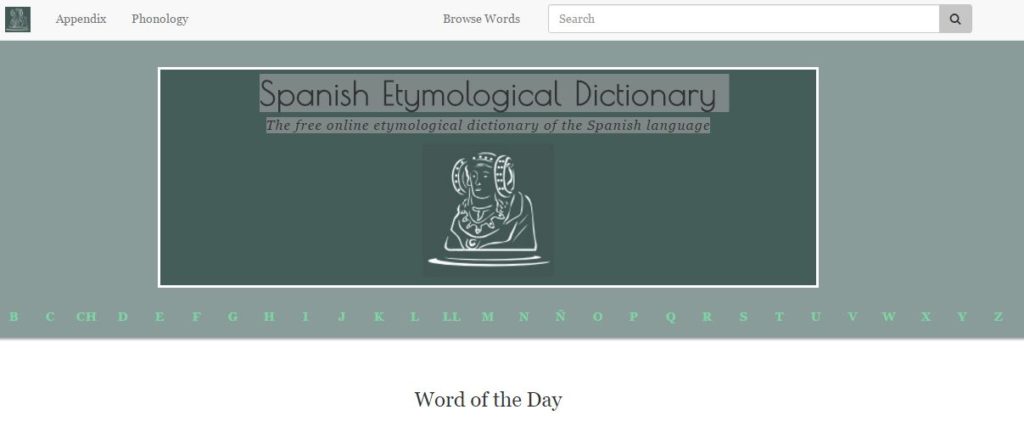
Today’s post is about a new online resource for the Spanish language lover: the Online Etymological Dictionary of Spanish, or OEDoS. A screen clip of the welcome screen is below. The website was inspired by Douglas Harper’s very useful online etymological dictionary of English. It went live in July, and has its own Facebook page. The primary resource consulted to create the entries has been Corominas’s Diccionario crítico etimológico de la lengua castellana. (This is the six-volume standard, whose shorter version is one of the “top 10 books” on my bookshelf.)

Capture

I contacted the OEDoS Team to find out more about their methodology. Via a friendly return email I learned that the dictionary began with the 2000 most frequently used words of Spanish, with others added because of etymological importance, user requests, and other reasons. My OEDoS contact’s (Patrick Welsh) explanation of how the OEDoS handles etymological disagreements was quite interesting:

As regards conflicting etymologies, we the OEDoS team recognize a dual responsibility of both accuracy and readability. We aim to capture disagreement between linguists whenever possible. In the interest of our time constraints and resources, this is not always possible. Sometimes this breeds disagreement on our side as well. For example, the etymology of hacer (http://spanishetym.com/term/hacer) sparked significant disagreement on historical accentuation and lexical borrowing; this caused the publication of the entry to be delayed for some time. We note the incisive criticism of Penny and others in the 1980s toward Meyer-Leubke, as well as very recent scholarship on Latin’s reflexes in Romance. Ultimately, we decided Meyer-Leubke’s comments were strong enough to overcome our initial wariness. Brief mention of two modern publications were included in the entry as well. Sometimes the entry you see in the dictionary is a snapshot of disagreement: not only between historical linguists at their university desks but between us as well


I hope that you will all visit this website and spread the word about the project.

The strange history of muñeca

A stray comment on /r/Spanish got me thinking about muñeca, the word that, bizarrely, means both ‘doll’ and ‘wrist’. The ‘doll’ meaning is primary. It’s the one listed first in dictionaries, and if you do a Google image search on muñeca, you see more dolls than wrists. It’s the first meaning that I learned, since ‘wrist’ is one of the less important body parts. When I eventually learned the second meaning, I was surprised that one word could have two such completely unrelated interpretations.

I’ve just looked up the history of muñeca in my can’t-live-without-it etymological dictionary by Joan Corominas. It turns out that the word’s original meaning was neither ‘doll’ nor ‘wrist’, but something entirely different: ‘milestone’, in the physical sense of a road marker.

Muñeca ‘milestone’ turns into both ‘wrist’ and ‘doll’.

How did this bizarre transformation take place? According to Corominas, the key was the interpretation of a milestone marker as something that sticks up out of the ground: a bump, or using fancier English, a protuberance. The word was then extended to ‘wrist’ because the wrist bone protrudes from the arm. The road to ‘doll’ began with the extension of muñeca to a bumpy bundle of rags, and from there to a rag doll, and then other dolls.

Muñeca‘s original meaning of ‘milestone’ has been lost from everyday discourse, but is still included in the Real Academia’s dictionary — but only after ‘doll’, ‘wrist’, and other meanings related to ‘doll’, such as ‘cadaver’ and ‘bimbo’.

Incidentally, the earlier history of muñeca is obscure. It is not Latin, but seems to come from a pre-Roman language, possibly Celtic.

Fun with Proto-Indo-European roots

Recently I’ve been playing with John Slocum’s terrific Indo-European Lexicon website and wishing I’d discovered it earlier. In case you didn’t know, Spanish and the other Romance languages are part of the Indo-European language family. Other branches of this enormous family include Germanic, Greek, Celtic, Slavic, and Indo-Iranian. Spanish is therefore related to language as diverse as Gaelic and Gujarati; to Sanskrit, Serbian, and Swedish; to Pashto, Persian, and Polish; and to Hindi and Hittite.

Dr. Slocum’s Lexicon lets you trace vocabulary roots up and down the Indo-European family tree. For example, let’s say you’re curious about the origin of the Spanish word pan “bread”. If you click on the Language Index you can then scroll down to Spanish. (For a shortcut, you can access the Spanish page here.) This page lists almost 500 Spanish words whose Indo-European roots are included in the Lexicon. Pan is traced back to the Proto-Indo-European root pā-. Click on that root and you’ll move up the tree, to an entire page devoted to pā-. This page provides a definition and a list of the root’s descendants in all ten branches of the Indo-European family.

It turns out that pan is related to several sets of English words. I knew about some of them, but not all.

  • food and fodder
  • company, companion
  • forage, foray, foster
  • pantry, pannier
  • pastor, pasture, repast, pastern, pester
  • antipasto (but not “pasta”, go figure)
  • pabulum

For other words, though not pan, tracing a root back down the tree can show you surprising connections within Spanish. For example, llama “flame” and blanco “white” share the same Indo-European root, as do armisticio, arrestar, asistir, costar, estado, and estar.

Why are you still reading? Run along and play!