Category Archives: Vocabulary

Jespersen’s Cycle in Spanish – past and present

When I started teaching Spanish in 2004, I put linguistics on the back burner — I assumed, forever. This changed in the summer of 2008, with a single “Aha!” moment during an advanced Spanish class I was taking at the Universidad Complutense de Madrid. (Another class that summer was the source of a useful reading list of Spanish light fiction.) Our professor, José Luis Ocasar (now at George Washington University), explained that en absoluto ‘absolutely’ had come to mean ‘absolutely not’ because of its frequent use in negative sentences, such as No era un nombre árabe en absoluto ‘It was absolutely not an Arab name’.

This immediately struck a linguistic bell: it was clearly an example of Jespersen’s Cycle, the well-known process by which affirmatives become negatives. Readers may be familiar with this process from the use of French pas (as in Je ne sais pas) to mean ‘no’ even without the ne. Recognizing it in Spanish was thrilling, like running into an old friend in an exotic locale. It also made me realize that my linguistics background gave me the privilege of understanding facts of Spanish in a different way than my fellow students. The desire to share this privilege is what eventually led me to write ¿Por qué?.

For me, Jespersen’s Cycle in Spanish has been the gift that keeps giving. I later learned that en absoluto is not the only ongoing instance of the process; en modo alguno ‘in some way’ has also come to mean ‘in no way’. Even better, looking back into the history of Spanish, it turns out that Jespersen’s Cycle starred in the creation of four Spanish negatives: nadienada, jamás, and tampocoNadie and nada began with Latin expressions built on the verb nascor ‘to be born’ (the source of nacer): non homines nati ‘no people born’ and non res nata ‘no thing born’. These were roughly equivalent to English ‘not a soul’ and ‘nothing on Earth’. Over time, nati became nadienata became nada, and both became standalone negatives. Jamás developed from the expression ya más ‘any more’, and tampoco from tanto poco ‘so little’, both paired with no so frequently that they became negative themselves.

Until this morning, I thought I knew all there was to know about Jespersen’s Cycle in Spanish. Then I read this useful blog post about the Spanish of Don Quijote. It included the use of persona instead of nadie — for example, in the sentence Una noche se salieron del lugar sin que persona los viese. While this usage is not possible in modern Spanish — the RAE doesn’t even list it with an ‘archaic’ warning — it is directly analogous to the rise of the French negative personne ‘nobody’.

Please let me know if I’m missed any other instances of Jespersen’s Cycle in Spanish.

Note: this post is basically an expansion of slides 20 and 21 of my 2016 New Year’s listicle, “The top 10 surprising ways that Spanish isn’t special”.


The strange history of muñeca

A stray comment on /r/Spanish got me thinking about muñeca, the word that, bizarrely, means both ‘doll’ and ‘wrist’. The ‘doll’ meaning is primary. It’s the one listed first in dictionaries, and if you do a Google image search on muñeca, you see more dolls than wrists. It’s the first meaning that I learned, since ‘wrist’ is one of the less important body parts. When I eventually learned the second meaning, I was surprised that one word could have two such completely unrelated interpretations.

I’ve just looked up the history of muñeca in my can’t-live-without-it etymological dictionary by Joan Corominas. It turns out that the word’s original meaning was neither ‘doll’ nor ‘wrist’, but something entirely different: ‘milestone’, in the physical sense of a road marker.

Muñeca ‘milestone’ turns into both ‘wrist’ and ‘doll’.

How did this bizarre transformation take place? According to Corominas, the key was the interpretation of a milestone marker as something that sticks up out of the ground: a bump, or using fancier English, a protuberance. The word was then extended to ‘wrist’ because the wrist bone protrudes from the arm. The road to ‘doll’ began with the extension of muñeca to a bumpy bundle of rags, and from there to a rag doll, and then other dolls.

Muñeca‘s original meaning of ‘milestone’ has been lost from everyday discourse, but is still included in the Real Academia’s dictionary — but only after ‘doll’, ‘wrist’, and other meanings related to ‘doll’, such as ‘cadaver’ and ‘bimbo’.

Incidentally, the earlier history of muñeca is obscure. It is not Latin, but seems to come from a pre-Roman language, possibly Celtic.

When does a pez become a pescado?

One of my favorite “fun facts” about Spanish is that it has two words for ‘fish’: pez, for a live fish, and pescado, for fish that is food, as in a restaurant or a fish market. Pez is a direct descendant of the Latin word pisces. Pescado is the past participle of the verb pescar ‘to fish’, and literally means ‘fished’; it’s fish that has been fished, or caught.

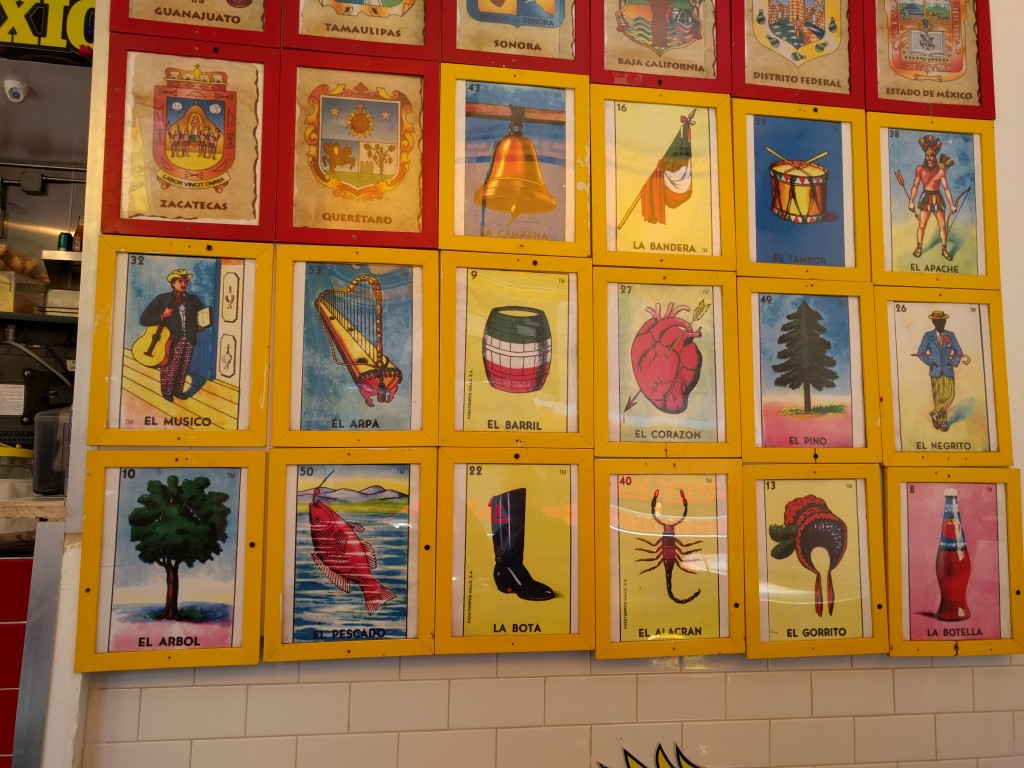
I was reminded of this word pair yesterday, when my husband and I had breakfast in Spanish Harlem, at a corner taquería, or centro de comida, called El Águila. The wall near our table was decorated with reproductions of Mexican state seals and lotería cards, which are used in a variety of bingo-like games as well as fortune-telling. Two of the lotería images caught my eye: “El Negrito” (next-to-last row, furthest right), because it’s so dated, and also “El Pescado” (bottom row, second from left, also see close-up).

El Águila

Since the fish is still in the water, and is still alive, I thought it would be labeled pez. Instead, the lotería card apparently captures the “decisive moment” in which the poor pez becomes a pescado. Once it’s on the hook, there is no turning back.

The taquería’s name, El Águila, is itself of linguistic interest. First, águila is one of those feminine Spanish nouns that take a masculine article (el) in the singular to stop the a of the feminine article la from blending in with the initial a of the noun, as it does (legitimately) in Italian words like l’amica (from la amica). Second, the taquería itself and its website are missing the accent mark in Águila. This illustrates the common, though technically incorrect, tendency to omit accent marks on capital letters.


The top 10 surprising ways that Spanish isn’t special

¡Próspero Año Nuevo!

My previous post presented the Top 10 reasons why Spanish is special. This post presents its opposite: the Top 10 reasons why Spanish isn’t special. Like the previous Top 10 list, it includes examples from Spanish grammar, vocabulary, spelling, and pronunciation.

This Top 10 list was constructed with native speakers of English in mind. It describes core aspects of Spanish that may seem peculiar, but turn out to be normal when considered in a broader linguistic context. Some of these are truly surprising! The inscrutable ‘personal a, for example, turns out to be a prime example of a linguistic phenomenon known as Differential Object Marking, while the use of positive expressions like en absoluto (‘absolutely’) with a negative meaning (‘absolutely not’), illustrates a well-known historical process called Jespersen’s Cycle.

To me, the two lists are equally interesting. I love both the special features of Spanish and its reflection of broader cross-linguistic tendencies. I hope you do, too.


The top 10 reasons why Spanish is special

Today’s post is the first of several I plan to make in the next few weeks to summarize the broad linguistic themes that emerged as I wrote my book. It is a follow-up on a post I did some months ago, “What makes Spanish unique”. This post is somewhat more general, and, I hope, more fun because it’s a slideshow.

Enjoy!

Click the bidirectional diagonal arrow to view in fullscreen mode.

Does “andurriales” have an English equivalent?

In my current research I’m revisiting the topic of pluralia tantum: words that are normally used in their plural form, even when no plural meaning is intended. Two good examples in Spanish are vacaciones ‘vacation’ and tardes in Buenas tardes ‘Good afternoon’.  In particular, I’ve been plowing through the list of pluralia tantum in the Real Academia’s Nueva Gramática de la lengua española (a lot of scholarly bang for your buck at $14.75). There I came across andurriales, which means parajes extraviados o fuera de camino ‘isolated or out-of-the-way places’.

I love the fact that there is, I think, no exact equivalent for this word in English. (Let me know if you think of one!) Andurriales doesn’t have boondocks’s negative connotation. In fact, this thoughtful exploration of the word on a Spanish vocabulary blog, La llave del mundo “The key to the world”, expands the definition poetiically as follows: esos paseos fuera de las rutas señaladas, que sugieren un paraje remoto, poco transitado, apartado, ignoto y cautivador… ‘those unmarked routes that suggest a remote, unknown, rarely visited, and captivating place.’

To my delight, the Llave bloggers illustrated the word with a passage from El séptimo velo, Juan Manuel de Prada’s prize-winning novel, which I wrote about a few times more than a year ago (most recently here). El séptimo velo is, as I described then, packed to the gills with recondite vocabulary, so it’s appropriate that andurriales should show up in it. The specific passage cited is from the dramatic description of the heroine’s family’s escape, over the Pyrenees, from Civil War-torn Spain: Sacando fuerzas de flaqueza, Estrada se internó por andurriales sólo frecuentados por las cabras, porteando a una Catalina exánime “Tapping his last reserves of strength, Estrada sought out andurriales barely used even by goats, carrying the exhausted Catalina.”

Every pair of languages undoubtedly has bountiful examples of such untranslatable vocabulary. Here’s a pretty good list for Spanish versus English. I take issue, though, with pena ajena ‘shame on someone else’s behalf’ (since it’s a phrase, not a word) and estrenar, since English has debut, and I wish they’d included anoche ‘last night’ along with anteayer ‘the day before yesterday’ (it was interesting, though, to learn the variant antier). The word tuerto ‘one-eyed’ is part of a larger set of words for disabilities that I discussed here.

My favorite example of an English word that doesn’t translate directly into Spanish is borrow, whose awkward Spanish equivalent is the phrasal pedir prestado ‘to ask for as a loan’. It’s remarkable that Spanish lacks a word for this everyday action.

Here is a longer list of words from a variety of languages that don’t translate well into English — but perhaps should.

A RAE map for Spanish dialects

I just stumbled across a fun feature on the Real Academia’s website: an interactive map that lets you find country-specific dictionary entries:

As an example, if you mouse-hover over Cuba, you will see that the country has 1892 acepciones, or lexical entries, in the dictionary. Clicking on the country brings you to a list of these entries. Some words on the list are used only in Cuba, such as abakuá, meaning a member of a men-only secret society. Others are general Spanish words with uses specific to Cuba. For example, in Cuba abanico ‘fan’ can refer to a wooden device that signals to a train conductor the correct branch of a track fork to take.

To my disappointment there are no acepciones for the United States, even though we have our own branch of the Academia, and more Spanish speakers than Spain. In contrast, the Philippines have 88 entries even though Spanish is no longer spoken there. Not fair!


¿Qué tal?

[Today is Spanish Friday so this post is in Spanish. ¡Scroll down for English translation!]

La pregunta informal ¿Qué tal? significa ¿Cómo estás? Una lectora me escribió con una pregunta interesante sobre ella:

Me llamo Jenny y soy maestra de español.  Unos estudiantes me preguntaron de dónde viene la frase «¿Qué tal?»  Sé que es la forma corta de «¿Qué tal estás?» y que “tal” tiene muchos usos en el idioma pero, ¿Qué significa literalmente «qué tal»?  ¿De dónde viene la frase?  
¿Sabe usted algo de los orígenes de la frase?

Para investigar, primero consulté el diccionario de la Real Academia Española. Esto explica que, en general, qué tal es un sinónimo de cómo. Por ejemplo, ¿Qué tal resultó el estreno? significa ¿Cómo fue el estreno? También confirma que la expresión específica ¿Qué tal? es una versión corta de ¿Qué tál estás?, que significa ¿Cómo estás?

En cuanto a la historia de la expresión, qué viene de quid en latín y tal viene de talis. Mi diccionario latino no incluye la expresión quid talis pero Google Translate (que en general no consulto ni de lejos, pero que fue útil en este caso) la traduce como ‘qué tipo de’. Como sabemos, estar se usa para describir las condiciones; es cognado de la palabra inglesa ‘state’. En ese caso, ¿Qué tal estás? expresa ‘En qué tipo de condición estás?

Otra manera de interpretar la situación es la siguiente.Tal es vago a propósito. Unos ejemplos de esto en Collins son tal cosa ‘anything of the sort’, a tal hora ‘at such-and-such time’, fuimos al cine y tal ‘we went to the movies and stuff’. Por otro lado, qué pide la especificidad. Por lo tanto, la combinación qué tal espera extraer lo específico de lo vago: de todas las condiciónes posibles, ¿en cuál te encuentras?

Me alegraría recibir otras interpretaciones.

—————————————————————————————————————————
The casual question ¿Qué tal? means “How are you?” or “What’s up?” A reader wrote me with an interesting question about it:
My name is Jenny and I’m a Spanish teacher. Some of my students asked me where the expression ¿Qué tal? comes from. I know that it’s short for Qué tal estás? and that tal has a lot of uses in the language, but what is the literal meaning of qué tal? Where does the expression come from?

To research this question, I first consulted the Real Academia Española’s dictionary. The RAE interprets qué tal in general as a synonym of ¿Cómo? ‘How?’. For example, ¿Qué tal resultó el estreno? translates as “How was the premiere?” The RAE also confirmed that ¿Qué tal? is indeed short for ¿Qué tál estás?. This is why it’s the equivalent of ¿Cómo estás? ‘How are you?’

As for the history of the expression, qué comes from Latin quid and tal from talis. My Latin dictionary doesn’t include the expression quid talis, but Google Translate (which in general I won’t touch with a ten-foot pole) translates it as ‘what type of’. As you may know, estar is used to describe conditions (it’s a cognate of English state). Putting the pieces together, ¿Qué tal estás? means ‘In what type of condition are you?’ or, more smoothly, ‘What sort of condition are you in?’

Another way to look at ¿Qué tal? is the following. Tal, which translates as ‘such’, is deliberately vague; some helpful examples from Collins are tal cosa ‘anything of the sort’, a tal hora ‘at such-and-such time’, and fuimos al cine y tal ‘we went to the movies and stuff’. On the other hand, qué demands specificity: ¿Qué libro? ‘which book’ and the like. Therefore, the combination qué tal serves to extract the specific from the vague: out of all possible conditions, in which do you find yourself?

I welcome other interpretations.

The most frequent Spanish verbs are irregular

It may seem perverse that the first verbs presented in most Spanish textbooks, typically ser and tener, are irregular. In fact, ser is undoubtedly the most irregular verb in the language. Why not start with nice, friendly regular verbs like hablarcomer, and vivir, and deal with the irregulars later?

The answer, of course, is that the most frequent, can’t-live-without-’em Spanish verbs are irregular. This is not a coincidence. Over time, the natural tendency in language evolution is to reduce irregularity by imposing a language’s normal patterns on previously exceptional forms, a process called analogy. That’s how English ended up with regular past tenses like helped in place of the Middle English form holp. Only the most frequently used words are able to resist analogy and maintain their irregularity.

(Analogy can also go in the opposite direction, causing previously tame verbs to ‘go rogue’, but we’ll sidestep this inconvenient fact for simplicity’s sake.)

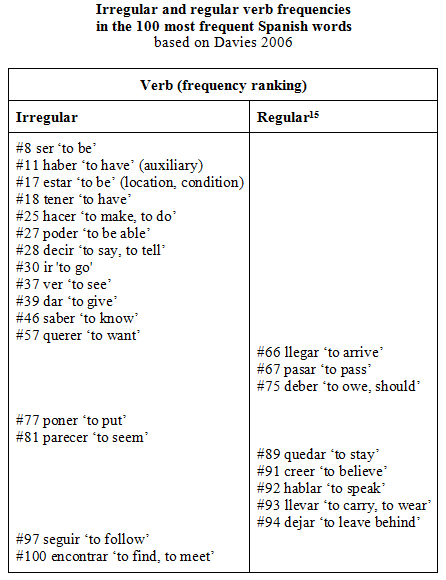
Actual verb frequency data are impressive. The table below shows the regular and irregular verbs among the 100 most frequent Spanish words, as cataloged in Mark Davies’s A Frequency Dictionary of Spanish: Core Vocabulary for Learners. The dozen most frequent verbs are all irregular. The most frequent regular verb (llegar ‘to arrive’) appears more than halfway down the list, and irregulars remain common throughout.

Reg irreg verbs in top 100

I’ve counted llegar and creer as regular verbs, by the way, because their spelling complications (like the u in llegué and the y in creyó) are completely predictable given the rules of Spanish pronunciation and spelling.

Because Spanish splits ‘to be’ into ser and estar, and ‘to have’ into haber and tener, the English versions of these verbs are of higher frequency. According to Mark Davies and Dee Gardner’s A Frequency Dictionary of Contemporary American English: Word Sketches, Collocates and Thematic Lists, ‘to be’ is #2 in English, and ‘to have’ #8. Another comparative goodie concerns subject pronouns. As you might expect, since Spanish usually relies on conjugation alone to say who did something, its subject pronouns are further down the frequency list than are those of English. See the comparison below.

subject pronoun frequency span eng


Overall, it’s surprising how much information one can glean from these lists. Muchas gracias, Prof. Davies.

Another day, another Spanish idiom

Yesterday I came across an interesting article on El País about the founding of the Real Academia Española, one of my favorite institutions. The article relates, with a lamentable lack of detail, how a group of eight Spaniards began meeting in 1713 to create the first Spanish dictionary. Three other colleagues soon joined the project, it received royal sanction the following year, and the rest is (linguistic) history. Missing from the article are the founders’ identities (besides the Marqués de Villena) and backgrounds (more nobility? writers? scholars?). Still, it’s an inspiring tale.

As usual, I read the article with an eye out for unfamiliar vocabulary. All I encountered was a novel (to me) expression: the author compares the RAE’s founding to cuatro gatos [que] se lanzaban al abismo (“four cats who jumped into an abyss”). Lanzarse al abismo was clearly a metaphor for starting a venture into the unknown. Cuatro gatos, on the other hand, seemed purely idiomatic.

Thanks to an appeal to the friendly folks on the wordreference.com Spanish-English vocabulary forum, and a Google search that yielded similar results, I learned that cuatro colloquially refers to a small quantity (in English we’d say “a handful”) and gato can be slang for “person”. (Wordreference.com itself gives a slang interpretation of gato as “person from Madrid”, but the usage seems to be more general.) So the mystery sentence boiled down to “a small group of people started an uncertain venture”.

I love the parallel between this use of gato and the English slang meaning of cat as “a cool person”. The choice of cuatro to stand for “a handful” is also pleasing. As a rule of thumb, I think of three as “a few” and five as “several”; four is right in between. From a literary perspective it was also rather bold to mix literal numbers (8 and 11 founding members) with the metaphorical number 4.

Still, it’s hard to shake off the image of a cat playing a lemming…