Author Archives: jhochberg

¡Andalucía!

Granada Airport (women’s bathroom)

Yesterday I came home from a two-week trip to Andalucía, Spain’s southernmost region, with my consuegra Sue. My previous blog post, written just before our trip, describes our itinerary and includes a map of our route. We went everywhere by train, bus, and foot.

Although this was my fifth trip to Spain, I hadn’t been to Andalucía since my first trip, back in 1980 (!!), when a friend and I visited Córdoba, Sevilla, and Granada after attending a summer-abroad college program in Madrid. I remember loving Córdoba and Granada and getting sick in Sevilla. It was definitely time for a return visit, and Sue was up for a second excursion after our successful tour of northern Spain two years ago.

Andalucía is an ideal destination because it combines natural beauty with layers of human history. There is a lot to see and do, and Sue and I had a wonderful time. In fact, the only downside of our trip was the hordes of other tourists who had had the same bright idea. Sue and I share a low-key approach to tourism, and quickly became allergic to the large groups of camera-wielding tourists who thronged the top attractions. We found the omnipresent selfie sticks to be particularly intrusive, and hope that the Spanish Ministry of Tourism will soon follow the lead of the many public and private sites that have banned the devices.

Here is a city-by-city summary of our trip, with some of my own pictures and lots of links. I hope to follow up this post with others inspired by linguistic observations during the trip.

First stop: Córdoba

Without knowing it, we had scheduled our visit to Córdoba to coincide with the city’s annual Fiesta de los Patios, in which residents enter their beautifully decorated interior patios in a city-wide competition. This timing proved more of a nuisance than a blessing, since it brought more crowds into the city, and we didn’t have the patience (or interest) to queue up in the long lines to view the patios entered in the contest. On the other hand, we were happy to take advantage of the free flamenco performances scheduled around the city during the Fiesta. I’ll never forget a midday performance where we were close enough to see the male dancer sweat, and the female dancer lose the flowers out of her hair as she tossed her head passionately. We learned that flamenco refers more to music than to dance; in fact, a nighttime performance we saw at the Plaza de la Corredera had only singing (with guitar accompaniment) and no dancing.

In Córdoba the main attraction is the grand Mezquita, or mosque, whose forest of red-and-white striped columns is now interrupted by a cathedral. The Mezquita was one of the highlights of my 1980 trip and it was exciting to see it again. It is a popular attraction, so crowd avoidance was a priority. We stayed at a modest hotel right across the street from the Mezquita and made sure to queue up for the 8:30 am opening.

Another major attraction, substantially less crowded, is the Alcázar de los Reyes Cristianos. This fortress/palace features beautiful gardens, but we were most interested in some objects displayed inside: a stunning (and huge) Roman sarcophagus — note that its carved doors are ajar — and a group of mosaics from a Roman McMansion that were only discovered in 1959, when the ground under the nearby Plaza de la Corredera was excavated in order to refurbish the market. What a gorgeous surprise!

I recommend also a stroll along the Guadalquivir river, where you will see outdoor bars, wheels from ancient mills, and feral Siamese cats.

Our favorite place to hang out, though, was the Kurtuba Gastro Bar, where one can relax and enjoy excellent salmorejo (a thick cold tomato soup, quite distinct from gazpacho) and perfect croquetas while admiring the resurrected columns of a Roman temple across the plaza.

Next stop: Sevilla

I was especially looking forward to Sevilla because I’d basically missed it the first time around due to illness. The city did not disappoint. Its two main attractions are the cathedral and the Real Alcázar. We bought tickets ahead of time for the Alcázar and spent hours exploring the gorgeous rooms and gardens. It was a perfect marriage of natural and man-made beauty, and likewise a felicitous combination of Arabic and later styles. The cathedral was impressive, especially Columbus’s tomb, and we enjoyed the hike up the Giralda tower, except for the crowds and selfie sticks.

From an academic perspective, my favorite destination in Sevilla was the Archivo de las Indias, located between the two other sites. This houses Spain’s official records of the colonial period. The ground floor has a permanent exhibition of some of the institution’s treasures, including the original Treaty of Tordesillas, which divided the New World between Spain and Portugal, and the “Capitulación of Santa Fe”, the contract between Christopher Columbus and the Catholic monarchs Ferdinand and Isabella. It was amazing to see these precious documents up close.

We stayed at the lovely Hotel Simón, down the street from the Cathedral, and had our breakfasts and one lunch at La Canasta bakery/café just across the street from the Cathedral. This is a Spanish chain similar to Panera and thus somewhat immune to being touristy. I obviously disagree with the negative reviews you see in that link.

Backtracking to Carmona

Sue and I both wanted to spend a night at a parador — a government-run luxury hotel — and so backtracked slightly on the road to Córdoba to stay at the one in the small town of Carmona, which my Top 10 guide book described as “one of the most impressive of all paradors”. For centuries Carmona’s hilltop setting gave the town a strategic importance, and the parador is located on the top of that hill, cheek-by-jowl with the ruins of the town’s Alcázar. Besides swimming in the inn’s outdoor pool, and sipping sherry at sunset on the terrace while admiring the view, we had a hard-working touristic morning exploring the Roman necropolis, located a ten minutes’ walk from “downtown” Carmona. This was one of the most interesting Roman ruins either of us had ever seen, and was amply signed and interpreted, with a museum housing the relics found in the tombs, including a carved elephant (!).

Here is a picture of Sue emerging from a Roman tomb:

We happened to be at the necropolis when a group of schoolchildren were visiting. They were treated to an educational re-enactment of a gladiator fight, and so were we.

The parador wasn’t expensive (it was cheaper than our digs in Cádiz), and we both thought that if you had a rental car it would be a great jumping-off point for a longer stay, with day trips to Sevilla and Córdoba as well as hikes in the countryside. Not to mention swimming and sherry.

Next stop: Cádiz

From Carmona we took the bus back to Sevilla and then a train to Cádiz, an ancient city with a strategic peninsular location on the Atlantic. Here we rented an apartment and settled in for two nights. During the day we dipped our toes in the ocean at nearby Caleta Beach, saw a really cool camera obscura built into an old tower, and walked all over the city. It’s a small town so you can get to know it fairly well in just a day, although a longer stay would be fun in beach season.

Pit stop: Ronda

The hilltop town of Ronda lies between Cádiz and our final destination of Granada, so we spent a night there at the fabulous little Hotel Ronda (our favorite lodging during the trip). Ronda is famous for its gorge and bridges. We basically spent half a day exploring the east side of the gorge, including the Arab baths and the rose garden, and half a day exploring the west side, hiking down into the gorge. We also had the best food of our trip at Casa Mateos.

Last stop: Granada

Granada’s main attraction is the Alhambra complex, containing the Palacios Nazaríes, the Alcazaba fortress, the Generalife summer palace, and many gardens. Based on my previous  trip to Andalucía we decided to visit the Alhambra twice, and this turned out to be a wise decision as the complex is so large and the crowds are daunting (despite timed tickets for the Palacios Nazaríes). The first day we visited the Palacios, a bit of the gardens, and the Alcazaba, which has fabulous views. We also enjoyed tea on the terrace at the parador, which has great views of the Generalife. The second day we explored the Generalife, where we had an illegal picnic on a bench in the gardens, and spent about an hour at the excellent museum within the Alhambra complex. Here’s a picture of some happy artichokes growing in the Alhambra gardens.

We rented a comfortable and light-filled apartment across the street from the Cathedral — two thumbs up for Casa de la Lonja! We bought food at the nearby Corte Inglés department store’s supermarket (tortilla española, gazpacho in a milk carton, flan, passable paella, excellent wine selection) and at the traditional market near the Cathedral.

Two specific sites I recommend besides the Alhambra are the Monasterio Cartuja, about a half hour walk from the Cathedral, and the Capilla Real adjacent to the Cathedral. The Monasterio features an over-the-top baroque chapel. Given how austere the monks’ lives were in general, entering the chapel must have been a daily shock to the senses. The monastery also features vivid (and sometimes gory) paintings by Juan Sánchez Cotán, a former painter of still lifes (I saw one in the Prado) who joined the order in his 40s, changing his life and his subject matter. The Capilla Real houses the bodies of the Catholic Monarchs (Isabella and Ferdinand) and Isabella’s personal art collection, which included paintings by Botticelli, Van der Weyden, Memling, and other masters. Not too shabby.

As a lover of all things Spanish who happens to be a modestly observant Jew, I usually don’t have any difficulty reconciling these two passions. But when I entered the Capilla Real and saw the tombs of Ferdinand and Isabella, I felt a wave of intense anger over what these leaders had done to my people back in 1492. Religion leads people to do the most awful things.

24 hours in Madrid

Sue and I flew from Granada to Madrid (the photo at the top of this blog is from the bathroom at the Granada airport), and I had a brief stopover in Madrid before flying home the next day. This gave me enough time to visit my favorite paintings at the Prado and the Thyssen-Bornemisza (no time for the Reina Sofía), walk through the Plaza Mayor and the Puerta del Sol, and attend a performance of El burlador de Sevilla, the original Don Juan play, first performed five hundred years ago and still going strong.

On my next trip I want to visit Asturias, and perhaps other northern destinations I’ve never seen, such as Santiago de Compostela, San Sebastián, and Bilbao. And something of the Pyrenees. Yikes!

A non-linguistic tour of Andalucía

[Here is a post I wrote about the trip afterwards.]

Two years ago, my consuegra Sue and I spent two weeks touring northern Spain, following an itinerary inspired by my research on the history of the Spanish language. On Friday we’ll meet up again in Córdoba to launch a two-week follow-up trip of Andalucía (southern Spain). This trip is purely touristic, though of course I’m looking forward to hearing Andalucían Spanish. Also, while in Seville we plan to visit the Archivo de Indias, which houses the records of the Spanish colonial period. It was Peter Boyd-Bowman’s research on these records that proved the Andalusian origin of Latin American Spanish (see Ralph Penny’s A History of the Spanish Language, p. 26).

This map shows our itinerary, looping counter-clockwise from Córdoba through Sevilla (the regions’s capital), the important port city of Cádiz, and the famous hill town of Ronda, ending up in Granada (poorly indicated on this map for some reason), where I’ve pre-purchased tickets to visit the Alhambra. Twice. You can’t see it on the map, but after Sevilla we’ll double back to spend one night in Carmona, a small town on the road to Córdoba (you can just see it to the right of the “A-4” marking east of Sevilla), so we can stay at its beautiful parador.

When I get back from Spain I’ll be hitting the road inside the United States: attending a wedding in Maryland, visiting grandkids in Philadelphia, touring Yosemite, visiting family in Salt Lake City, and grading Spanish AP tests in Cincinnati. I don’t expect to be blogging during these travels, so most likely you’ll hear from me again in late June. Wish us a ¡Buen viaje!

Graphing the takeover of the -ra subjunctive

Regular readers of this blog know that I’m obsessed with the two different versions of the Spanish imperfect subjunctive. This is the verb form that you see in sentences like Quería que Miguel estudiara más ‘I wanted Michael to study more’. This -ra form is more common in general, but it’s equally acceptable to use forms with -se, in this case estudiase. The -ra and –se imperfect subjunctives are both understood around the Spanish-speaking world; their relative frequency varies according to dialect.
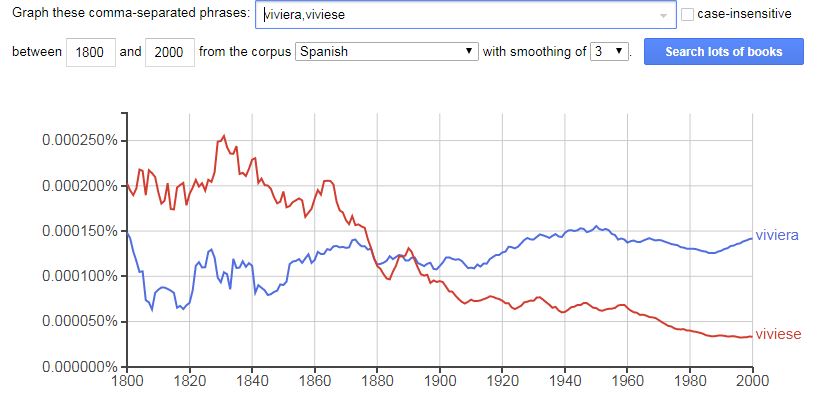
This aspect of Spanish is interesting for two different reasons. First of all, it’s extraordinarily unusual for a language to have such “twin” forms in the heart of their grammar. I haven’t been able to find a single other example after searching the linguistics literature for over five years. Second, neither of these forms is a direct descendant of Latin’s own imperfect subjunctive. Rather, two other existing conjugations were “repurposed” as imperfect subjunctives: the -se version in Old Spanish, and the -ra form more recently, in the time of Cervantes.

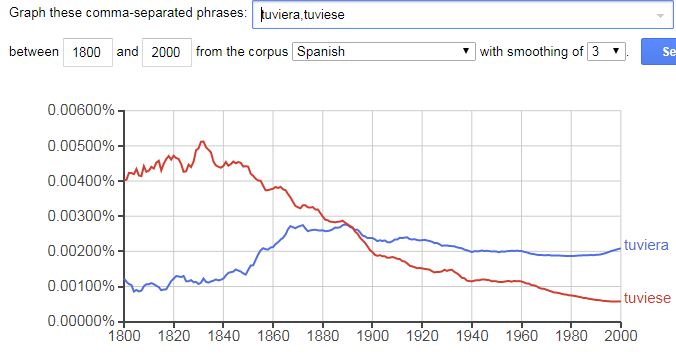
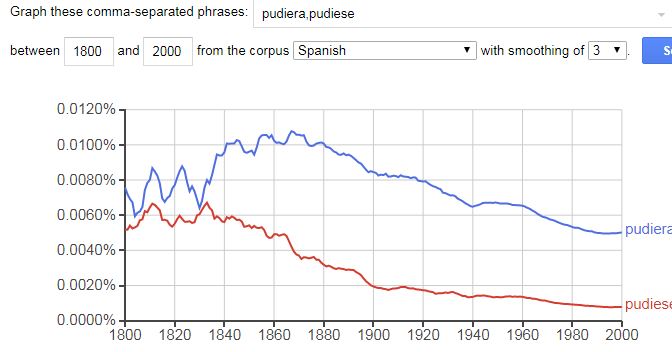
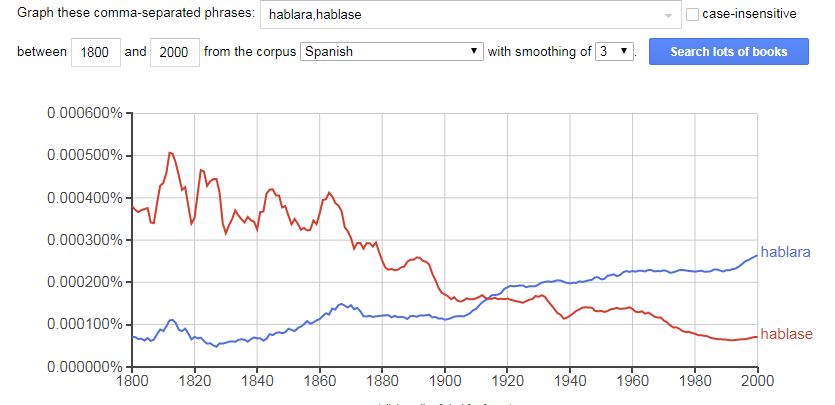
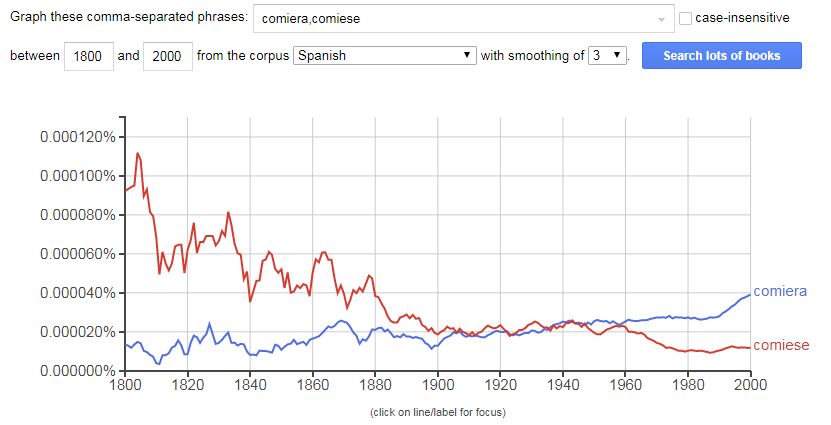
Google Books’ “Ngram Viewer” provides an easy way to see the newer -ra subjunctives overtaking the older -se forms. Google has digitized over 25 million books in English, Spanish, and other languages. Their free “Ngram Viewer” tool analyzes word frequencies in this corpus, making it easy to compare frequencies of two or more words over time.

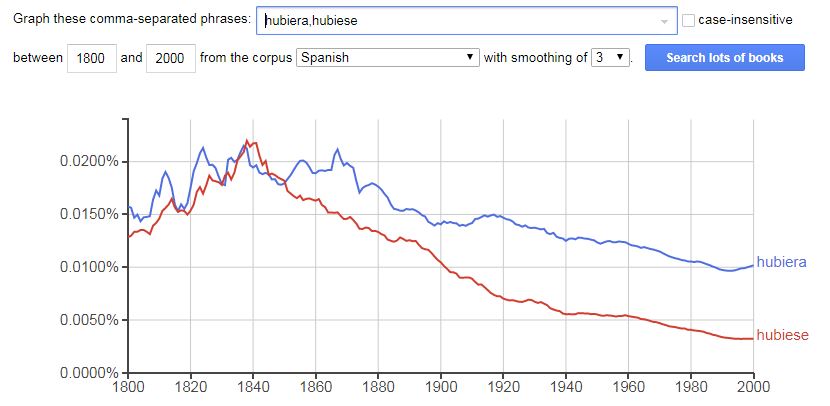
In this post I’ve reproduced six graphs comparing -ra and -se subjunctive frequencies over the last two centuries. The first three graphs (one above, two below) show historical frequencies for the two forms of the imperfect subjunctive for the common irregulars tenerhaber, and poder. The remaining three graphs show frequencies for the three regular verbs often used to illustrate Spanish’s -ar-er, and -ir noun classes: hablarcomer, and vivir. In every case you can see the innovative -ar forms come from behind — or, less often, from parity — to overtake their -se twins. This happened earlier for the irregular verbs than the regulars; I don’t have a theory about why.

Keep in mind that written language is relatively conservative, so it’s safe to assume that -ar actually made its move somewhat earlier than shown in these graphs.


Double consonants in Spanish

[An observant reader pointed out that this post includes double vowels as well as double consonants. I really should have entitled the post “Double letters in Spanish” — but now it is, methinks, too late! I had consonants on the mind because the trigger for this post was coming across the word sabbat.]

If I had a dime for every time I crossed out an extra l from a student’s spelling of inteligente…well, I’d have a lot of dimes. Same for an extra l in mochila (undoubtedly influenced by English words like Godzilla and gorilla), or an extra s in profesora. Add in a few nickel penalties for students who pronounce leer like (King) Lear, and I could treat myself to lots of Starbucks.

These spelling and pronunciation errors are both triggered by a significant difference between Spanish and English spelling: in Spanish, almost every letter is pronounced. (Notable exceptions include the silent h (as in hola) and the u seen in quiquegui, and gue sequences, as in quisoquesoguiso, and guerra.) This means that inteligente and mochila only need one l to represent the spoken /l/ sound, profesora only needs one s, and the two e‘s of leer must be pronounced individually. Double oo‘s exist also, as in cooperación, and again both vowels are pronounced.

This rule also explains why Spanish spelling preserves the double nn in words like perenneconnotar, and innato. According to the Real Academia Española (RAE) these words are pronounced with a long n. While some native speakers I’ve checked with say that they pronounce nn words as if they had a single n, you can certainly hear long pronunciations: for example, here.

My (2010) edition of the RAE’s Ortografía de la lengua española also refers to double bb‘s. I had never heard of this combination until I opened the book to check up on the nn words. Moreover, the RAE’s three examples — subbéticosubbloque, and subboreal (see below) — are so obscure that they aren’t even listed in the RAE dictionary! (This tickles my funny bone.) So I’m not going to lose any sleep over them.

Also in keeping with this rule, Spanish simplifies most double letters in loanwords; the Ortografía gives the examples of driblar (from dribble), chófer (from chauffeur), and zigurat, inter alia.

Most remarkable, therefore, are the double letters that Spanish tolerates in certain loan words. Except as indicated, the following words with double letters (most from this Span¡ishDict comment) are in the RAE dictionary:

  • sabbat ‘Sabbath’
  • affaire
  • sheriff
  • reggae
  • gamma
  • zoo
  • hippie (note adjectival form jipi)
  • dossier
  • gauss
  • motocross
  • topless (spelled with ss in WordReference.com but with single s in the RAE dictionary)
  • vendetta
  • watt
  • jacuzzi
  • jazz
  • mozzarella
  • paparazzi
  • pizza
  • puzzle (spelled with zz in WordReference.com but with single z in the RAE dictionary)

We all know that Spanish spelling is phonetic, but these exceptions make it a little less so.


Just saw this kind review from last year

Tim Guilford, an educational consultant in the UK, published this kind review of ¿Por qué? in a UK teaching blog. It came out last year but I just saw it.

The text is below:

¿Por qué? – 101 Questions about Spanish is a great read. Working around 101 questions and the answers to them, this punchy format really adds to the book’s appeal.

The range of questions is varied and each section is a nice length for a read on a daily commute or to dip into for a few minutes during a break or before bed.

After every little foray into Judy Hochberg’s book, I came away having learnt something new about the language that I have loved and taught for most of my career. (Slightly embarrassingly too, but in the spirit of honesty, I have to admit that each read also gave me a slightly smug feeling of potential academic one-upmanship, should such questions ever crop up in conversation!)

Judy Hochberg’s explanations are clear and you sense her enthusiasm for her subject. And, yes, these are just the sort of questions students of Spanish ask, every day. Here is an appetiser:

Question: ‘Why do Spaniards use the ‘th’ sound?’

Answer: In a nutshell, in the fifteenth century two consonants ‘ts’ and ‘dz’ kind of got married and the off-spring was ‘th’.

There you are, you see, wasn’t that interesting? Well, I thought so.

My personal favourite is how ‘hay’ can mean both ‘there is’ and ‘there are’? (Surely all Spanish verbs need to be singular or plural?) It turns out this all had its roots in a kind of early, medieval, linguistic existentialism, as the poor old Romans lost all ability to speak Latin properly, “innit tho”. Whilst this must have been a tough time for the purists, I’m glad it happened, because Spanish was thus born and books like this could be written.

Highly recommended!

57 words with eñe

I’ve had the wonderful Spanish ñ on my mind lately (see e.g. here), and today decided to make a list of reasonably common Spanish words that use this characteristic letter. This started as a plain list of 57 words. Then I added translations. Then I couldn’t resist going back in time: I knew that the ñ sound had several different origins, but was curious to see how this worked out statistically.

The results are below, in tabular form so you can play with the words yourself if you like. The table is sorted by Type, meaning the type of the word’s origin; within each type, words are listed in alphabetical order. The types themselves are ordered by frequency.

  • The most common origin is therefore the first one you see in the table: a Latin ne or ni. When followed by another vowel, the e or i turned into a y sound, which in turn had a transformative effect on the n.  An example is España, from Latin Hispania. (The y sound had a similar effect on other consonants, not just n, and the resulting changes are referred to as palatalization.)
  • The next most common origin is a Latin double nn; this is the source of the tilde (~) itself. An example is año, from Latin annus. Pleasingly, the suffix -eño has a dual origin, with one derivational path of the ne/ni type (seen in words like isleño) and another of the nn type (seen in pequeño).
  • The third group is a Latin gn or ng sequence as in enseñar from Latin insignare. I knew that some ñ‘s came from gn, but the ng words were a surprise.
  • Next are words borrowed from other languages. Here we find words that begin with an ñ, from languages as disparate as Quechua (chuño), Dutch (ñu), and Italian (tacaño).
  • The mn group could really be collapsed under nn, because these words passed through an nn stage before emerging with an ñ. An example is sueño, from Latin somnus.
  • Some words on the list were internally derived from other Spanish words. For example, caña ‘reed’ gave rise to both cañón and cañada.
  • Finally, one word (rebaño) is of unknown origin — too bad I missed it when writing this recent post — and one (cariño) has a known origin that doesn’t seem likely to produce an ñ.
Word Translation Origin Type
1.           araña spider Lat. aranea ne/ni
2.           baño bathroom Lat. balneum ne/ni
3.           campaña field, campaign Lat. campania ne/ni
4.           compañero companion Lat. compania ne/ni
5.           emponzoñar to poison Lat. potiniare ne/ni
6.           España/español Spain/Spanish Lat. Hispania ne/ni
7.           huraño shy Lat. foraneus ne/ni
8.           isleño islander -eño suffix from Lat. ‑ineus ne/ni
9.           jalapeño type of pepper Jalapa (Mex. prov.) plus -eño ne/ni
10.       migraña migraine Lat. hermicrania ne/ni
11.       montaña mountain Lat. montanea ne/ni
12.       ordeñar to milk Lat. ordiniare ne/ni
13.       piña pinecone, pineapple Lat. pinea ne/ni
14.       saña rage Lat. insania ne/ni
15.       señor, señora, señorita Mr., Mrs., Miss Lat. senior ne/ni
16.       viña vine Lat. vinea ne/ni
17.       añil indigo Ar. an-nil nn
18.       año year Lat. annus nn
19.       caña reed Lat. canna nn
20.       engañar to fool Lat. ingannare nn
21.       guiño wink Lat. cinnus nn
22.       muñeca wrist, doll Lat. bonnicca nn
23.       niño boy Lat. ninnus nn
24.       ñoño dull Lat. nonnu nn
25.       paño cloth Lat. pannus nn
26.       peña rock, crag Lat. pinna nn
27.       pequeño small -èño suffix from Lat. ‑innu nn
28.       enseñar to teach Lat. insignare gn/ng
29.       estaño tin Lat. stagnum gn/ng
30.       heñir to knead Lat. fingere gn/ng
31.       leña firewood Lat. ligna gn/ng
32.       puño fist Lat. pugnus gn/ng
33.       reñir scold Lat. ringi gn/ng
34.       señal signal Lat. signa gn/ng
35.       tamaño size Lat. tam magnus ‘so big!’ gn/ng
36.       teñir to dye Lat. tingere gn/ng
37.       uña nail Lat. ungula gn/ng
38.       bruñir polish Occ. brunir borr
39.       buñuelo fritter Cat. bony borr
40.       champaña champagne Fr. champagne borr
41.       chuño potato starch Quech. ch’uñu borr
42.       gañán farmhand Fr. gaaignant borr
43.       ñandú rhea Guar. ñandú borr
44.       ñoqui gnocchi Ital. gnocchi borr
45.       ñu gnu Dutch gnoe borr
46.       tacaño stingy Ital. taccagno borr
47.       vicuña Quech. uikuña borr
48.       daño harm Lat. damnum mn
49.       doña lady Lat. domina mn
50.       dueño master Lat. dominus mn
51.       otoño autumn Lat. autumnus mn
52.       sueño dream Lat. somnus mn
53.       apañar to fix from paño (below) der
54.       cañada ravine from caña der
55.       cañón cannon, canyon from caña der
56.       cariño affection Lat. carere
57.       rebaño flock unknown

Viggo Mortensen, “el argentino”

I have Arturo Pérez-Reverte’s Capitán Alatriste books on my mind these days because El Ministerio del Tiempo, the Spanish TV show I’m currently enjoying on Netflix, has a running joke about a time-traveler from the 1500s (played by Nacho Fresneda) who resembles Pérez-Reverte’s swashbuckling hero.

The Alatriste doppelganger specifically reminded me of an amusing conversation I had a few years ago with Lorena, a friendly Mexican woman who used to have a coffee kiosk near my train station. I frequently picked up a cup of coffee there and, naturally, would also enjoy a chat in Spanish.

One morning I happened to have the first volume of the Alatriste series with me when I picked up my coffee. I showed it to Lorena and she instantly recognized the handsome man on the cover. “Es el argentino,” she said.

This tickled my funny bone since she was referring to Viggo Mortensen, who played Alatriste in a movie based on the series, and who is actually Danish-American. Mortensen lived in Argentina when he was a young boy, returning with his American mother to the United States at age 11. It’s impressive that he’s held onto his Spanish…and his Argentinian accent.

Coincidentally, my son Aaron just sent me this clip of Viggo Mortensen speaking six languages, including Spanish:

If you look on YouTube you will find similar videos of him speaking other numbers of languages. Wouldn’t it be great if all Americans were multilingual?

Even more coincidentally, I recently rewatched Peter Jackson’s The Lord of the Rings trilogy, starring Mortensen as Aragon. He was perfect for the role — and in a few scenes, speaks Elvish.

Tildes in logos

Lately I’ve been on a mini-quest for tildes in logos. By “tilde”, I mean the curvy mini-N that forms the top part of the distinctive Spanish letter ñ. (Just to be confusing, in Spanish itself, tilde also refers to diacritical marks in general, including those seen in words like café.)

Here are some of my findings, in no particular order:

A weekly Spanish publication distributed with the Friday edition of the newspaper “El Mundo”. Available online at elcultural.com.


A Spanish blog having to do with the language of sports.

The international organization devoted to Spanish education and culture.

A subreddit for educational talk about Spanish-language matters.

This bizarre use of the tilde gets the message across for this Spanish hotel chain.

Even more bizarre is the s+tilde in this logo for Cantabria-based Link Seafood Sources.

I think “CNN en español” hit it out of the park with this one.

I see a tilde here in the curves on the left-hand side of the logo. Do you?


¡El Ministerio del Tiempo has arrived!

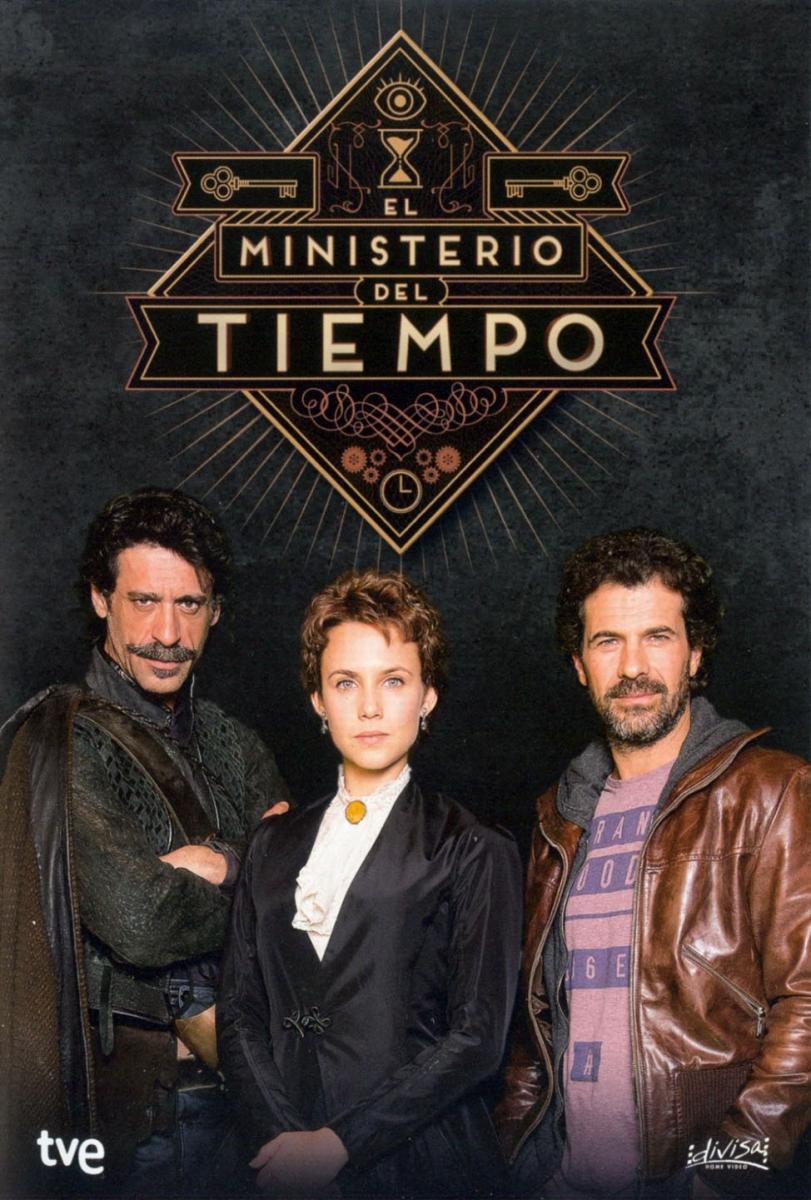
For months I’ve been hearing about El Ministerio del Tiempo, a popular science-fiction TV show from Spain. It has just come out on Netflix in the USA, and I’m in the middle of the first episode. It’s awesome!

Image result for ministerio del tiempo

The show is about a secret Spanish government agency that controls a set of portals to Spain’s past. As best as I understand it so far, their mission is to stop nefarious time travelers from changing history. In the first episode they recruit new agents from the 1500s, 1800s, and the present (shown left to right in the picture). The show features a star turn by Diego Velázquez and multiple shout-outs to Arturo Pérez-Reverte‘s Capitán Alatriste.

As a linguist I am of course enjoying the older Spanish spoken in the 1500s scenes. And so far the plot and characters seem to be lots of fun.

Try it yourself!

An Academia for Ladino!

Regular readers of this blog already know that I’m a big fan of the Spanish language academy system, consisting of the Real Academia Española (RAE) and its 22 sister institutions, and collectively known as the Asociación de Academias de la Lengua Española (ASALE).

I now have a new reason to love the Academia: the institution now expects to add a new sister academy, based in Israel, that is devoted to Ladino. Also known as Judeo-Spanish, or judeoespañol, Ladino is the language of the Jews expelled from Spain in 1492 and their descendants. Once spoken by hundreds of thousands of Jews around the Mediterranean, especially in Turkey, the language is now in danger of extinction. Unlike Yiddish, its German-based counterpart, which is still spoken as a first language by Hasidic communities in Israel and the United States, Ladino lacks fresh native speakers, and its older speakers are dying out.

A language academy for Ladino wouldn’t save the language, but it would help to conserve, study, and honor it.

According to an article in El Cultural, the RAE/ASALE has approved the formation of the Academy and has passed the bureaucratic baton to the State of Israel. Once Israel recognizes the Academy, it can then formally apply for membership in ASALE. It is hoped that this will take place by the next ASALE convention in 2019.

Very exciting!