Author Archives: jhochberg

A linguistic “busman’s holiday” in Argentina

In case you aren’t familiar with the expression, a “busman’s holiday” is a vacation that closely mirrors a tourist’s everyday life. A “busman” (normally one would say “bus driver”) spends a lot of time on the road, so a vacation that involves a fair amount of travel would be more of the same.

Because I’m obsessed with Spanish, my recent trip to Argentina was very much a busman’s holiday. For one thing, during the trip I spoke very little English: only in phone calls home, and with Spanish speakers who wanted to practice their English. My travel buddy Susan and I spoke only Spanish with each other, and I had as many conversations as I could with Argentinians and other Spanish speakers. As a result, my Spanish improved perceptibly during the trip. Immersion works!

My most memorable such conversation took place at the Puerto Iguazú airport, on our way back from seeing the waterfalls. While waiting for our flight I met a Paraguayan civil engineer who was working on a new highway that would bring drivers to the new bridge to Brazil just north of Hito Tres Fronteras (pictured in my previous post). She said something along the lines that “once the bridge and highway are completed, there will be no more traffic.” For a New Yorker raised with the ghost of Robert Moses, the famed builder who never met a stretch of concrete he didn’t like, this was an extreme provocation. One theme of Robert Caro’s classic memoir The Power Builder is that the more roads and bridges Moses built, with the purported aim of decreasing traffic, the worse traffic got. My new friend had never heard of Robert Moses, so this was an exciting conversation for both of us. The Power Broker is now on her English reading list.

Besides the sheer joy of speaking Spanish, the other “busman’s holiday” aspect of my trip was relishing the dialectal features of Argentinian Spanish. As a warmup I devoted some of my free time before the trip to Argentinian fiction. I reread Guillermo Martínez’s La muerte lenta de Luciana B. (2008), which I had found an easy-to-read page-turner years ago. While it was still exciting the second time around, Martínez’s treatment of the title character now struck me as somewhat outdated and sexist. I also read Mariana Enriquez’s truly weird but wonderful novel Nuestra parte de noche (2021), about a sort-of-Satanic cult operating in exactly those parts of Argentina that we were about to visit, namely Buenos Aires and Corrientes province, including Iguazú. During our trip I reread Eduardo Sacheri’s La pregunta de sus ojos (2003), the novel that inspired the 2009 Argentinian movie El secreto de sus ojos and its 2015 English-language adaptation Secret in their eyes. I’ve seen both movies, and the novel is better.

These books reminded me of Argentinian vocabulary like remera for T-shirt and biro (or birome) for a pen. La pregunta de sus ojos in particular featured a near-constant stream of descriptors like boludo ‘imbecile’ and pibe ‘kid.’ Once I arrived in Argentina, local vocabulary was all around me. For example, while texting with our airbnb hostess during my short wait for Susan at the airport I learned to use departamento instead of apartamento and tránsito instead of tráfico.

By the way, these words exemplify a variety of well-known mechanisms of semantic change. Remera is an example of ‘broadening,’ since it originally referred to a shirt worn by a rower (remar means ‘to row’). Biro(me) is an ‘eponym’ that memorializes Ladislao José Biro, the Hungarian-Argentine inventor of the ballpoint pen. Boludo, like English ‘blockhead’, is a metaphorical extension from a shape (bola ’round’) to a personality trait, while pibe was borrowed from Catalan pevet, Portuguese pivete, or Italian pivetto.

As a further “by the way,” Corominas traces the history of pibe from peu (the Catalan word for ‘foot’) to a footed incense holder, to odorous incense, to something with a strong smell, to an infant, to a child. This is as wacky as the evolution of muñeca from ‘milestone’ to either ‘wrist’ or ‘doll,’ yet every step is plausible.

As for as the Argentinian accent, its most salient aspect is probably the lilting intonation that the language has absorbed from Italian (listen at 4:25 here). When I overhear this intonation in the speech of tourists in New York I’m often emboldened me to ask, with a fair rate of success, ¿Son ustedes de Argentina? I didn’t try to adopt this intonation on my trip, but did have fun replacing the usual Spanish glide in words like yo and calle with a harder /dʒ/ or just /ʒ/ consonant, as in ‘Joe’ or ‘pleasure,’ respectively. This is the feature that gave the Argentinian revolutionary Ernesto Guevara the nickname ‘Che.’

My next post will discuss the outstanding feature of Argentinian grammar: voseo.

¡Argentina!

In March I finally went to Argentina. “Finally” because I’ve wanted to go there for ages, partly for the usual touristic reasons — the country’s culture, natural beauty, and cuisine — but also, as you might guess, to enjoy Argentina’s special variety of Spanish. I’ll write about that in my next post.

I went with my friend Susan R., whom I met through this blog. She is a retired Spanish teacher and an experienced traveler. We hadn’t spent much time together before this trip, but turned out to be highly compatible travel buddies.

Here’s a slideshow about the trip.
I uploaded it as a PDF to sidestep some technical difficulties.

Argentina is a huge country! Since this was our first visit, Susan and I decided to limit our trip to Buenos Aires and the famous waterfalls of Iguazú, located at the meeting point of Paraguay, Brazil, and Argentina. In Buenos Aires we did the normal touristic things, like visiting the tomb of Eva Perón. We took a fantastic tango lesson that ended up with a few hours at a milonga, or dance hall, where porteños (residents of Buenos Aires) go to actually dance, not to just watch a show. We ate a lot of meat (“When in Rome…”), drank a lot of wine, and also enjoyed a lot of top-quality gelato, a testimony to Argentina’s animal husbandry and Italian heritage.

Besides our two-night trip to Iguazú, which was of course spectacular, we made two day trips from Buenos Aires, one to the Tigre Delta, where we enjoyed a boat ride and had lunch on an island, and one to the Uruguayan city of Colonia del Sacramento, on the other side of the Río de la Plata. I would recommend the former though not the latter. Colonia is a pleasant city but not special enough to justify the time it took to cross the river and go through customs in both directions.

Argentina has a perennially troubled economy. While we were there inflation was down somewhat, but there was no question that people were still suffering; we read that over half of Argentinians live below the poverty line. As tourists we were insulated from their hardship, and in fact reaped the silver lining of paying bargain prices for restaurants and lodging. At least we were helping out the economy with an infusion of our American dollars.

Speaking of which, a consequence of Argentinian’s economic chaos is that tourists have to think ahead about how to pay for goods and services. When traveling in Europe I normally pay by credit card almost everywhere, and withdraw cash from a local ATM if necessary. Everything we read and were told about traveling in Argentina told us to bring cash with us, because many businesses don’t take credit cards and ATMS give a terrible exchange rate.

In fact we were able to use our credit cards more than we expected. When in need of Argentinian pesos, to get the more favorable dólar azul rate we exchanged our crisp $100 U.S. bills at cuevas (informal money-changing shops) or Western Unions, or with private individuals we trusted. Our airbnb hostess in Buenos Aires vouched for a gentleman named Pedro, who could always be found outside the café across the street. I have to admit that this was something of a thrill.

The other complication of our trip was mosquitos. There had been a lot of rain before we arrived and mosquitos had multiplied alarmingly. We were forewarned to bring our own insect repellent, since little was left to buy in porteño shops. We gave our leftover repellent to friends of Susan’s as a going-away present.

The main surprise of the trip, at least for me, was how much Argentinians love mate. I knew that this herbal tea is popular in Argentina, but had no idea how omnipresent it is. It was common to see people carrying their mate y bombilla sets outside the home, not just while sharing a drink in a park, but when just walking around the city. Many people also carry a thermos of hot water to refresh their mate after drinking all the liquid. We also saw hot water dispensers for mate, like this one, in public places. There’s even an app you can use to find them.

Apparently the mate leaves release more caffeine every time you add water, so the drink becomes more and more addictive.

Language teachers talk about “Culture with a capital C,” like painting and literature, versus “culture with a little c,” meaning the everyday objects and customs that make life different depending on where you live. Mate is a great example of the latter.

Bad Spanish – fixed!

I usually do the New York Times “Connections” puzzle first thing every day. The idea is to divide a grid of sixteen words into four groups of four related words each: for example, four names of sports teams, four words that mean yelling at someone, four words whose first syllable is the name of an insect, and so on. It doesn’t take long and is often clever, because a single word can suggest multiple themes for a group.

The puzzle for May 14, however, featured an egregious instance of bad Spanish. The four groups were as follows:

The problem here, of course, is that the third word in the list of Spanish pronouns (sus) isn’t a pronoun. It’s a possessive adjective, meaning ‘his,’ ‘her,’ ‘your,’ or ‘their,’ depending on context. An example might be No me gustan sus ejemplos ‘I don’t like your examples.’

I immediately complained to the Times via the feedback link on their puzzle page. Apparently many other puzzlers did, too, because the name of the fourth category was soon modified to “Spanish pronouns/possessives”:

This new category name is certainly awkward. (A better solution would have been to swap in an actual pronoun instead of sus.) To be fair, in my book ¿Por qué? I did pretty much the same thing, shoehorning the question “How can su mean ‘it ‘his,’ ‘her,’ ‘their,’ and your’?” into the “Pronouns” section of Chapter Nine, “Names, Nouns, and Pronouns.” I remember thinking at the time that the question didn’t really fit — but I couldn’t come up with a better place.

Anyway, I appreciate the Times‘s listening to us Spanish lovers. As usual, they should check with an educated Spanish speaker — ¿perhaps a Spanish teacher? — first.

Flash sale on “¿Por qué?”

Bloomsbury Academic Press is running a 30% off sale this week, ending Sunday, May 12. So you can buy ¿Por qué? 101 Questions about Spanish for $25.86 (plus tax) instead of the usual $36.95 ($35.68 on Amazon). Delivery within the US is an additional $3.50.

(The first link above will take you to the Bloomsbury purchase page; the second will take you to the book info page on this blog.)

Stock up now — this book will make a great birthday or holiday present for your favorite Spanish teacher(s)!

A Spanish teacher in Italy

I recently returned from a short visit to Italy with my husband. It was our third time there together. We spent one day in Milan, three in Florence, and four in Bologna, including a day trip to Ravenna to see the mosaics. My mother used to tell me about the mosaics, so I had her very much in my thoughts while we were there. It was the best day of the trip.

The first time we went to Italy, I worked through the first 100 or so pages of a standard Italian grammar workbook on the plane ride over. (It’s hard for me to sleep on an airplane, so I decided to use the time productively.) Given my Spanish, my French, and a year of college Latin, I found Italian easy to pick up. I managed to have some respectable conversations with hotel receptionists and restaurant servers. This time, I worked through Language Transfer’s Introduction to Italian course, which I recommend 100%! I also bought a short grammar reference book and an adorable book of short Italian stories for beginners, which I devoured. My favorite story was about a lonely yellow sock with a green stripe whose owner matches him with a lonely green sock with a yellow stripe, and wears them all over the world. This book was a lot of fun.

What struck me most about Italian the second time around was the similarity between its past tense and that of French. Like French, Italian has mostly abandoned the simple past (like I ate) in favor of the periphrastic past (like I have eaten), a transformation that may be underway with Spanish in Spain. Also, both Italian and French use two different auxiliaries (‘to have’ and ‘to be’) to form the periphrastic past tense, and the past participle (like eaten in I have eaten) agrees with the verb’s subject or object in a rule-governed but confusing way.

I also learned that Italian, unlike Spanish or French, does not have a periphrastic future tense. In Spanish and French you can either use the future tense conjugation (e.g. comeré ‘I will eat’) or, as in English, use the verb ‘to go’ as an auxiliary (e.g. Voy a comer ‘I’m going to eat’). Catalan doesn’t have a periphrastic future either, and in fact uses the verb anar ‘to go’ to form a periphrastic past, e.g. va parlar ‘He/she spoke’ — literally, ‘he/she went and spoke’. This tells us that the use of ‘to go’ as a future auxiliary, which Spanish and English speakers take for granted, must not have been uniformly present in Vulgar Latin.

Like other Spanish speakers (I suppose), I found that Spanish occasionally tripped me up when I was trying to speak Italian. For example, in Spanish andar and caminar both mean ‘to walk,’ but in Italian andare means ‘to go.’ As another example, I kept confusing Italian cinque ‘five’ with Spanish quince ‘fifteen’. But overall, Spanish was more of a help than a hindrance.

I did get to speak some Spanish during our trip, for example with a couple from Colombia who were staying at our hotel in Bologna. It was such a pleasure to slip back into my comfort zone! I also took advantage of our presence in the European Union to finally purchase a jigsaw puzzle of Gaudi’s “El Capricho” house in Comillas, Spain that I had been coveting since 2019, thereby saving $35 on postage.

During this visit, my attempts at conversation were less successful than previously, with people I spoke with switching to English. I can think of several possible explanations for this:

  • Perhaps this year’s crash course in Italian wasn’t as successful as previous attempts. I am several years older, after all. But I sincerely believe that my Italian is pretty good, given that I don’t actually speak Italian! I’d rather find an alternative explanation. So…
  • Since we were staying at more luxurious hotels this time around, perhaps their staff are proudly bilingual, and trained to reply to clients in their own language.
  • It’s also possible that given the current influx in American tourists in Italy, Italian hospitality workers in general are primed to speak English

At any rate, now that I’m home Italian is going on the back burner — until the next viaggio.

Bad Spanish — Guilty conscience 2nd edition

Last year I posted about bad Spanish in a storefront advertisement for a public health program in New York City. I called that post a “guilty conscience edition” because I felt bad criticizing the program. But I think it’s important to call out bad Spanish wherever it appears.

On Monday I had occasion to visit one of the city’s great medical establishments, formerly known as Columbia Presbyterian Hospital, but now as NewYork-Presbyterian/Columbia University Irving Medical Center. In the Milstein Building, where I went for breakfast, I spotted two problematic signs. They are shown below “as is” and digitally revised.

Bad Spanish at the Milstein Hospital Building

My suggested revision

The first sign is inside the lobby, on the way out. My suggested revision resolves the current disagreement between plural pases and singular usado in favor of the singular (in line with singular entregue), and restores the very necessary accent mark on aquí. (Accent marks are required on both lower- and upper-case letters.) I also followed the English version in using possessive su instead of the definite article el or los.

The second sign is on the outside wall of the building, near the front exit. It’s a doozy! My revision eliminates the unnecessary and un-Spanish capital letters on pacientes, empleados, and visitantes. More importantly, it removes the offensive apostrophe in visitantes. Like English, Spanish doesn’t form plurals with ’s. In fact, apostrophes are only used in written Spanish to represent colloquial shortenings like pa’ for para.

I’m grateful to Columbia Presbyterian for seeking to accommodate their Spanish-speaking staff and visitors, but wish they had consulted with a trained Spanish speaker/speller before having these signs made.

Septiembre, octubre, noviembre, diciembre

If you are reading this blog you must be interested in languages, so you may already be familiar with the etymology of the last four months of the year in Spanish, English, and many other languages. They come from the Latin words for seven, eight, nine, and ten, and were thus named because the Roman calendar began in March, making September the seventh month and so on.

Despite being fascinated by languages since I was a girl, speaking at least three languages that use these words, and knowing the relevant numerical prefixes, I somehow never made the connection between the numbers and the months until recently, when I started to study Italian in preparation for an upcoming trip. I had made some progress in Italian before but have now zoomed ahead using Language Transfer, a method developed by linguist and humanitarian Mihalis Eleftheriou. In his free courses, Mr. Eleftheriou likes to draw connections between the target language and English (and sometimes other languages), and in the process points out interesting etymologies such as these.

I recommend Language Transfer’s “Complete Spanish” as a first course in Spanish (or a refresher) to anyone who reads this blog. And if Mr. Eleftheriou comes across this blog post, I encourage him to contact me. I would be delighted to send him a copy of my first book (¿Por qué?) in thanks for his help with Italian.

For the sake of completeness, the etymology of the remaining months of the year is as follows:

eneroJanus, Roman god of beginnings and gates
febreroLatin februa ‘purification’. Since February was the last month of the Roman calendar, the Romans held a feast of purification on the ides of the month (February 15).
marzoMars, god of war
abrilunknown / disputed
mayoMaia, earth goddess and wife of Vulcan
junioJuno, goddess of marriage and wife of Jupiter
julioJulius Caesar
agostoAugustus Caesar

¡Another Hispania review!

I am honored that Hispania, the official journal of the American Association of Teachers of Spanish and Portuguese, has now reviewed both of my books. To be honest, the second review, of my book Bringing Linguistics into the Spanish Language Classroom, actually appeared more than a year ago. This shows how lackadaisical I’ve become about keeping this blog up to date…but better late than never, ¿no?

As with ¿Por qué?, this new review is positive. Some excerpts:

  • “The book is full of eye-opening details, backed up by references, that even experienced linguists may not be fully aware of. Readers may even find themselves going through the contents as when reading a book from cover to cover, while consulting the slides as they read along. Reading this book is an enjoyable experience.”
  • “The frequent comparisons between Spanish and other languages are particularly enlightening, and contribute to a better understanding of the topics.”
  • Bringing Linguistics into the Spanish Language Classroom is a treasure trove of ideas, facts and activities, and is enthusiastically recommended.”

You can access the review here. It starts on the second page of the PDF.

Teaching preterite and imperfect (again)

This semester I have been in the odd situation (for a Spanish teacher) of teaching the crucial topic of preterite vs. imperfect (e.g. hablé vs. hablaba) after a multi-year gap. For the last few years I have only been teaching our introductory course, but for this semester I requested an higher-level class, which begins with a review of the past tense before launching into the subjunctive. So here I am.

During this hiatus, Routledge published my second book, Bringing Linguistics into the Spanish Language Classroom: A Teacher’s Guide. This book obviously focuses on pedagogy, and comes with hundreds of PowerPoint slides that teachers can use in their classrooms. You can actually download these slides from the Routledge website without purchasing the book (click on “support materials”), but of course I recommend buying the book as well!

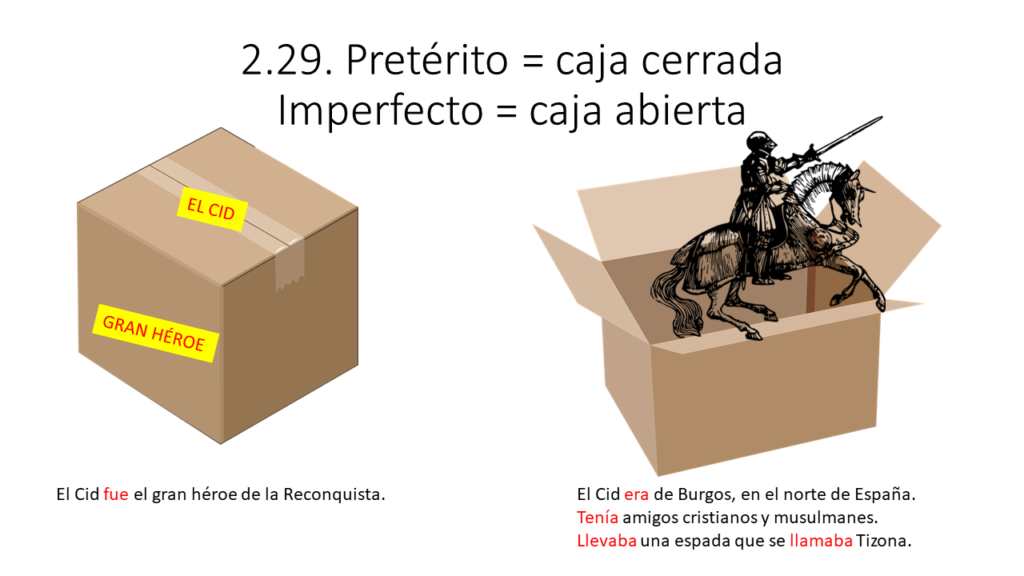
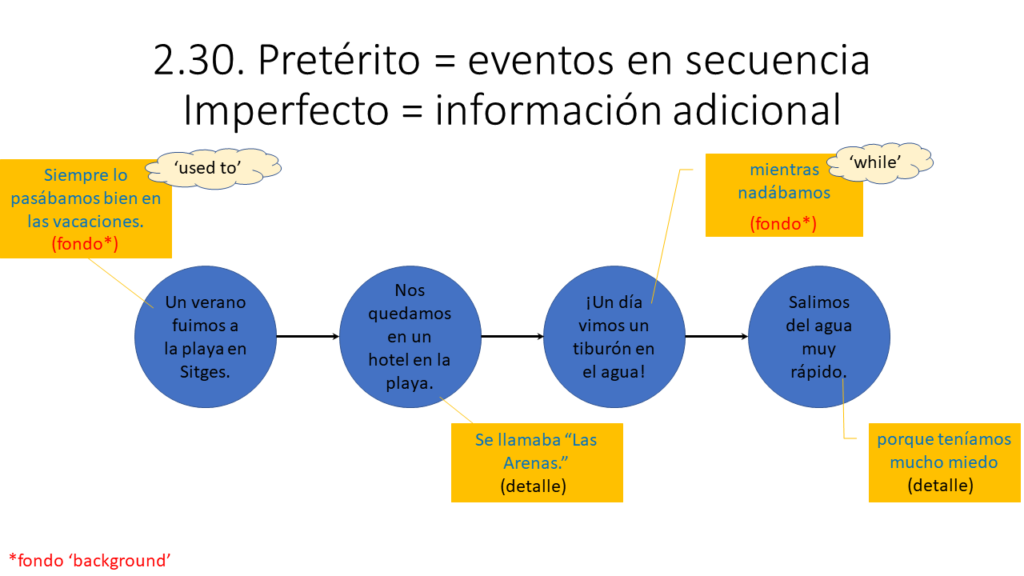
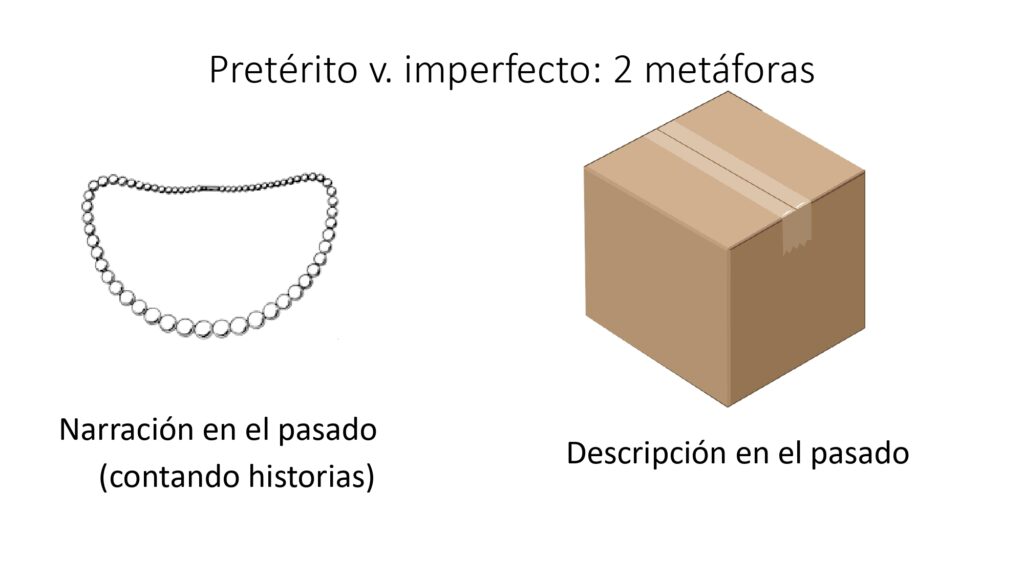
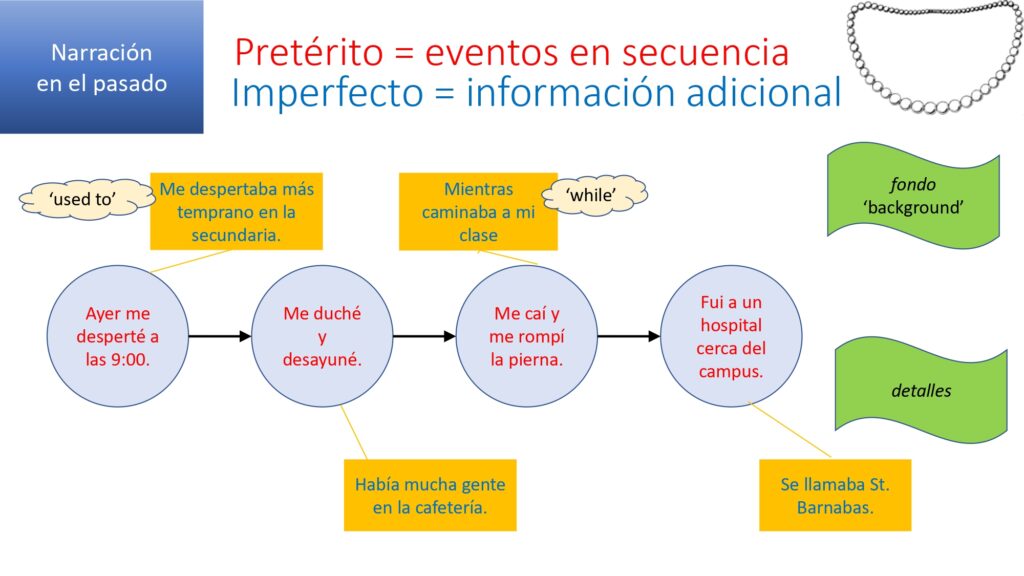
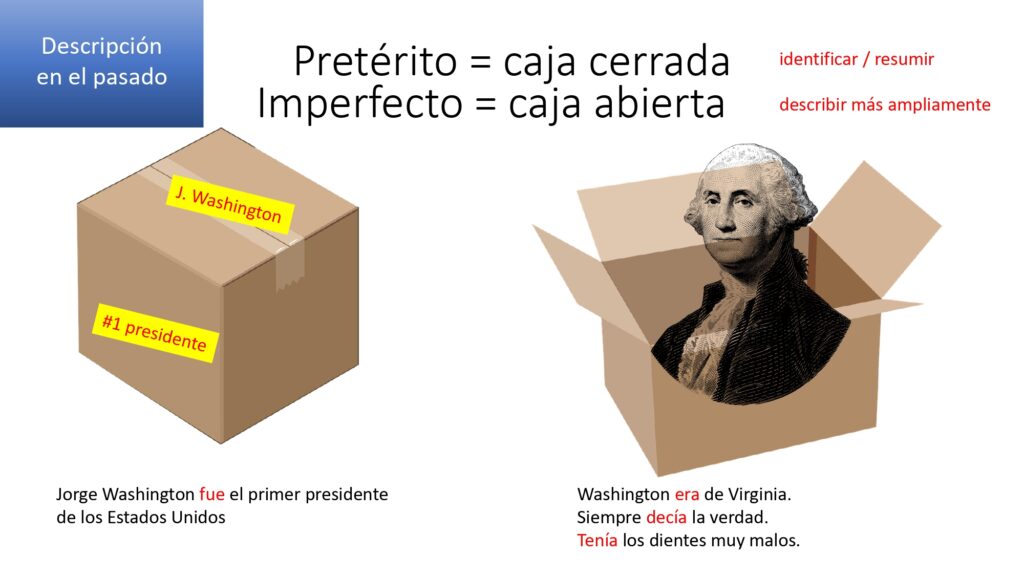
The book’s section on preterite and imperfect introduces two metaphors: beads on a string, and a closed versus open box. Here’s the relevant text from the book, followed by slides that illustrate the metaphors:

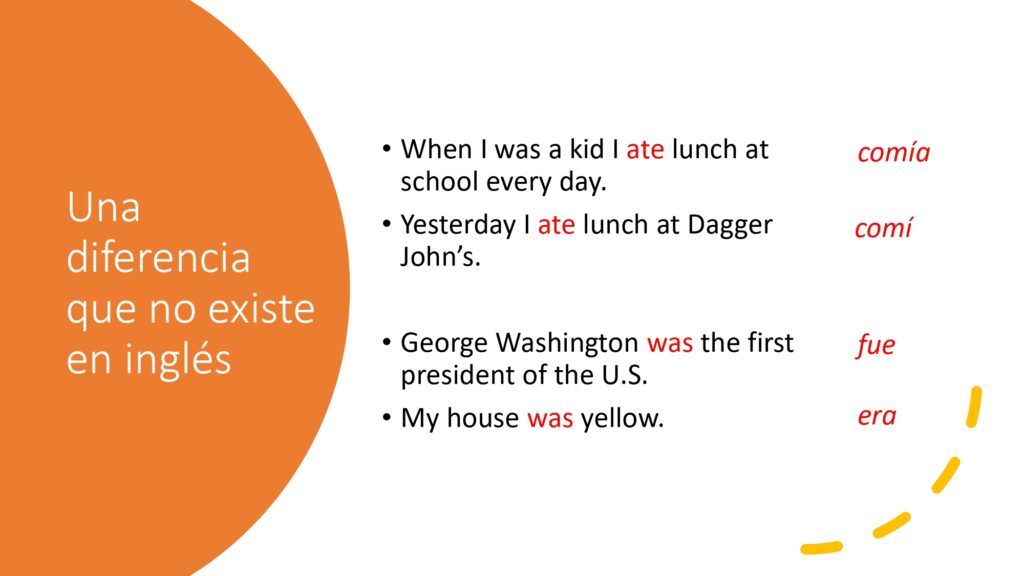
The distinction between completed and continuing events is simple in the abstract but elusive in practice. For this reason many teachers train their students to rely on various rules of thumb when deciding between preterite and imperfect. Some of these rules concern the type of past occurrence; for example, students may learn to use the preterite to describe beginnings and endings (e.g. empezó and terminó) and the imperfect to describe the weather (e.g. llovía). Other rules focus on contextual clues, such as specific timeframes for the preterite (e.g. todo el día) and mientras for the imperfect. While helpful, the former rules are fallible (e.g. El orador empezaba a hablar cuando el micrófono falló; Ayer llovió durante tres horas) and the latter are often absent in actual speech or writing. Sooner or later students have to grapple with the aspectual difference itself.

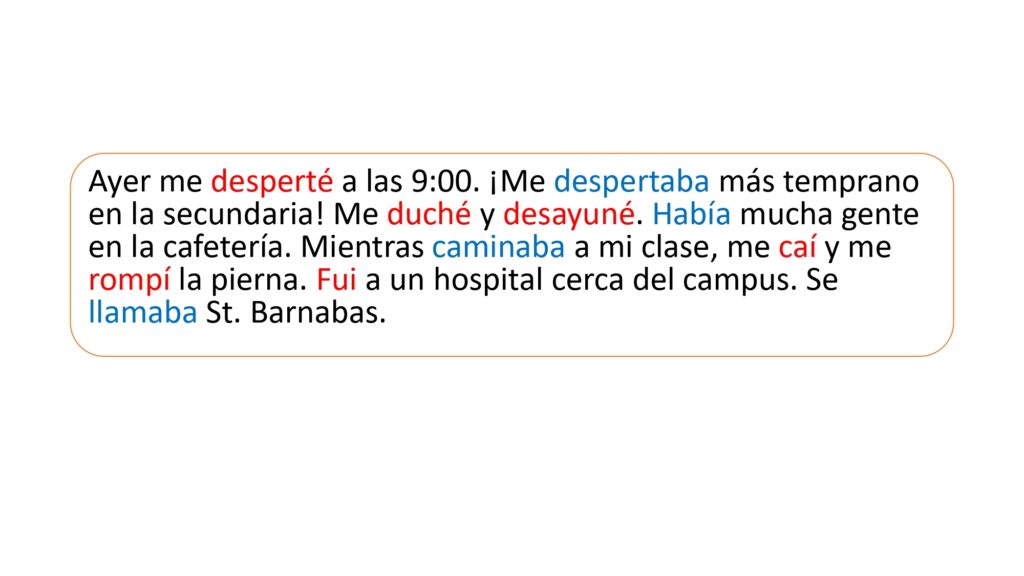
The visual metaphors in Slides 2.29 and 2.30 can help. Slide 2.29 depicts the preterite as a closed box containing a past occurrence (in this case the life of El Cid), and the imperfect as an open box that “unpacks” the occurrence, telling us more about it. This metaphor is particularly helpful when deciding between fue and era. Slide 2.30 depicts multiple preterite events as discrete and sequenceable, like beads on a string. This metaphor is particularly useful when teaching students to construct narratives. The animation in [the PowerPoint version of] Slide 2.30 shows how one can use the imperfect to add color to a bares-bones preterite narrative, an exercise described later in this section. Students may be interested in learning that children usually acquire the two tenses in this same order, i.e. preterite before imperfect (Slide 5.19).

In our first class meeting of the semester, I embedded the slides from my book into a mini-lesson in which I:

  1. elicited some preterites during a class-opening chat;
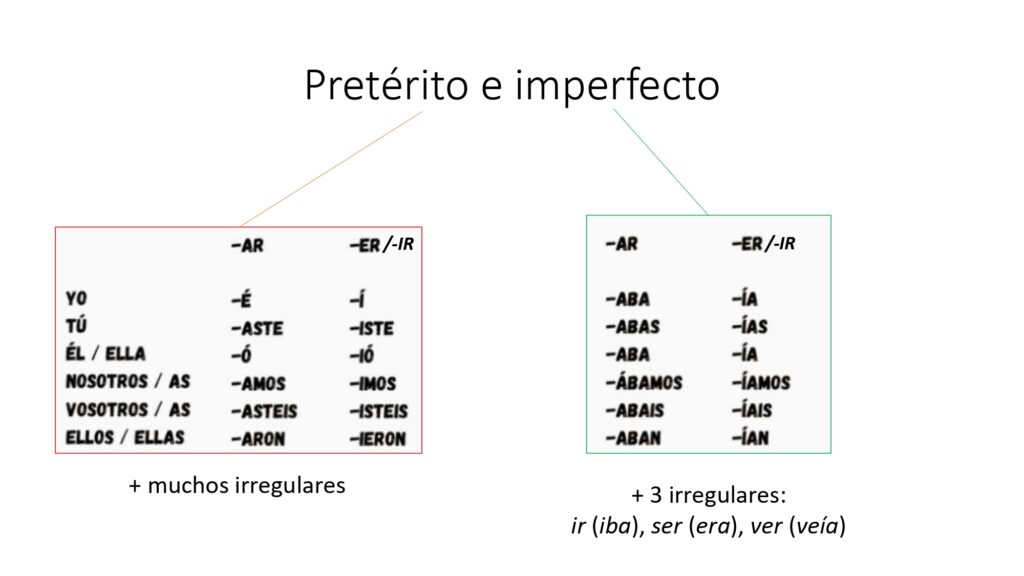
  2. briefly reviewed the two conjugations;
  3. contrasted Spanish with English to explain the challenge of this topic;
  4. presented the two metaphors at a high level;
  5. walked through the “beads in a string” (un collar de perlas) animation in an updated version of my book’s slide 2.30;
  6. showed the result: a natural switching back-and-forth between the two tenses;
  7. presented the open vs. closed box metaphor (again, with an updated version of the published slide);
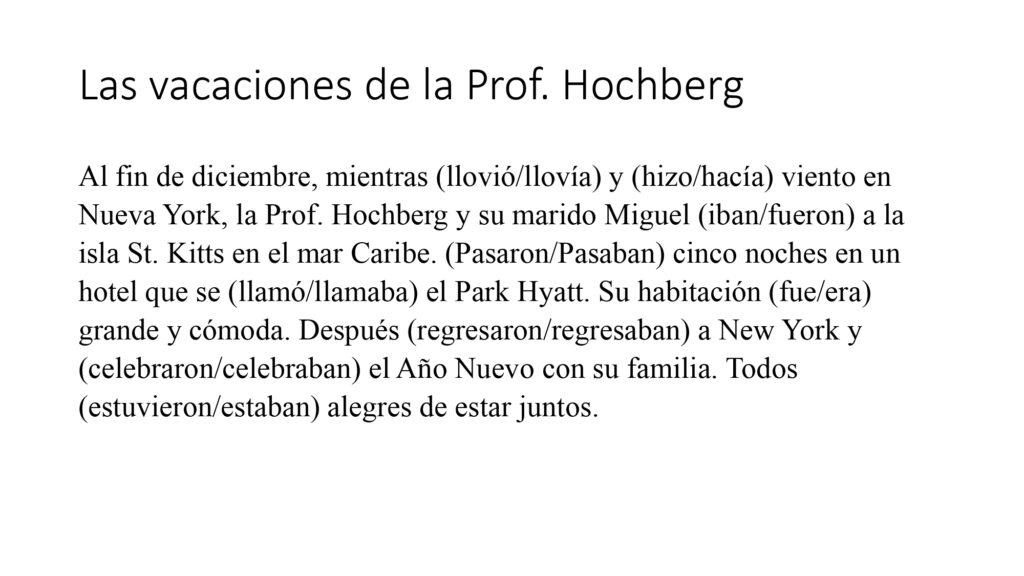
  8. had students choose between preterite and imperfect in a simple passage.

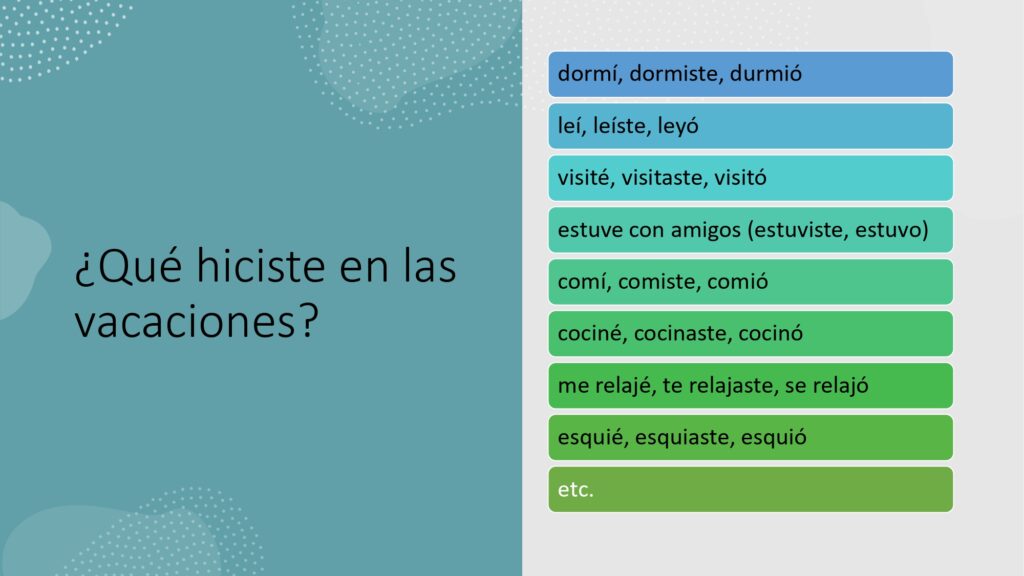
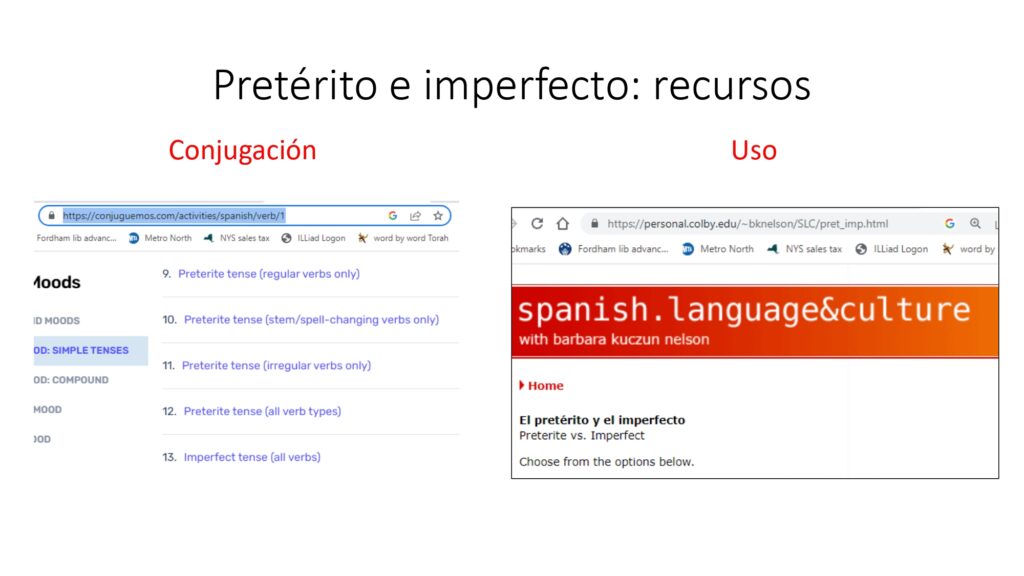
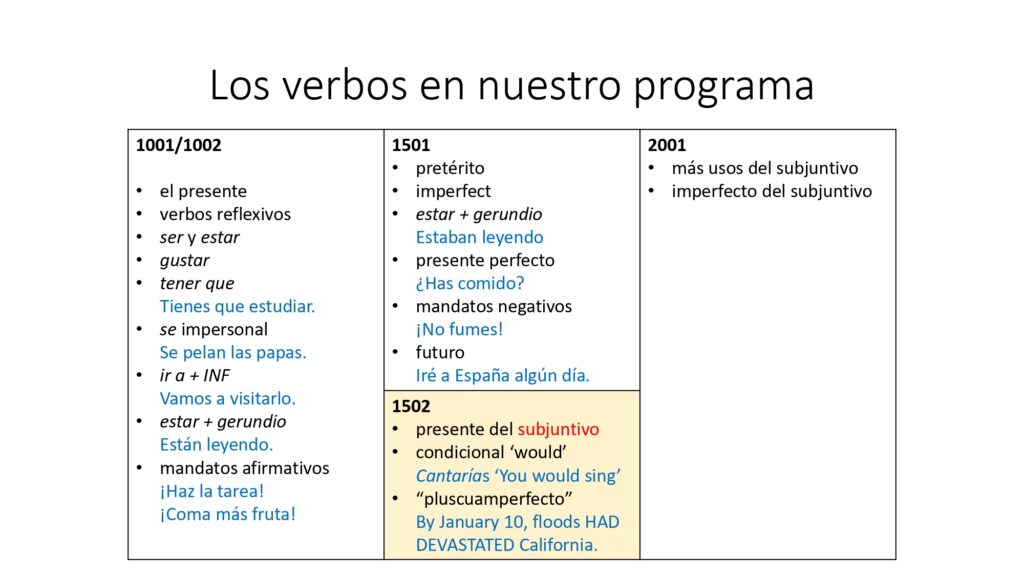
I also presented some favorite resources for students to pursue on their own, including my own divide-and-conquer, one-page summary of the preterite conjugation. A final slide showed them where we were, verb-wise, in our Spanish language sequence.

In the next class, I reviewed the use of preterite and imperfect via a group effort to tell the Cinderella story, then had pairs of students write short and simple narratives of their own, giving them a choice of well-known stories from Noah’s Ark to Avatar. Each pair received three pink index cards on which to write three key events on the preterite, and then white index cards, as needed, for them to add background information and details in the imperfect.

I had never had the chance to classroom-test these specific slides from my book, so it was exciting to finally put them into practice, especially since my students were receptive to the two metaphors. They did a decent job with their narratives; I’ll see how what they learned holds up as the semester rolls on.

Something borrowed, something blue

For the last few years I’ve had a research project about Spanish word origins on the back burner. This summer I’ve resurrected the project, and it is simmering nicely: I have now finished the first major stage.

The focus of the project is Spanish borrowings, or loanwords: words in Spanish that originated in other languages. The project applies to Spanish the methodology from Martin Haspelmath and Uri Tadmor’s World Loanword Database (WOLD) project. Beginning in 2004, Haspelmath and Tadmor organized a team of linguists to collect data on loanwords in forty-one languages around the world. In 2009 they published their results in a book, Loanwords in the World’s Languages: A Comparative Handbook (De Gruyter), and the contributing linguists shared their data on the WOLD website.

My goals in this project are:

  1. To compare Spanish to the forty-one languages in the WOLD project, in terms of (i) its percentage of loanwords, and (ii) these words’ characteristics, such as their part of speech.
  2. To quantify the relative contributions of different source languages to Spanish vocabulary. I already did this for my first book, using a random sampling of five hundred words from a standard Spanish etymological dictionary. But that sample may have skewed toward more recherché vocabulary.
  3. To address various issues involved in etymological research, in Spanish and in general.

More about the WOLD project

In order to obtain comparable results across the WOLD languages, all participating linguists started with the same list of 1460 core meanings: ‘house,’ ‘mother,’ ‘go,’ and so on. Each linguist identified ‘their’ language’s words for these meanings, then traced the origins of those words using a standardized set of guidelines. I have now completed the first of these two steps for Spanish. It raised all sorts of interesting issues, which I will discuss in my next blog post.

One goal of the WOLD project was to compare the frequency of borrowing in different languages. In other words, of the core meanings, how many were expressed in each language by loanwords? As shown in the table below, borrowing rates ranged from 1.2% for Mandarin Chinese to 62.7% for Selice Romani. Yaron Matras’s review of the WOLD Handbook in the journal Language points out that these two languages are spoken in diametrically different environments. Speakers of Mandarin “show little or no bilingualism”; the language has “a status as a majority language, a powerful standard, and a sociopolitically dominant population.” In contrast, Selice Romani is associated with “universal multilingualism, a minority language status, the absence of a written standard, and sociopolitical marginalization.”

Romanian, the only Romance language in the project, fell into the “high borrowers” category (25.9% to 45.6%), as did English. My previous research (see above) placed Spanish in the “very high borrowers” category, with roughly one-third “native” vocabulary (from Vulgar Latin), one-third later borrowings from Latin, and one-third words from other languages. It will be interested to see whether this holds up for a WOLD-based lexicon.

Borrowing typeLanguages (in increasing order of % loanwords)
“Low borrowers”
(1.2 – 9.7%)
Mandarin Chinese, Old High German, Manange, Ket
“Average borrowers”
(10.7 – 22.4%)
Otomi, Seychelles Creole, Gawwada, Hug, Oroqen, Hawaiian, Kali’na, Iraqw, Q’eqchi’, Wichí, Zinacantán Tzotzil, Malagasy, Dutch, Kanuri, White Hmong, Mapudungun, Hausa, Lower Sorbian
“High borrowers”
(25.9 – 45.6%)
Takia, Thai, Yaqui, Swahili, Vietnamese, Sakha, Archi, Imbabura Quechua, Kildin Saami, Bezhta, Indonesian, Japanese, Ceq Wong, Sarmaccan, English, Romanian, Gurindji
“Very high borrowers”
(51.7 – 62.7%)
Tarifyt Berber, Selice Romani

Another goal of the WOLD project was to learn more about borrowing in general. The research confirmed several generally accepted principles about borrowings:

  • Function words were borrowed less than content words (nouns, verbs, adjectives, and adverbs). Overall, 12% of function words were borrowed, compared to 25% of content words.
  • Nouns were more likely to be borrowed (31%) than other types of content words (14-15%).
  • Borrowing was most common for cultural vocabulary, such as religion, clothing, housing, law, social and political relations, agriculture, food, and warfare; and least common for personal vocabulary, such as sense perception, spatial relations, body parts, and kinship.

Motivation

My interest in the WOLD methodology dates from 2018, when I was starting to work on my second book, Bringing Linguistics into the Spanish Language Classroom. The book is organized around five themes, or “essential questions,” including “How is Spanish different from other languages?” and “How is Spanish similar to other languages?” I thought it would be interesting to compare Spanish to the WOLD languages so that I could say either “Spanish has borrowed more words than most other languages” or “Spanish has borrowed a typical amount of words.” (I was confident that Spanish would be a “low borrower.”)

I originally imagined that I could research this topic in a couple of weeks, but soon ran into methodological issues such as:

  • Should word pairs like hijo and hija (‘son/daughter’) be counted as two separate words, even though they are just masculine and feminine forms of the same word?
  • WOLD linguists could identify multiple words for a single meaning. How far should this be taken for Spanish? How does one draw the line between synonyms and dialectal variants?
  • When looking up word origins, the WOLD guidelines count a word as borrowed if it entered the language at any point in the language’s history. This would include, for instance, words borrowed into Classical or Vulgar Latin, such as gato ‘cat.’ (Vulgar Latin cattus is believed to be Afro-Asiatic in origin, and replaced the original Latin feles.) This guideline rubbed me the wrong way. Shouldn’t Spanish begin with Vulgar Latin?

After three months of a futile quick-and-dirty run at these issues, I decided to put the project on my back burner and eventually do a more thorough job that would hopefully yield publishable results. So…here we are.