¡Yamnaya!

After taking some weeks off for summertime fun with my family I am now back to research for my third book. I’ve continued to work my way through David Crystal’s The Story of English in 100 Words — still inspirational and intimidating. But I’ve also taken a detour to devour Laura Spinney’s book Proto: How One Ancient Language Went Global, about the pre-history of the Indo-European languages. I will definitely want to touch on this topic in my book, since it’s part of the history of Spanish.

For those of you who may be unaware, the Indo-European language family includes thousands of languages spoken today: Romance languages like Spanish, Germanic languages like English, Slavic languages like Russian, Baltic languages like Lithuanian, and Celtic languages like Welsh; Greek, Albanian, and Armenian; Hindi and other languages of northern India; and languages of Central and Western Asia including Pashtun (Afghanistan) and Persian (Iran). It also includes languages that are no longer spoken and (unlike Latin) have no spoken descendents. These include Oscan and Umbrian ( “Italic” languages related to Latin), languages of ancient Turkey including Hittite and Phyrgian (“Anatolian” languages), and Tocharian A and B, once spoken in the Tarim Basin of northwestern China.

I learned about the Indo-European language family as an undergraduate and graduate linguistics student. However, my knowledge of the family’s origins was vague: I knew only that it arose somewhere north of the Black Sea. (Or was it the Caspian Sea???) Although I was aware that in the years — decades, really 😉 — since I completed my PhD, there had been substantial new research on this topic, I hadn’t followed the field.

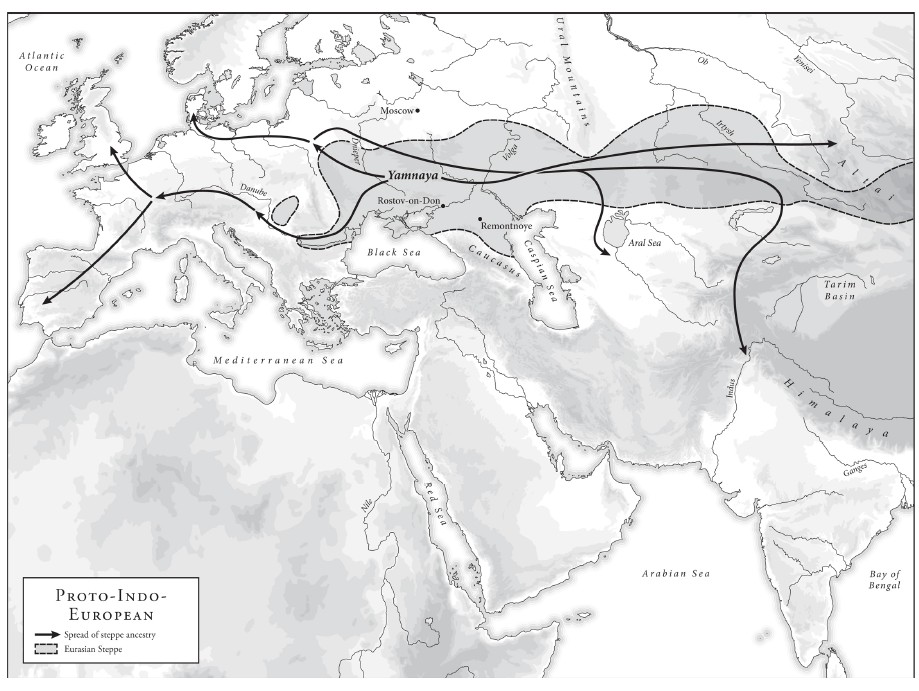
Proto has brought me up to date — and can I say “Wow?” Spinney’s book combines recent research from linguistics, archaeology, and genetics (DNA analysis) to illuminate what is known today about the origin of the Indo-European languages. Essentially, Proto-Indo-European — the common ancestor of the language family — spread east and west through the Eurasian steppe (grasslands), conveyed by cattle herders equipped with horses and wagons. The steppe was a natural environment in which such people could thrive and spread. Researchers call these steppe herders the Yamnaya, which means ‘pit grave’ in Russian, because of their burial practices.

The illustration below, from pp. 60-61 of Spinney’s book, shows the progression of Indo-European (black arrows) through the steppe (shaded area) and beyond. My vague memory wasn’t that far off, since the arrows show a specific point of origin in the steppe north of the Black Sea.
Genetic analysis of DNA from Yamnaya remains suggests an exciting possibility:

“The earliest Yamnaya males … carried a very narrow cluster of Y chromosomes. Later on, after the population had grown, other Y chromosomes entered the mix, but the first of their kind may have been closely related to each other on their father’s side. One way to interpret the evidence is to think of the Yamnaya as a single clan or brotherhood who distinguished themselves by their burial rite. They may have left a larger group, or been expelled from it, and having moved out of their ancestral valley became increasingly nomadic unril they vanished into the grasslands for good. If that is who they were it prompts an extraordinary reflection: fewer than a hundred people may have spoken the dialect that gave rise to all extant Indo-European languages.” (p. 69)

While Proto doesn’t have anything to say about Spanish specifically, it does include interesting speculation about the connection among Italic, Germanic, and Celtic languages:

Germanic, Celtic and Italic are related by common descent. This is evident from their grammar, their pronunciation and their core vocabulary (English – – father mother brother; Old Irish athir máthir bráthir ; Latin pater mter frter). But the relationships between them aren’t equal. Celtic and Italic are generally considered to be closer to each other than either is to Germanic, like twins with a third sibling.…Some linguists suspect that Italic and Celtic arose as a single, possibly short-lived language, Italo-Celtic, while Germanic arose separately.

As I had hoped, Proto provided me with the information I need to write about Indo-European origins. On other counts, as a linguist I especially enjoyed learning about Anatolian and Tocharian, two branches of the Indo-European family that had always flown under my cognitive radar. I think that many people interested in languages or history would find the book to be an informative and accessible read. It provides a dizzying overview of the early history of humanity around the Black Sea: a region that, like the Fertile Crescent, would be a springboard for widespread advances in civilization for millenia to come. I recommend it highly.

Recent gleanings from David Crystal

As a first step in research for my new book I have continued to work my way through David Crystal’s inspirational The Story of English in 100 Words. I hit the 25-word mark yesterday, and thought this would be a good time to blog about what I’ve learned since my previous post, which covered Crystal’s Introduction and his first few words.

To begin with, I’ve learned lots of fun facts about my own language! Here are a few:

  • The word out serves as a verb, adverb, exclamation, preposition, adjective, and noun. Wow!
  • The word street was one of the first borrowings into English from Latin. It was applied to the paved, straight roads that the Romans built, while the earlier Anglo-Saxon word weg (now ‘way’) was relegated to older paths.
  • The groom of bridegroom was originally guma, a somewhat poetic Old English word for ‘man’. Speakers substituted the similar-sounding groom when guma dropped out of normal usage. Groom originally meant ‘boy’ but had acquired its current equestrian meaning by the time of this substitution.
  • The only cookery words that come from Old English, not French, are grind and dough. Who knew?
  • Many legal expressions like goods and chattels, fit and proper, and will and testament, originally combined Germanic and Latin words so that they would be widely understood.
  • The game of Monopoly caused American jail (apparently descended from Parisian French) to overtake the (apparently Norman) gaol outside of the U.S.
  • Middle English didn’t have separate words for ‘spring’ and ‘summer’, but merged them both into sumer, as in the famous English round (song) Sumer is icumen in, Lhude sing cuccu.
  • We think of wee as Scottish, but it originated in Northern England, not over the border in Scotland.

—————–

As I’d hoped, Crystal’s book is giving me interesting ideas for my own book about Spanish, or at least questions:

  • Does Spanish have phrases with deliberately bilingual origins, like goods and chattels in English?
  • What word can I discuss that is only found in legal Spanish? (Maybe the future subjunctive…)
  • Crystal includes the title dame. What Spanish title should I discuss?
  • I should definitely include some Spanish word pairs that consist of a newer word and an earlier one from a different source (as in street and way). Some possibilities are abarca/sandalia, simiente/semilla, vianda/comida, and/or hostal/hotel. Of course, sometimes a new borrowing completely overwrites an earlier word, for example French té, which ousted Portuguese cha (itself borrowed from Mandarin).
  • Apparently pork meant ‘penis’ in American slang of the 1930s. Are any Spanish slang words for body parts worth discussing?
  • Speaking of slang words for body parts, Crystal points out that cunt is taboo enough to sometimes be referred to as “the c-word”, which can also mean ‘cancer’. English also has the “f-word” and the “n-word”. Does Spanish have any such words that, like Voldemort, must not be named? I will include some taboo words in any case.
  • The lack of separate words for ‘spring’ and ‘summer’ in early English reminds me of the lack of modern Spanish words for ‘evening’ and ‘night’. Were there earlier Spanish uber-terms that eventually split into two words? (And what can I call them instead of “uber-terms”, which I just invented? Portmanteau means something else, doesn’t it?) Did this happen, in recorded history, with color terms, which tend to proliferate as languages evolve? (See e.g. Guy Deutcher’s Through the Language Glass, one of my favorite linguistics books written for a general audience.)
  • English slang frequently uses negative words as positives, e.g. wicked, mad, insane, crazy, and of course bad. Is there anything like this in Spanish?
  • Crystal’s discussion of phrasal verbs like take out and take away, which are distinctively English (perhaps Germanic, more generally?) reminded me that I should definitely discuss pronominal verbs (reflexive and otherwise), which are distinctively Spanish.
  • Crystal says out that the word count, as opposed to countess, was initially avoided because its earlier pronunciation was similar to that of cunt. This reminded me of Tom Lathrop’s assertion that the verb jugar, originally jogar, ‘evolved’ its u to make the verb sound less like joder. Is this assertion taken seriously? Are there other examples of this avoidance process in the history of Spanish?

Unrelated to Crystal’s book, I’ve also made notes to myself to include

  • Words that illustrate spelling changes, like saqué or empecemos. Maybe the best way to do this is with a word like cero or cebra.
  • Diminutives, aggrandatives, and so on. Spanish has a wealth of derivational suffixes! Likewise I should include interesting prefixes such as re- prefix, which can be an intensifier (rebueno) or a repeater (rehacer).
  • The full range of parts of speech.
  • Words from a broad range of semantic categories such as the 24 used in the WOLD project.

On a final note, the New York Times “Connections” game, which I play every morning — my current streak is 69! — recently included the word loanword. Many commenters on the Connections blog complained that this word was too obscure. So did my husband. NOT ME!!!

A shout-out to David Crystal

As I explained in my first blog post about my planned third book, David Crystal’s book The Story of English in 100 Words inspired me to tackle this project, and studying his book is the first item on my research to-do list. Since then, I’ve gotten to work.

So far, reading The Story of English has been both discouraging and encouraging. Discouraging, because David Crystal knows more about English than I will ever know about Spanish. Each entry in the book is rich with information and presented in a most engaging manner. For example, the entry for the word and:

  • quotes the first written example of the word;
  • talks about the importance of “little words”;
  • explains the origin of the ampersand (&);
  • reveals an earlier abbreviation for and: a symbol that resembles the number 7 but that dips below the line of writing (like a j, q, or p) — this came as a complete surprise to me!
  • thoroughly debunks the shibboleth against beginning sentences with and and other conjunctions, quoting grammarians both past and present and citing a host of authors who followed this practice.

I doubt that I’ll be able to do as good a job for Spanish as Crystal did for English, but I’ll try. In the meantime, I recommend The Story of English to any of my readers who are interested in languages in general, not just Spanish.

At the same time, reading The Story of English is encouraging. For one thing, I see how good a book of this type can be. Additionally, while I am still in the book’s early pages, it has already given me several ideas for my own book. For example, Crystal’s discussion of and suggests the following:

  • I should include early written examples of the words when they are available and interesting. (See canoa in my earlier post.)
  • I should include “little words”. Conmigo is on my list for sure — it’s a fascinating double compound, since both con- and -go came from Latin cum ‘with’, but centuries apart. I will probably mention mas when I talk about accent marks. Accented más, which means ‘more’, has eclipsed it in the last century and a half, as shown by the Google ngrams graph below. Por and para are also likely: para began as por + a ‘to’, which is why so many of its uses have a directional meaning.
Más overtakes mas (generated using books.google.com/ngrams). Y axis shows how often each word has occurred in Google’s corpus of Spanish books.
  • Regarding abbreviations, I’ll definitely cover the tilde’s origin as a shorthand for n (perhaps in an entry for año?), and the sexual politics of the arroba (@), an English abbreviation borrowed into politically correct Spanish. You can see the former in the letter from Christopher Columbus in my June 23 post, for example corazõ for corazón (two lines above canoas) and bãcos for bancos (one line below).
  • The most obvious Spanish shibboleth is the shifting guidance either in favor of or against leísmo. Le is sure to be one of my 100 words.

As I mentioned above I’m still at the beginning of Cyrstal’s book, which is why this post is mostly about and. The book’s Introduction, besides providing a broad chronology of English and its principal lexical contributors, raises other useful points, all of which I will hope to cover in Spanish:

  • Besides native words and borrowings, Crystal mentions several other sources of English words: de novo invention, slang and vulgar vocabulary, onomatopoeia, idioms, criminal jargon, and regionalisms.
  • He also touches on vocabulary topics including standardization, the impact of printing, specific authors, biblical translations (including shibboleth, which is probably why it was on my mind), prescriptive grammar, and spelling reform — each topic grounded by one or words on his list.
  • He covers different mechanisms of word formation that have come into play in the history of English, such as reduplication (dilly-dally), shortening, compounding, and proper nouns like valentine or Watergate becoming common nouns, for which the obvious Spanish example is biro.

Overall, Crystal characterizes English as “a playful and innovative language, whose speakers love to use their imaginations in creating new vocabulary.” I’m not ready to provide any parallel insight for Spanish, but I hope that soon I will be.

Plans for a third book

Now that I’m not planning to teach this fall, my longstanding idea for a third book about Hispanic linguistics has jumped off the back burner and into the front of my brain. My inspiration for this project is David Crystal’s The Story of English in 100 Words (St. Martin’s Press, 2011). Crystal’s book is 256 pages long, so you can do the math — he devotes two or three pages to each of one hundred words carefully chosen to represent the history of the English language.

I’m planning to do the same for Spanish — and to write the book simultaneously in English and Spanish, to reach a wider audience! The English title will probably be The Story of Spanish in 100 Words and the Spanish title either La historia del castellano en 100 palabras or La historia del español en 100 palabras.

“My” hundred words will include:

  • words that entered the language in every relevant century;
  • words from the many sources that Spanish vocabulary draws on, from Proto-Indo-European to American English;
  • words that reflect different aspects of Spanish and Latin American culture, and the cultures that they have interacted with;
  • words that illustrate the evolution of distinctive aspects of the Spanish language, such as the formal pronoun usted;
  • words that illustrate common linguistic processes, such as a word’s taking on a negative connotation over time, as in bárbaro ‘barbarian’, which in Latin had the more neutral meaning ‘foreigner’.

I already have a preliminary list of almost 100 words, many of which are placeholders like “something from Quechua.” My first task will be to flesh out this list with words from sources including:

  • David Crystal’s book, with the expectation that some of his 100 English words will suggest Spanish equivalents;
  • this blog;
  • my first two books;
  • The American Heritage Dictionary’s Spanish Word Histories and Mysteries, which focuses on Spanish words that English has borrowed;
  • Antonio Tello Argüello’s Historia particular de 100 palabras, in which this Argentinian poet traces the origins of his favorite words;
  • suggestions from you, my readers. Fire away in the comments!

Without a doubt the first word in the book will be yugo ‘yoke.’ I will start there because yugo so perfectly illustrates the Indo-European language family of which Spanish is an important member. Indeed, the Proto-Indo-European root of yugo, *yugóm, has descendants in every branch of the Indo-European language family! Besides yugo itself and English yoke, some examples are Greek ζυγός, Cornish yew, Hindi युग, and Czech jho. This wide dissemination is culturally significant because it shows that the original Indo-European people, who most likely lived in or near today’s Ukraine, had already learned to tame cattle and plow fields before they spread out to conquer most of Europe and South Asia. Yugo also has a fun connection with the word yoga; just as a yoke connects two oxen, the practice of yoga is supposed to forge a spiritual connection with a higher power or one’s better nature.

Another must-include word is canoa ‘canoe’, the first indigenous American word to enter the Spanish language. Christopher Columbus used this Taíno word in a letter to Luis de Santangel, dated 15 February 1493, about his first voyage to the New World. You can see it on the second page of this copy of the letter in the Rare Books collection of the New York Public Library, about two-thirds of the way down. (Click on the thumbnail of the second page, then one of the viewing options, preferably “2560 px.”) I’ve circled it in this screen clip:

Columbus wrote: Ellos tienen en todas las islas muy muchas canoas, a manera de fustas de remo, de ellas mayores, de ellas menores ‘On all the islands they have very many canoas, a kind of rowboat, some larger and some smaller.’ Note that Columbus took care to explain what a canoa was because he knew it was a new word.

I hope to reach a wide audience with this book, and so will seek a non-academic publisher, either directly or with the help of an agent. Any ideas for likely publishers or agents will be most welcome as I pursue this project.

I’ve cleaned up my act

Since I’ve neglected my blog in recent months and even years, a number of links on my Teaching page had become broken. All links on that page are now functioning! If you teach or study Spanish, you should have a look. Please contact me if you ever encounter other broken links on the blog.

A favorite preterite/imperfect exercise

This isn’t the post I promised about my next book project. However, it is otherwise related to my “hanging up my sombrero” as a classroom Spanish teacher (same link).

I am now gleefully clearing out Spanish textbooks, and books about teaching Spanish, from my bookshelf. Before discarding Imágenes, a 2007 textbook from Houghton Mifflin by Debbie Rusch, Marcela Domínguez, and Lucía Caycedo Garner, I scanned one of my favorite activities, a retelling of “Jack and the Beanstalk” that helps students acquire the distinction between the preterite and imperfect. Like most English speakers I struggled with this concept, and it wasn’t until I used this specific activity in my own classroom that I finally “got it” myself. Perhaps some of my readers will find it useful as well, for themselves and/or their students.

Many Spanish teachers use familiar stories to teach and practice preterite and imperfect, such as Barbara Kuczun Nelson‘s Superhombre and Ricitos de Oro stories. What I like about this “Jack and the Beanstalk” exercise is that its columnar organization graphically divides the plot elements into those that naturally take the preterite and those that take the imperfect.

By the way, two other Ah-ha!!! preterite/imperfect moments for me were:

  • When the professor in a summer class I took at the Universidad Complutense de Madrid told us to use the preterite to express an overall evaluation, e.g. thumbs-up or thumbs-down. I later generalized this to an open vs. closed box metaphor.
  • When an exercise in the same Imágenes textbook showed me that bounded time trumps repetition, so that (for instance) you use the preterite to say that you played golf every day during your vacation. This is an example I’ve mentally returned to over and over again.

Adiós al aula

The title of this post translates as ‘Farewell to the classroom’: I’ve decided not to continue teaching in the fall. This decision has been a long time coming. It is mostly due to a gut feeling that twenty years as a classroom Spanish teacher — five in a high school, and fifteen as a college adjunct — is enough. In addition, I’ve taken on new responsibilities in my personal life, so that I’ve felt increasingly squeezed and stressed. Finally, I want to stop teaching while I’m young enough to be able to fully enjoy my freedom.

Another factor is that Fordham University, where I’ve done most of my adjuncting, is on the verge of revising its undergraduate language requirement. By “revising” I really mean “eviscerating”: reducing the current two years of required language study (of course many students place out of part of this) to a single semester. This is likely to drastically reduce my department’s need for adjuncts, so I’ve been expecting to retire when the change is implemented. I’m just doing it a little sooner.

This does not mean, of course, that I will abandon Spanish, or teaching. I’m open to doing some tutoring. For those of you who teach Spanish linguistics classes, please contact me about giving a guest lecture on any of the topics covered in this blog and my books. I expect to return to writing in this blog more frequently, and also have in mind a third book project that I will share with you in my next post. Finally, I teach Hebrew “on the side” and would love to do more of that, and also improve my own skills in that fascinating language.

As my classroom teaching career has drawn to a close I’ve been reflecting on what it means to be an effective college language instructor. In recent semesters I’ve grown increasingly disaffected by the traditional curriculum followed in every college where I’ve taught. These courses cover an enormous amount of material during two or three class meetings per week over the course of a short semester. A typical first-semester Spanish class, for example, covers:

  • several hundred words in basic categories like education, family, housing, hobbies, personal characteristics, the calendar, and numbers;
  • subject pronouns, including multiple forms of address (, usted, and ustedes);
  • noun gender and number;
  • definite and indefinite articles;
  • agreement of adjectives and articles with nouns;
  • possessive adjectives and possession with de(l);
  • telling time;
  • the present indicative, with its many irregularities;
  • using gustar;
  • the basics of ser vs. estar;
  • forming questions and negative sentences;
  • when to conjugate a verb and when to use the infinitive;
  • the present progressive;
  • expressing the near future with ir a and obligation with tener que;
  • reflexive verbs.

I’m an experienced teacher, and I think I’m pretty good. I do my best to present vocabulary and grammar in an engaging fashion, embedded in culture, and to provide time to practice in class. But in my opinion it’s impossible to get through this much material this quickly without (i) essentially telling students to go home and memorize the vocabulary, and (ii) spending class time on activities that boil down to grammar drills, albeit in a variety of fun and creative formats.

This is fine for students who have a flair for language. I don’t worry about them. But most students will succeed only to the extent that they (i) are willing to work, and also (ii) possess as many as possible of following abilities and skills:

  • grasping new concepts, and being curious about them;
  • memorization (a skill otherwise mostly lacking in education today);
  • “thinking on their feet”, i.e. recalling and integrating different aspects of the language that they have learned;
  • a “good ear”;
  • willingness to make mistakes.

Depending on where one teaches, and who happens to enroll in one’s classes, there may be depressingly few students each semester who possess enough of these traits to have a decent chance of actually learning the target language.

Were I to continue as a classroom instructor I would look into alternative teaching methodologies as a way to reach more students. I understand the principle of Comprehensible Input, and I love the Dreaming Spanish videos, but am not sure how one designs a classroom curriculum around the CI approach. Coming from a vastly different direction, I’ve always been a fan of the Michel Thomas method, including its recent adaptation in Language Transfer, and have wondered how it could be implemented in a classroom, not just a tutorial.

Of course, even if I wanted to try an alternative methodology, as an adjunct I would be limited in my ability to do so. I’d have to try to fit these ideas within the scope and sequence of an already jam-packed existing traditional course.

While I’m not retiring as a classroom language instructor specifically because of these concerns, they do add a tinge of sadness to my departure. I’m curious to see how college-level foreign language pedagogy will evolve — but I’ll be watching from the sidelines.

¡Hasta la próxima!

Fun with “voseo” in Argentina: Part 2

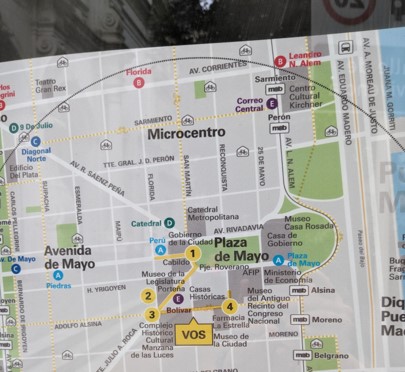
The street map below, which I saw on a downtown Buenos Aires signpost, captures the linguistic “Alice in Wonderland” vibe I experienced on my recent trip to Argentina. The VOS ‘you’ in the yellow box south of the Plaza de Mayo on the map was intended as a “You are here” location marker. However, as I explained in my previous post, voseo — the use of vos instead of standard Spanish — is a hallmark of Argentinian Spanish, as well as certain other Latin American dialects. So to me, this map told me that “I was here” linguistically — in the heartland of voseo — as well as geographically.

I was accustomed to seeing vos and its associated verb forms in Latin American novels, but spotting and hearing them ‘in the wild’ was a real thrill throughout my trip. As soon as I arrived at Buenos Aires’s Ezeiza airport I saw posters like the ones below, whose vos command forms tell the traveler to ‘connect yourself’ with WiFi, and ‘tempt yourself’ with the airport’s delicious food.

Later in my trip I was tickled pink to glimpse this large “VOS” featured on a branch office of the insurance company “La Segunda.” (I snapped this cell phone picture through a taxi window, hence the funny angle.) Its slogan Lo primero sos vos ‘You are first’ tells customers that they are the company’s top priority.

Although I’ve known about voseo forever, I had never had a good reason to actually learn the relevant forms. So before my trip I gave myself a crash course. I was surprised to see that in most cases, the only distinction between standard Spanish forms and their corresponding vos forms is stress. Specifically:

  • In standard Spanish, present tense forms like amas ‘you love’ and comes ‘you eat,’ as well as informal () command forms like ¡Ama! ‘Love!’ and ¡Come! ‘Eat,’ all stress the next-to-last syllable. Because this is the standard stress pattern for Spanish words that end in a vowel or s (think cuchara and cucharas), they are written without an accent mark.
  • Vos forms display the opposite pattern. As illustrated by present-tense amás and comés, and commands ¡Amá! and ¡Comé!, these words are stressed on the last syllable, and therefore require a written accent mark.

As soon as I saw the Conectate and Tentate posters illustrated above, I realized that the final stress on vos commands further complicates an already challenging topic in Spanish: the use of accent marks in command forms with pronouns.

  • In standard Spanish, the next-to-last stress of commands like ¡Ama! and ¡Come! is heard in formal and plural affirmative commands as well (¡Ame! ¡Amen! ¡Coma! ¡Coman!). In written Spanish, when you add a pronoun to any of these commands, you must also add an accent mark to maintain stress on what is now the third-to-last syllable. Some examples are informal ¡Cómelo! ‘Eat it!’, formal ¡Levántese! ‘Get (yourself) up!’, and plural ¡Escríbanles! ‘Write (to) them!’
  • In contrast, because vos commands are stressed on the last syllable (e.g. ¡Conectá!), adding a pronoun means that you can drop the accent mark, since the stressed syllable is now in the usual next-to-last position (¡Conectate!).
  • This means that Argentinians need to add an accent mark when adding pronouns to formal and plural commands like ¡Levántese! and ¡Escríbanles!, but remove an accent mark when adding a pronoun to informal (vos) commands like ¡Conectate!.

This situation is guaranteed to confuse anyone but a linguist! Not surprisingly, many Argentinians (incorrectly) omit the accent mark in formal commands with pronouns because they are used to doing this in informal commands. (I don’t know what the situation is with plural commands, which are less common.)

Below are two examples of such errors from our trip to Igauzú. The seatback airline safety instructions on the left omitted the accent mark on abróchese ‘buckle.’ (As you can see, I added it with a pen mid-flight, in the spirit of Deck and Herson’s self-righteous but inspirational The Great Typo Hunt.) Likewise, the informational panel on the right, from the Iguazú waterfall park, omitted the accent mark on acérquese ‘approach.’ Note that the safety instructions and the informational panel correctly accented cinturón, más, and información, implying that the missing accent marks on the commands were a sign of weakness in grammar rather than an overall spelling deficit. The missing accent mark on the subjunctive verb form esté (which I also wrote in myself) supports this conclusion.

Finally, I can’t help but ask: since verb forms, which are mostly used in the Northern hemisphere, have the opposite stress pattern from and vos forms, which are mostly used in the South, could this possibly have something to do with the Coriolis effect?

Just joking!

Fun with “voseo” in Argentina: Part 1

Dear reader: Once I sat down to write this post I realized that I had plenty to say about voseo as a linguistic phenomenon. So I’ve restricted myself to that topic here. In my next post I’ll actually tell you about my enjoyment of voseo while in Argentina.

My favorite aspect of Argentinian Spanish is voseo, the use of the pronoun vos instead of to mean ‘you’ in familiar settings. As a linguist, I appreciate voseo for three reasons.

First, voseo has an amazing history. Argentina, along with certain other regions in Central and South America, retained the archaic vos pronoun while the rest of Latin America followed Spain’s lead in settling on . The outcome of versus vos in each region depended on the degree of contact between it and Spain during the colonial period. Argentina could not be reached directly, via the Atlantic, because rampant piracy in the Atlantic forced Spain to restrict ocean travel. Spaniards could only reach Argentina by sailing to the Caribbean, crossing the Isthmus of Panama via mule train, sailing to a Pacific port such as Lima, and crossing the Andes. Argentina, like other effectively remote parts of the New World, was thus insulated from linguistic changes back in Spain.

I remember how excited I was to read about this connection between Latin American linguistic history and piracy (!!!) in Ralph Penny’s essential A History of the Spanish Language. It was the subject of my first blog post more than ten years ago, and was one of two linguistic insights that inspired me to write my first book. (The other was my spotting of Jespersen’s Cycle at work in the creation of Spanish negatives, both old and new.)

Second, voseo helps to illustrate that linguistic complexity begets variation. When English speakers begin to study Spanish, they are often taken aback to learn that our single pronoun you corresponds to at least three in Spanish: singular (informal) and usted (formal), and plural ustedes. Spain further divides plural ‘you’ into informal vosotros and formal ustedes. As is often the case, the complexity of this aspect of the language is paralleled by extensive dialectal variation: not just vosotros in Spain and vos in parts of Latin America, but also differences in how speakers around the world use and usted. For example, Spaniards favor over usted in all but the most formal of situations, and in parts of Columbia usted connotes intimacy.

(By the way, two other examples of complexity begetting variation in Spanish are (i) its inventory of seven third person direct and indirect object pronouns (lo, la, los, las, le, les, and se), which has spawned the variant usage patterns of leísmo, loísmo, and laísmo, and (ii) its relative abundance of consonants (17-19, depending on dialect), as opposed to vowels (5), with the result that most phonetic variation in Spanish dialects involves consonants.)

Third — I’m perhaps going out on a limb here — voseo is something that most Spanish speakers are aware of. As a result, you can start an interesting conversation about language differences by asking a Spanish speaker ¿En su país se usa o vos? Likewise, you can ask about usage of versus usted in their country. I can’t think of any aspect of English grammar that could inspire a parallel discussion. We’re stuck with matter-of-fact questions about vocabulary, such as “Do you say soda, pop, or coke?”

A linguistic “busman’s holiday” in Argentina

In case you aren’t familiar with the expression, a “busman’s holiday” is a vacation that closely mirrors a tourist’s everyday life. A “busman” (normally one would say “bus driver”) spends a lot of time on the road, so a vacation that involves a fair amount of travel would be more of the same.

Because I’m obsessed with Spanish, my recent trip to Argentina was very much a busman’s holiday. For one thing, during the trip I spoke very little English: only in phone calls home, and with Spanish speakers who wanted to practice their English. My travel buddy Susan and I spoke only Spanish with each other, and I had as many conversations as I could with Argentinians and other Spanish speakers. As a result, my Spanish improved perceptibly during the trip. Immersion works!

My most memorable such conversation took place at the Puerto Iguazú airport, on our way back from seeing the waterfalls. While waiting for our flight I met a Paraguayan civil engineer who was working on a new highway that would bring drivers to the new bridge to Brazil just north of Hito Tres Fronteras (pictured in my previous post). She said something along the lines that “once the bridge and highway are completed, there will be no more traffic.” For a New Yorker raised with the ghost of Robert Moses, the famed builder who never met a stretch of concrete he didn’t like, this was an extreme provocation. One theme of Robert Caro’s classic memoir The Power Builder is that the more roads and bridges Moses built, with the purported aim of decreasing traffic, the worse traffic got. My new friend had never heard of Robert Moses, so this was an exciting conversation for both of us. The Power Broker is now on her English reading list.

Besides the sheer joy of speaking Spanish, the other “busman’s holiday” aspect of my trip was relishing the dialectal features of Argentinian Spanish. As a warmup I devoted some of my free time before the trip to Argentinian fiction. I reread Guillermo Martínez’s La muerte lenta de Luciana B. (2008), which I had found an easy-to-read page-turner years ago. While it was still exciting the second time around, Martínez’s treatment of the title character now struck me as somewhat outdated and sexist. I also read Mariana Enriquez’s truly weird but wonderful novel Nuestra parte de noche (2021), about a sort-of-Satanic cult operating in exactly those parts of Argentina that we were about to visit, namely Buenos Aires and Corrientes province, including Iguazú. During our trip I reread Eduardo Sacheri’s La pregunta de sus ojos (2003), the novel that inspired the 2009 Argentinian movie El secreto de sus ojos and its 2015 English-language adaptation Secret in their eyes. I’ve seen both movies, and the novel is better.

These books reminded me of Argentinian vocabulary like remera for T-shirt and biro (or birome) for a pen. La pregunta de sus ojos in particular featured a near-constant stream of descriptors like boludo ‘imbecile’ and pibe ‘kid.’ Once I arrived in Argentina, local vocabulary was all around me. For example, while texting with our airbnb hostess during my short wait for Susan at the airport I learned to use departamento instead of apartamento and tránsito instead of tráfico.

By the way, these words exemplify a variety of well-known mechanisms of semantic change. Remera is an example of ‘broadening,’ since it originally referred to a shirt worn by a rower (remar means ‘to row’). Biro(me) is an ‘eponym’ that memorializes Ladislao José Biro, the Hungarian-Argentine inventor of the ballpoint pen. Boludo, like English ‘blockhead’, is a metaphorical extension from a shape (bola ’round’) to a personality trait, while pibe was borrowed from Catalan pevet, Portuguese pivete, or Italian pivetto.

As a further “by the way,” Corominas traces the history of pibe from peu (the Catalan word for ‘foot’) to a footed incense holder, to odorous incense, to something with a strong smell, to an infant, to a child. This is as wacky as the evolution of muñeca from ‘milestone’ to either ‘wrist’ or ‘doll,’ yet every step is plausible.

As for as the Argentinian accent, its most salient aspect is probably the lilting intonation that the language has absorbed from Italian (listen at 4:25 here). When I overhear this intonation in the speech of tourists in New York I’m often emboldened me to ask, with a fair rate of success, ¿Son ustedes de Argentina? I didn’t try to adopt this intonation on my trip, but did have fun replacing the usual Spanish glide in words like yo and calle with a harder /dʒ/ or just /ʒ/ consonant, as in ‘Joe’ or ‘pleasure,’ respectively. This is the feature that gave the Argentinian revolutionary Ernesto Guevara the nickname ‘Che.’

My next post will discuss the outstanding feature of Argentinian grammar: voseo.