Tag Archives: Indo-European

¡Yamnaya!

After taking some weeks off for summertime fun with my family I am now back to research for my third book. I’ve continued to work my way through David Crystal’s The Story of English in 100 Words — still inspirational and intimidating. But I’ve also taken a detour to devour Laura Spinney’s book Proto: How One Ancient Language Went Global, about the pre-history of the Indo-European languages. I will definitely want to touch on this topic in my book, since it’s part of the history of Spanish.

For those of you who may be unaware, the Indo-European language family includes thousands of languages spoken today: Romance languages like Spanish, Germanic languages like English, Slavic languages like Russian, Baltic languages like Lithuanian, and Celtic languages like Welsh; Greek, Albanian, and Armenian; Hindi and other languages of northern India; and languages of Central and Western Asia including Pashtun (Afghanistan) and Persian (Iran). It also includes languages that are no longer spoken and (unlike Latin) have no spoken descendents. These include Oscan and Umbrian ( “Italic” languages related to Latin), languages of ancient Turkey including Hittite and Phyrgian (“Anatolian” languages), and Tocharian A and B, once spoken in the Tarim Basin of northwestern China.

I learned about the Indo-European language family as an undergraduate and graduate linguistics student. However, my knowledge of the family’s origins was vague: I knew only that it arose somewhere north of the Black Sea. (Or was it the Caspian Sea???) Although I was aware that in the years — decades, really 😉 — since I completed my PhD, there had been substantial new research on this topic, I hadn’t followed the field.

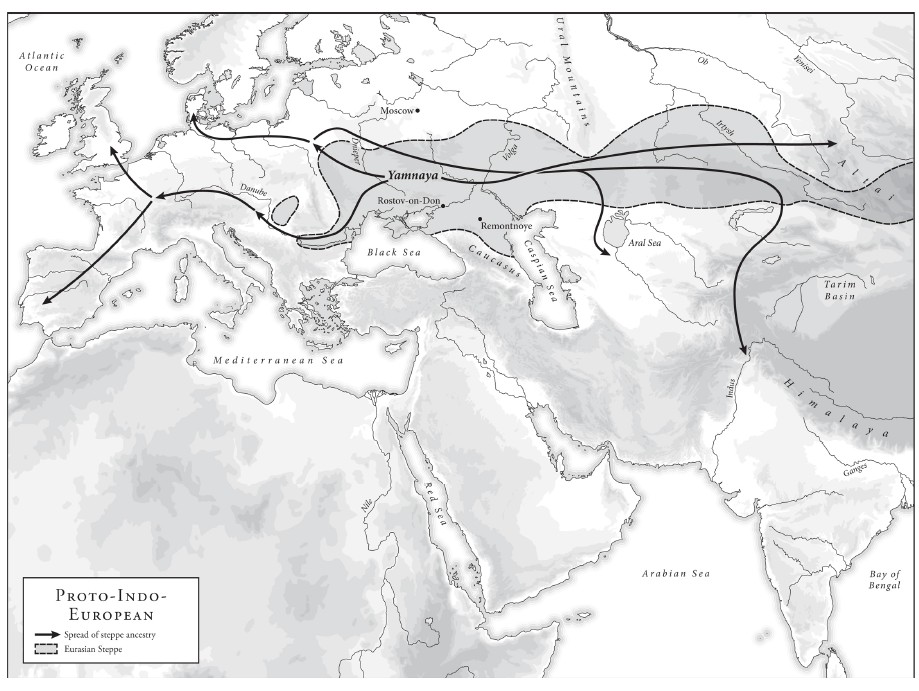
Proto has brought me up to date — and can I say “Wow?” Spinney’s book combines recent research from linguistics, archaeology, and genetics (DNA analysis) to illuminate what is known today about the origin of the Indo-European languages. Essentially, Proto-Indo-European — the common ancestor of the language family — spread east and west through the Eurasian steppe (grasslands), conveyed by cattle herders equipped with horses and wagons. The steppe was a natural environment in which such people could thrive and spread. Researchers call these steppe herders the Yamnaya, which means ‘pit grave’ in Russian, because of their burial practices.

The illustration below, from pp. 60-61 of Spinney’s book, shows the progression of Indo-European (black arrows) through the steppe (shaded area) and beyond. My vague memory wasn’t that far off, since the arrows show a specific point of origin in the steppe north of the Black Sea.
Genetic analysis of DNA from Yamnaya remains suggests an exciting possibility:

“The earliest Yamnaya males … carried a very narrow cluster of Y chromosomes. Later on, after the population had grown, other Y chromosomes entered the mix, but the first of their kind may have been closely related to each other on their father’s side. One way to interpret the evidence is to think of the Yamnaya as a single clan or brotherhood who distinguished themselves by their burial rite. They may have left a larger group, or been expelled from it, and having moved out of their ancestral valley became increasingly nomadic unril they vanished into the grasslands for good. If that is who they were it prompts an extraordinary reflection: fewer than a hundred people may have spoken the dialect that gave rise to all extant Indo-European languages.” (p. 69)

While Proto doesn’t have anything to say about Spanish specifically, it does include interesting speculation about the connection among Italic, Germanic, and Celtic languages:

Germanic, Celtic and Italic are related by common descent. This is evident from their grammar, their pronunciation and their core vocabulary (English – – father mother brother; Old Irish athir máthir bráthir ; Latin pater mter frter). But the relationships between them aren’t equal. Celtic and Italic are generally considered to be closer to each other than either is to Germanic, like twins with a third sibling.…Some linguists suspect that Italic and Celtic arose as a single, possibly short-lived language, Italo-Celtic, while Germanic arose separately.

As I had hoped, Proto provided me with the information I need to write about Indo-European origins. On other counts, as a linguist I especially enjoyed learning about Anatolian and Tocharian, two branches of the Indo-European family that had always flown under my cognitive radar. I think that many people interested in languages or history would find the book to be an informative and accessible read. It provides a dizzying overview of the early history of humanity around the Black Sea: a region that, like the Fertile Crescent, would be a springboard for widespread advances in civilization for millenia to come. I recommend it highly.

El género desenfrenado — Gender gone wild

[Today is Spanish Friday so this post is in Spanish. ¡Scroll down for English translation!]

Últimamente he vuelto mi atención de los pluralia tantum al género gramatical (otra vez), y he investigado un poco la historia del género en otros idiomas relacionados al español. Ya sabía que el latín tenía tres géneros (masculino, feminino, y neutro), que heredó este sistema del proto-indo-europeo, que el francés y el italiano (como el español) solo tienen el masculino y el femenino), y que el alemán todavía tiene el neutro. He aprendido que:

  • Todos los lenguajes romanos perdieron el género neutro. Esto implica que ya habría ido fallando en el latín vulgar.
  • El alemán no es el único idioma indo-europeo moderno en preservar el neutro. Otros incluyen el gujarati (un idioma de India), el griego, y el ruso.
  • El inglés no es el único idioma indo-europeo moderno en haber perdido completamente el género gramatical. Otros incluyen el armenio y el bengalí.
  • El resultado romance (con el masculino y el femenino, pero sin el neutro) es el más común. Otros idiomas en esta ala incluyen el albanés, el hindi, los idiomas célticos, y los idiomas bálticos (el letón y el lituano).
  • El polaco y el serbio (los dos eslavos) han sorprendentemente aumentado sus sistemas de género de tres a cinco géneros por medio de dividir el masculino en tres géneros distintos: objetos inanimados, seres humanos, y otras entidades animadas. Para una geek lingüística como yo, ¡esto es una de las cosas más interesantes que he aprendido en los últimos meses! Se puede enterar más de ello en Wikipedia (busca la expresión “five genders”) o, para una fuente más respetable, en las páginas 425-6 de Indo-European Language and Culture: An Introduction, por Benjamin Fortson IV. Recomiendo este libro de todas maneras.

—————————————————————————————————————————————-

I’ve recently turned my attention from pluralia tantum back to noun gender, and did some research on the history of gender in languages related to Spanish. I already knew that Latin had three genders (masculine, feminine, and neuter), that it inherited this system from Proto-Indo-European, that French and Italian (like Spanish) only have masculine and feminine, and that German has neuter. Here’s what I’ve learned in the last few days.

  • All Romance languages lost the neuter gender. This implies that it must already have been on its way out in Vulgar Latin.
  • German isn’t the only modern Indo-European language to preserve the neuter gender. Others include Gujarati, Greek, and Russian.
  • English isn’t the only modern Indo-European language to have completely lost gender. Others include Armenian and Bengali.
  • The Romance outcome (masculine and feminine in, neuter out) is the most common. Other languages in this camp are Albanian, Hindi, the modern Celtic languages, and the Baltic languages (Latvian and Lithuanian).
  • Polish and Sorbian (these are both Slavic languages) have actually jumped from three genders to five by splitting masculine into three categories: inanimate, human, and other animate. For a language geek like me, this is one of the most coolest things I’ve learned in the last several months! You can read about it on Wikipedia (search for the phrase “five genders”) or, for a more reputable source, on pp. 425-6 in Benjamin Fortson IV’s Indo-European Language and Culture: An Introduction, which I strongly recommend in any case.

Fun with Proto-Indo-European roots

Recently I’ve been playing with John Slocum’s terrific Indo-European Lexicon website and wishing I’d discovered it earlier. In case you didn’t know, Spanish and the other Romance languages are part of the Indo-European language family. Other branches of this enormous family include Germanic, Greek, Celtic, Slavic, and Indo-Iranian. Spanish is therefore related to language as diverse as Gaelic and Gujarati; to Sanskrit, Serbian, and Swedish; to Pashto, Persian, and Polish; and to Hindi and Hittite.

Dr. Slocum’s Lexicon lets you trace vocabulary roots up and down the Indo-European family tree. For example, let’s say you’re curious about the origin of the Spanish word pan “bread”. If you click on the Language Index you can then scroll down to Spanish. (For a shortcut, you can access the Spanish page here.) This page lists almost 500 Spanish words whose Indo-European roots are included in the Lexicon. Pan is traced back to the Proto-Indo-European root pā-. Click on that root and you’ll move up the tree, to an entire page devoted to pā-. This page provides a definition and a list of the root’s descendants in all ten branches of the Indo-European family.

It turns out that pan is related to several sets of English words. I knew about some of them, but not all.

  • food and fodder
  • company, companion
  • forage, foray, foster
  • pantry, pannier
  • pastor, pasture, repast, pastern, pester
  • antipasto (but not “pasta”, go figure)
  • pabulum

For other words, though not pan, tracing a root back down the tree can show you surprising connections within Spanish. For example, llama “flame” and blanco “white” share the same Indo-European root, as do armisticio, arrestar, asistir, costar, estado, and estar.

Why are you still reading? Run along and play!