Mind your y’s and o’s

After all these years, I’m still refining my knowledge of Spanish. Just this week I learned a subtle detail about an obscure but genuine rule of Spanish: the occasional change of y and o (‘and’ and ‘or’) to e and uY and o are pronounced ee and oh, and this change happens when one of these words comes before a word that begins with the same sound. So, for example, we say bonita e inteligente ‘pretty and smart’ and siete u ocho ‘seven or eight’ to keep the vowels from merging into each other at the boundary of y and inteligente, and likewise of o and ocho.

We have a similar phenomenon in English, where a changes to an before words that begin with a vowel, so that we say, for example, an apple and an elephant as opposed to a pear and a zebra. Just as in the Spanish case, this prevents the vowel of the word a from running into the first vowel of the following word. The linguistic term for such a change is dissimilation.

I would describe the y/o rule as “basic advanced Spanish”, meaning that anyone who wants a good command of the language will eventually learn it. I always get a kick out of teaching it: students are surprised to learn that these basic words, which they may have been using for years, have two different forms. That’s when I bring in the a pear/an apple example from English and really blow their minds.

The detail that I just learned has to do with words that begin with hie-, such as hierro ‘iron’. The letter h is silent in Spanish, so that normally the ye rule applies before words that begin with hi-, as in aguja e hilo ‘needle and thread’. However, in words like hierro the i takes on a consonantal y sound — that is, the word is pronounced yero — so there is no need for the ye change. A good example is the phrase madera y hierro ‘wood and iron’.

Here’s the rule as explained in the Real Academia Española’s Ortografía:

“La y copulativa mantiene su forma cuando la palabra que sigue a la conjunción comienza por un diptongo de /i/ + vocal, ya que en esos casos la /i/ del diptongo no es plenamente vocálica, sino que se acerca, en la pronunciación espontánea, al fonema consonántico /y/. Al no confluir ya dos fonemas vocálicos iguales, la y copulativa no necesita transformarse en e: madera y hierro [madéra i yérro], agua y hielo [água i yélo], alfa y iota [álfa i yóta].”

By the way, no Spanish words begin with ie-, just as none begin with ue-. At the beginning of a word the ie sequence is always spelled hie- or ye- (as in yeso ‘plaster’), and the ue sequence, hue- as in huevo ‘egg’. A fun fact for your Tuesday!

Many thanks to reader and friend Daniel Nappo for bringing this topic to my attention.

Linguistic gems from recent reading (2017 edition)

The title of this post is a shout-out to one I wrote back in 2014. That “linguistic gems” post described a nice stylistic use of the imperfect subjunctive in the Spanish novel La carta esférica, and a reminiscence about the trilled r from the Puerto Rican novel Felices días tío Sergio.

Today’s gems come from the Spanish-language novel that I’m currently reading, Sofía Segovia Huracán. It was this Mexican author’s first novel; she revised and republished it last year after the great success of her second novel, El murmullo de las abejas. I’m 50 pages into Huracán and completely hooked.

So far, Huracán is the picaresque tale of a Mexican boy who is given away (regalado) to a farmer because his family can’t afford to keep him. He eventually runs away and makes his living as a petty thief. I’m waiting for him to figure out how to redeem his life — and, of course, I’m waiting for the actual hurricane of the title.

In the meantime, I’m especially enjoying two aspects of the author’s Spanish. First, Segovia often puts into written form her characters’ “improper” Spanish, as shown in the selection below:

¡Ya nos mandastes al demonio! ‘You sent us to the devil!’
¿Adónde vamos? ‘Where are we going?
Nosotros agarramos pa Tabasco. Tú lo matastes, tú te vas pa otro lado. ‘We’re heading for Tabasco. You killed him, you go the other way.’

The preterite past tense forms mandastes and matastes here have a final -s added to the standard forms mataste and mandaste. This is a very natural extension of the final -s that ‘you’ forms have in all other verb tenses, such as matas ‘you kill’, mandarás ‘you will sent’, and mandabas ‘you used to send’. I’ve read about this phenomenon but have never seen it in print. Pa as a shortened version of para ‘for’ that is common in colloquial Spanish in several countries, including Mexico. I’ve seen it written elsewhere as pa’. 

The other aspect of Segovia’s Spanish that I particularly enjoy is her deliberate and even playful exploitation of some of the grammatical contrasts that are a Spanish instructor’s bread and butter. In this sentence, about the protagonist’s time in a street gang, Segovia plays with gender:

Aniceto no estaba acostumbrado a tanta orden y tanto orden. ‘Aniceto wasn’t used to so many orders and so much organization.’ (“command and control’?)

Orden is one of a set of Spanish words whose meaning changes with its gender; some other examples are el capital ‘money’ and la capital‘, el cura ‘priest’ and la cura ‘cure’, and el coma ‘coma’ and la coma ‘comma’. You will find a longer list here.

Also on the subject of the street gang, Segovia plays with the por/para contrast:

Si no era [el jefe] él quien hacía cumplir su ley, era el resto del grupo el que lo hacía por él y para él. ‘If the gang leader didn’t make Aniceto obey, the rest of the gang would do it in his place and for his benefit.’

The Spanish version is much more elegant, ¿no?

I’m looking forward to unearthing more gems as I make my way through Huracán!

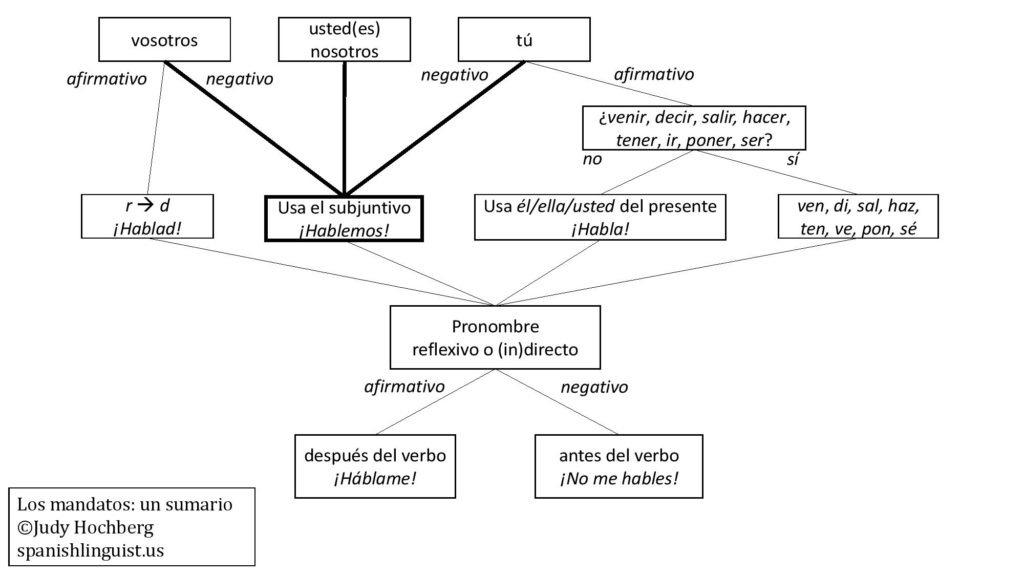
Mandatos (commands) summary chart

An upcoming review session with a student who is struggling with Spanish commands inspired me to make this chart. Some notes:

  • I used boldface for the subjunctive box and the lines leading into it in order to emphasize that in most cases, the command form is just the subjunctive.
  • I left out two details:
    • dropping the final s on affirmative nosotros commands before nos (e.g. quedémonos ‘let’s stay’) or se (e.g. enseñémosela ‘let’s teach them it’);
    • the irregular affirmative vosotros command idos (for ir).
  • The accent marks usually needed when a pronoun is added simply follow the regular rules for Spanish. That’s why you see one on háblame ‘talk to me’ (same stress pattern as e.g. teléfono) but not on dime ‘tell me’ (same stress pattern as cine).
  • The irregular affirmative  commands are listed in the order of the mnemonic “Vin Diesel has ten weapons, eh?”

A subtle case of the subjunctive

Today I’ll start by sharing a gorgeous example of the subjunctive/indicative contrast that I recently noticed in one of my favorite Spanish novels, Jordi Sierra i Fabra’s Cuatro días de enero. Then I’ll circle around and explain what makes it so gorgeous.

Lo ha matado al salir de aquí, después de estar contigo….El objetivo eras tú [Patro], por lo que sabes o puedas contar.
‘They killed him when he left after seeing you. The real target was you [Patro], for what you know or might say.

A bit of background: I like to tell my students that the subjunctive/indicative distinction is easier to master than the the preterite/imperfect distinction. The contexts, or triggers, that require the subjunctive are usually clear-cut, whereas there’s often a lot of subjectivity in deciding whether a given past tense context triggers the preterite or the imperfect. For example, Ojalá ‘God willing’ always triggers the subjunctive, whereas ayer ‘yesterday’ can be followed by either the preterite or the imperfect, depending on how the speaker perceives what happened yesterday.

For this reason, I’m intrigued by subjunctive/indicative contexts that allow more flexibility. Certain triggers are famously ambiguous. For example, tal vez and quizás, both meaning ‘maybe’, can be followed by either the subjunctive or the indicative, depending on whether you are pessimistic or optimistic:

  • Tal vez venga ‘He might come, but probably won’t’ (subjunctive)
  • Tal vez viene‘ He might come, and probably will’ (indicative)

Most Spanish grammar guides (e.g. here) cover in depth a second flexible context: so-called “adjective clauses”, or relative clauses that describe (give more information about) a noun, i.e. a person, place, or thing. A subjunctive In an adjective clause indicates that the clause describes a hypothetical person, place, or thing while an indicative indicates that the noun is real. Consider, for example, the sentence pair below, which I remember from tenth grade (!!), and which distinguishes between a hypothetical and an actual secretary:

  • Busco una secretaria que sepa escribir a máquina ‘I’m looking for a (hypothetical) secretary who can type’ (subjunctive)
  • Busco una secretaria que sabe escribir a máquina ‘I’m looking for an (actual, specific) secretary who can type’ (indicative)

Not all flexible relative clauses are adjective clauses. This brings us back to the example I started this post with, in which the relative clause functions as a noun.

Lo ha matado al salir de aquí, después de estar contigo….El objetivo eras tú, por lo que sabes o puedas contar.
‘They killed him when he left after seeing you. The real target was you, for what you know or might say.

I love this example because it contains both an indicative and a subjunctive within a single relative clause! This combination subtly mirrors the progression of the speaker’s thoughts: from the murderer’s certain motive for killing Patro — what she knew — to the murderer’s hypothetical motive — what Patro might say. As with the venga/viene and sepa/sabe examples, the subjunctive and indicative forms of the verb provide a compact and elegant way to achieve this distinction.

Frankly, having looked through my collection of grammar books and websites, I’m not sure what category the puedas subjunctive falls into. The noun clauses with the subjunctive presented in grammars typically follow classic WEIRDO triggers like Espero queEs triste que, Ojalá que, and Dudo que. Nevertheless, the puedas example strikes me as splendid Spanish. Any ideas?

My talk at HLCCNY’s Feria del Libro

It was a real thrill to participate in this weekend’s Feria del Libro Hispana/Latina, organized by the Hispano/Latino Cultural Center of New York. Here are some takeaways from the event.

  1. There was genuine interest in my book! I sold several copies, and my talk on “Aspectos sobresalientes del español” (video below, text here) was well received. While I have always believed that ¿Por qué? should be of interest to Hispanics as well as Spanish teachers, students, and linguists, this is my first proof. I will continue to work to identify other ways of reaching this community, and welcome any reader suggestions.

2. I fell in love with this year’s Feria’s honoree, the poet and translator Rhina Espaillat. She is one warm and classy lady, both accomplished and approachable. She gave a wonderful talk about the art of translation which included several examples of poems she has translated from English to Spanish and vice versa.

3. Another highlight was, surprisingly, a presentation by Mayra Faña on her new book El vino, La bebida intelectual. I say “surprising” because a wine book was the last thing I would have expected to be on the program, which leaned toward poetry. However, Sra. Faña is passionate about wine — her day job is, I think, in engineering, but she gives wine appreciation classes — and wrote the book as part of her crusade to increase appreciation and consumption of wine in the Hispanic community. Her talk was excellent; my favorite part was her discussion of the difference between Argentinian and Chilean wines.
I am myself rather lazy/timid in the wine department, and buy only through established wine clubs. But if I wanted to read a book about wine, it would be this one.

4. I shared a table with Altagracia Cabrera, who has recently published a novel, ¡Dios hazme blanca!, about racial prejudice in the Dominican Republic. She brought her adorable granddaughter and grand-niece to the fair. In this picture you can see them holding copies of the book while wearing their abuela’s promotional T-shirts.

5. The event was catered by La Brisa restaurant in Jackson Heights. So good! But after three days of eating roast pork and tostones (fried plantains), it was a relief to cook up a batch of one of my favorite vegan soups, featuring yellow split peas and lots of vegetables.

My talk this Saturday (Queens, NY)

For those of you in the New York area, I’ll be speaking 8:00 pm Saturday night at the 11th Feria del Libro Hispana/Latina in Jackson Heights, Queens. You can see the flyer below. I will also have a table to sell my book on Friday, Saturday, and Sunday. Here is more information about the fair.

The organizers asked me to provide an interesting title for the talk, which I did, but I think the result is a bit confusing because it looks like this is the title for the BOOK. Whatever. Also, they added an (incorrect) accent on lingüista — but at least they remembered the diaeresis (double dots) on the u. As a final linguistic note, note that in the name of the fair the organization went with feminine hispana/latina (to agree with feria) rather than masculine hispano/latino (to agree with libro). I find this disconcerting every time I read or say the name of the fair because the adjectives immediately follow libro.

This talk will be a real challenge for me because it will be (i) to a non-academic audience, (ii) in Spanish, and (iii) without PowerPoint. It will be my first real attempt to promote my book to a Spanish-speaking, non-academic audience. Wish me luck!

Say it isn’t so (again), (Trader) Joe’s

I feel really bad picking on Trader Joe’s for a third time. It’s my favorite grocery store! Maybe other stores are just as bad, but I see more mistakes at TJ’s because I go there so often.

Be that as it may…

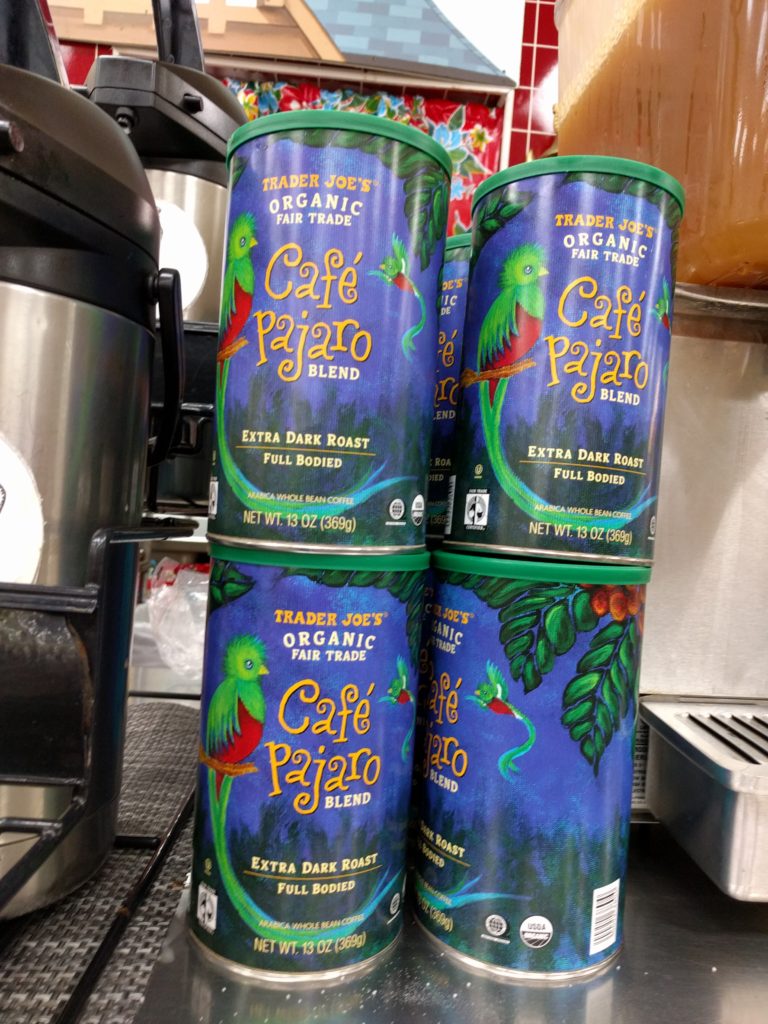
This morning’s free coffee sample at my local TJ’s was particularly excellent. It was Café Pajaro, an organic, full-bodied, 100% Arabica variety from Guatemala. Amazon reviews describe it as “best coffee ever”, “best TJ brand on the market today”, and “dark and smooth”. The design of the coffee canister respects the variety’s Guatemalan heritage by picturing a quetzal, the indigenous bird whose name comes from Nahuatl (the language of the Aztecs) and has been extended to the country’s currency.

The Spanish on the label, on the other hand, disrespects this heritage because, although café receives its proper accent, an accent is missing from pájaro (meaning ‘bird’).

I’ve complained about TJ’s cavalier treatment of accent marks in the previous posts linked to above, but this incident is particularly galling*. If they can get it right in one word, why not in the other?

TJ’s has an online comment form if anyone wants to join me in complaining.

*In my previous “Bad Spanish” post I complained that TJ had omitted the accent in auténtica but not in French soirée. I’d have to call that incident “gaul-ing.” (Sorry.)

“Spanish Thrives”…or does it?

I’m always happy to see articles about Spanish in the non-academic media. So it was with great interest that I read a recent article in the New York Times, “Spanish Thrives in the United States Despite an English-only Drive”. This article described the vibrancy of the Hispanic community in the U.S. today, touching on its multiple roots — Puerto Rico, Spain, Mexico, Central America, and Colombia are all mentioned — and its cultural manifestations, including food, music, literature, media, and sports.

However, the article also recognizes that this vibrancy is likely to wane, linking to research that predicts that English will, over time, take over as a first language among Hispanics. This buttresses my own reading on this topic. For example, in a 2001 research review, USC professor Carmen Silva-Corvalán wrote that “a pesar de las actitudes positivas, en los grupos 2 y 3 es evidente el uso cada vez menos frecuente del español, incluso en el dominio familiar” (p. 329). (‘In spite of positive attitudes [toward Spanish], second- and third-generation Americans clearly use Spanish less and less, including within the family.’)

The specific linguistic phenomena described in the Times article — “Spanglish” (alternating Spanish and English within a sentence), and the large-scale absorption of English vocabulary into Spanish — are two warning signs, like canaries in a coal mine, that indicate the ongoing erosion of Spanish competence among US Hispanics. Linguists like Silva-Corvalán also describe a third “canary”: the partial or even complete loss of certain complex grammatical structures in the speech of second and, especially, third-generation Hispanics .

Please see this earlier blog post on a related topic.

Spanish linguist’s guide to verb conjugations

I just wrote out some thoughts on Spanish verb conjugations in order to answer a question on Reddit, and thought they might be of more general interest.

The question was how to learn Spanish verb conjugations. I recommended conjuguemos.com, as always, for verb practice. But I also summarized the different conjugations, lumping them into eight groups from a learner’s perspective.

In this effort I wasn’t careful to distinguish tense, aspect, and mood; life is too short. And of course, the longer-term challenge is knowing WHEN to use each conjugation.

  1. The present tense takes a lot of practice because (i) it is usually the first tense you study, (ii) -ar, -er, and -ir verbs have distinct endings, and (iii) there are a lot of irregulars.
  2. The imperfect is super-easy because (i) -er and -ir verbs have the same endings and (ii) there are only three irregulars.
  3. The preterite, like the present, has tons of irregulars, but at least -er and -ir verbs have the same endings. I have a nice summary on my Teaching page (look for “Todo el pretérito”). My basic advice is to “divide and conquer.”
  4. For historical reasons, the two subjunctive (present and past) conjugations are similar to the normal (“indicative”) present and the preterite, respectively. This means that once you have learned the latter it’s mostly a matter of getting used to a somewhat different set of endings. It helps that -er and -ir verbs have the same endings in the present subjunctive, and that -ar, -er, and -ir verbs ALL follow the same conjugation pattern in the past (“imperfect”) subjunctive (starting with the ellos/ellas/ustedes form of the preterite). However, the present subjunctive does have six irregulars of its own. And the imperfect subjunctive actually has two possible sets of endings (-ra and -se), though learners can just stick with the -ra set.
  5. The future and conditional are a piece of cake because you aren’t really conjugating, you’re just sticking endings onto the infinitive, and these endings are identical for -ar-er, and -ir verbs. Although there are a bunch of irregulars, they all evolved to simplify pronunciation, so they feel good in your mouth.
  6. The perfect tenses with haber (like he comido) all use the same participle (the -ado/-ido thing), so once you (i) memorize a few irregular participles (like escrito) and (ii) know how to conjugate haber in the tense of your choosing, you are set.
  7. Same for the various progressive tenses (like estoy comiendo and estaba bailando), except that here you probably already know how to conjugate estar, so all you need to learn is the present participle (the -ando/-iendo thing), which again has a few irregulars (like durmiendo and leyendo) which are predictable once you get the hang of them.
  8. Commands build on what you already know. Mostly you use the subjunctive. The only exception is affirmative informal commands, both singular () and plural (vosotros). For historical reasons, affirmative  commands resemble the él/ella/usted form of the present tense, plus 8 irregulars, while affirmative vosotros commands simply change the -r of the infinitive for a -d, e.g. hablad ‘Speak, you guys’. A complication with commands is that object pronouns go before negative commands (No lo hagas) but glom onto the end of affirmative commands, often requiring an accent mark to maintain the normal stress position (Cómelo). Here is a summary of these complications.


Despacito redux

“The Jackal”, the Italian comedy team that posted the video of the three comedians dissing Despacito in a car — yet unable to resist singing along with it — has now put out a sequel. It features a cameo with Luis Fonsi himself. It is, again, very funny. But make sure to watch the earlier video first; I linked to it in this post.