Category Archives: The Story of Spanish in 100 Words

¡Yamnaya!

After taking some weeks off for summertime fun with my family I am now back to research for my third book. I’ve continued to work my way through David Crystal’s The Story of English in 100 Words — still inspirational and intimidating. But I’ve also taken a detour to devour Laura Spinney’s book Proto: How One Ancient Language Went Global, about the pre-history of the Indo-European languages. I will definitely want to touch on this topic in my book, since it’s part of the history of Spanish.

For those of you who may be unaware, the Indo-European language family includes thousands of languages spoken today: Romance languages like Spanish, Germanic languages like English, Slavic languages like Russian, Baltic languages like Lithuanian, and Celtic languages like Welsh; Greek, Albanian, and Armenian; Hindi and other languages of northern India; and languages of Central and Western Asia including Pashtun (Afghanistan) and Persian (Iran). It also includes languages that are no longer spoken and (unlike Latin) have no spoken descendents. These include Oscan and Umbrian ( “Italic” languages related to Latin), languages of ancient Turkey including Hittite and Phyrgian (“Anatolian” languages), and Tocharian A and B, once spoken in the Tarim Basin of northwestern China.

I learned about the Indo-European language family as an undergraduate and graduate linguistics student. However, my knowledge of the family’s origins was vague: I knew only that it arose somewhere north of the Black Sea. (Or was it the Caspian Sea???) Although I was aware that in the years — decades, really 😉 — since I completed my PhD, there had been substantial new research on this topic, I hadn’t followed the field.

Proto has brought me up to date — and can I say “Wow?” Spinney’s book combines recent research from linguistics, archaeology, and genetics (DNA analysis) to illuminate what is known today about the origin of the Indo-European languages. Essentially, Proto-Indo-European — the common ancestor of the language family — spread east and west through the Eurasian steppe (grasslands), conveyed by cattle herders equipped with horses and wagons. The steppe was a natural environment in which such people could thrive and spread. Researchers call these steppe herders the Yamnaya, which means ‘pit grave’ in Russian, because of their burial practices.

The illustration below, from pp. 60-61 of Spinney’s book, shows the progression of Indo-European (black arrows) through the steppe (shaded area) and beyond. My vague memory wasn’t that far off, since the arrows show a specific point of origin in the steppe north of the Black Sea.
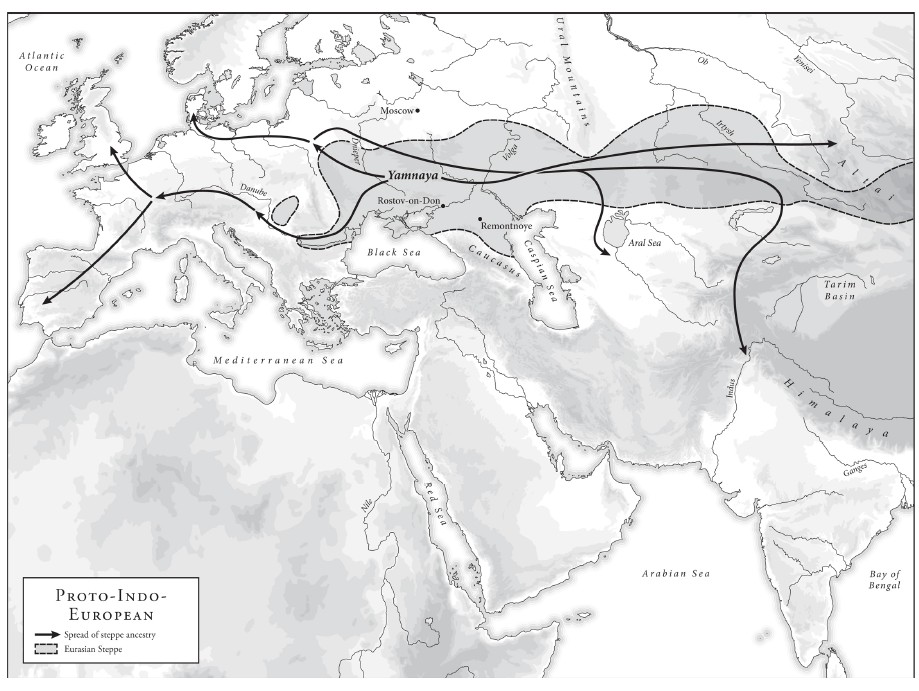
Genetic analysis of DNA from Yamnaya remains suggests an exciting possibility:

“The earliest Yamnaya males … carried a very narrow cluster of Y chromosomes. Later on, after the population had grown, other Y chromosomes entered the mix, but the first of their kind may have been closely related to each other on their father’s side. One way to interpret the evidence is to think of the Yamnaya as a single clan or brotherhood who distinguished themselves by their burial rite. They may have left a larger group, or been expelled from it, and having moved out of their ancestral valley became increasingly nomadic unril they vanished into the grasslands for good. If that is who they were it prompts an extraordinary reflection: fewer than a hundred people may have spoken the dialect that gave rise to all extant Indo-European languages.” (p. 69)

While Proto doesn’t have anything to say about Spanish specifically, it does include interesting speculation about the connection among Italic, Germanic, and Celtic languages:

Germanic, Celtic and Italic are related by common descent. This is evident from their grammar, their pronunciation and their core vocabulary (English – – father mother brother; Old Irish athir máthir bráthir ; Latin pater mter frter). But the relationships between them aren’t equal. Celtic and Italic are generally considered to be closer to each other than either is to Germanic, like twins with a third sibling.…Some linguists suspect that Italic and Celtic arose as a single, possibly short-lived language, Italo-Celtic, while Germanic arose separately.

As I had hoped, Proto provided me with the information I need to write about Indo-European origins. On other counts, as a linguist I especially enjoyed learning about Anatolian and Tocharian, two branches of the Indo-European family that had always flown under my cognitive radar. I think that many people interested in languages or history would find the book to be an informative and accessible read. It provides a dizzying overview of the early history of humanity around the Black Sea: a region that, like the Fertile Crescent, would be a springboard for widespread advances in civilization for millenia to come. I recommend it highly.

Recent gleanings from David Crystal

As a first step in research for my new book I have continued to work my way through David Crystal’s inspirational The Story of English in 100 Words. I hit the 25-word mark yesterday, and thought this would be a good time to blog about what I’ve learned since my previous post, which covered Crystal’s Introduction and his first few words.

To begin with, I’ve learned lots of fun facts about my own language! Here are a few:

  • The word out serves as a verb, adverb, exclamation, preposition, adjective, and noun. Wow!
  • The word street was one of the first borrowings into English from Latin. It was applied to the paved, straight roads that the Romans built, while the earlier Anglo-Saxon word weg (now ‘way’) was relegated to older paths.
  • The groom of bridegroom was originally guma, a somewhat poetic Old English word for ‘man’. Speakers substituted the similar-sounding groom when guma dropped out of normal usage. Groom originally meant ‘boy’ but had acquired its current equestrian meaning by the time of this substitution.
  • The only cookery words that come from Old English, not French, are grind and dough. Who knew?
  • Many legal expressions like goods and chattels, fit and proper, and will and testament, originally combined Germanic and Latin words so that they would be widely understood.
  • The game of Monopoly caused American jail (apparently descended from Parisian French) to overtake the (apparently Norman) gaol outside of the U.S.
  • Middle English didn’t have separate words for ‘spring’ and ‘summer’, but merged them both into sumer, as in the famous English round (song) Sumer is icumen in, Lhude sing cuccu.
  • We think of wee as Scottish, but it originated in Northern England, not over the border in Scotland.

—————–

As I’d hoped, Crystal’s book is giving me interesting ideas for my own book about Spanish, or at least questions:

  • Does Spanish have phrases with deliberately bilingual origins, like goods and chattels in English?
  • What word can I discuss that is only found in legal Spanish? (Maybe the future subjunctive…)
  • Crystal includes the title dame. What Spanish title should I discuss?
  • I should definitely include some Spanish word pairs that consist of a newer word and an earlier one from a different source (as in street and way). Some possibilities are abarca/sandalia, simiente/semilla, vianda/comida, and/or hostal/hotel. Of course, sometimes a new borrowing completely overwrites an earlier word, for example French té, which ousted Portuguese cha (itself borrowed from Mandarin).
  • Apparently pork meant ‘penis’ in American slang of the 1930s. Are any Spanish slang words for body parts worth discussing?
  • Speaking of slang words for body parts, Crystal points out that cunt is taboo enough to sometimes be referred to as “the c-word”, which can also mean ‘cancer’. English also has the “f-word” and the “n-word”. Does Spanish have any such words that, like Voldemort, must not be named? I will include some taboo words in any case.
  • The lack of separate words for ‘spring’ and ‘summer’ in early English reminds me of the lack of modern Spanish words for ‘evening’ and ‘night’. Were there earlier Spanish uber-terms that eventually split into two words? (And what can I call them instead of “uber-terms”, which I just invented? Portmanteau means something else, doesn’t it?) Did this happen, in recorded history, with color terms, which tend to proliferate as languages evolve? (See e.g. Guy Deutcher’s Through the Language Glass, one of my favorite linguistics books written for a general audience.)
  • English slang frequently uses negative words as positives, e.g. wicked, mad, insane, crazy, and of course bad. Is there anything like this in Spanish?
  • Crystal’s discussion of phrasal verbs like take out and take away, which are distinctively English (perhaps Germanic, more generally?) reminded me that I should definitely discuss pronominal verbs (reflexive and otherwise), which are distinctively Spanish.
  • Crystal says out that the word count, as opposed to countess, was initially avoided because its earlier pronunciation was similar to that of cunt. This reminded me of Tom Lathrop’s assertion that the verb jugar, originally jogar, ‘evolved’ its u to make the verb sound less like joder. Is this assertion taken seriously? Are there other examples of this avoidance process in the history of Spanish?

Unrelated to Crystal’s book, I’ve also made notes to myself to include

  • Words that illustrate spelling changes, like saqué or empecemos. Maybe the best way to do this is with a word like cero or cebra.
  • Diminutives, aggrandatives, and so on. Spanish has a wealth of derivational suffixes! Likewise I should include interesting prefixes such as re- prefix, which can be an intensifier (rebueno) or a repeater (rehacer).
  • The full range of parts of speech.
  • Words from a broad range of semantic categories such as the 24 used in the WOLD project.

On a final note, the New York Times “Connections” game, which I play every morning — my current streak is 69! — recently included the word loanword. Many commenters on the Connections blog complained that this word was too obscure. So did my husband. NOT ME!!!

A shout-out to David Crystal

As I explained in my first blog post about my planned third book, David Crystal’s book The Story of English in 100 Words inspired me to tackle this project, and studying his book is the first item on my research to-do list. Since then, I’ve gotten to work.

So far, reading The Story of English has been both discouraging and encouraging. Discouraging, because David Crystal knows more about English than I will ever know about Spanish. Each entry in the book is rich with information and presented in a most engaging manner. For example, the entry for the word and:

  • quotes the first written example of the word;
  • talks about the importance of “little words”;
  • explains the origin of the ampersand (&);
  • reveals an earlier abbreviation for and: a symbol that resembles the number 7 but that dips below the line of writing (like a j, q, or p) — this came as a complete surprise to me!
  • thoroughly debunks the shibboleth against beginning sentences with and and other conjunctions, quoting grammarians both past and present and citing a host of authors who followed this practice.

I doubt that I’ll be able to do as good a job for Spanish as Crystal did for English, but I’ll try. In the meantime, I recommend The Story of English to any of my readers who are interested in languages in general, not just Spanish.

At the same time, reading The Story of English is encouraging. For one thing, I see how good a book of this type can be. Additionally, while I am still in the book’s early pages, it has already given me several ideas for my own book. For example, Crystal’s discussion of and suggests the following:

  • I should include early written examples of the words when they are available and interesting. (See canoa in my earlier post.)
  • I should include “little words”. Conmigo is on my list for sure — it’s a fascinating double compound, since both con- and -go came from Latin cum ‘with’, but centuries apart. I will probably mention mas when I talk about accent marks. Accented más, which means ‘more’, has eclipsed it in the last century and a half, as shown by the Google ngrams graph below. Por and para are also likely: para began as por + a ‘to’, which is why so many of its uses have a directional meaning.
Más overtakes mas (generated using books.google.com/ngrams). Y axis shows how often each word has occurred in Google’s corpus of Spanish books.
  • Regarding abbreviations, I’ll definitely cover the tilde’s origin as a shorthand for n (perhaps in an entry for año?), and the sexual politics of the arroba (@), an English abbreviation borrowed into politically correct Spanish. You can see the former in the letter from Christopher Columbus in my June 23 post, for example corazõ for corazón (two lines above canoas) and bãcos for bancos (one line below).
  • The most obvious Spanish shibboleth is the shifting guidance either in favor of or against leísmo. Le is sure to be one of my 100 words.

As I mentioned above I’m still at the beginning of Cyrstal’s book, which is why this post is mostly about and. The book’s Introduction, besides providing a broad chronology of English and its principal lexical contributors, raises other useful points, all of which I will hope to cover in Spanish:

  • Besides native words and borrowings, Crystal mentions several other sources of English words: de novo invention, slang and vulgar vocabulary, onomatopoeia, idioms, criminal jargon, and regionalisms.
  • He also touches on vocabulary topics including standardization, the impact of printing, specific authors, biblical translations (including shibboleth, which is probably why it was on my mind), prescriptive grammar, and spelling reform — each topic grounded by one or words on his list.
  • He covers different mechanisms of word formation that have come into play in the history of English, such as reduplication (dilly-dally), shortening, compounding, and proper nouns like valentine or Watergate becoming common nouns, for which the obvious Spanish example is biro.

Overall, Crystal characterizes English as “a playful and innovative language, whose speakers love to use their imaginations in creating new vocabulary.” I’m not ready to provide any parallel insight for Spanish, but I hope that soon I will be.