Category Archives: Teaching

Adiós al aula

The title of this post translates as ‘Farewell to the classroom’: I’ve decided not to continue teaching in the fall. This decision has been a long time coming. It is mostly due to a gut feeling that twenty years as a classroom Spanish teacher — five in a high school, and fifteen as a college adjunct — is enough. In addition, I’ve taken on new responsibilities in my personal life, so that I’ve felt increasingly squeezed and stressed. Finally, I want to stop teaching while I’m young enough to be able to fully enjoy my freedom.

Another factor is that Fordham University, where I’ve done most of my adjuncting, is on the verge of revising its undergraduate language requirement. By “revising” I really mean “eviscerating”: reducing the current two years of required language study (of course many students place out of part of this) to a single semester. This is likely to drastically reduce my department’s need for adjuncts, so I’ve been expecting to retire when the change is implemented. I’m just doing it a little sooner.

This does not mean, of course, that I will abandon Spanish, or teaching. I’m open to doing some tutoring. For those of you who teach Spanish linguistics classes, please contact me about giving a guest lecture on any of the topics covered in this blog and my books. I expect to return to writing in this blog more frequently, and also have in mind a third book project that I will share with you in my next post. Finally, I teach Hebrew “on the side” and would love to do more of that, and also improve my own skills in that fascinating language.

As my classroom teaching career has drawn to a close I’ve been reflecting on what it means to be an effective college language instructor. In recent semesters I’ve grown increasingly disaffected by the traditional curriculum followed in every college where I’ve taught. These courses cover an enormous amount of material during two or three class meetings per week over the course of a short semester. A typical first-semester Spanish class, for example, covers:

  • several hundred words in basic categories like education, family, housing, hobbies, personal characteristics, the calendar, and numbers;
  • subject pronouns, including multiple forms of address (, usted, and ustedes);
  • noun gender and number;
  • definite and indefinite articles;
  • agreement of adjectives and articles with nouns;
  • possessive adjectives and possession with de(l);
  • telling time;
  • the present indicative, with its many irregularities;
  • using gustar;
  • the basics of ser vs. estar;
  • forming questions and negative sentences;
  • when to conjugate a verb and when to use the infinitive;
  • the present progressive;
  • expressing the near future with ir a and obligation with tener que;
  • reflexive verbs.

I’m an experienced teacher, and I think I’m pretty good. I do my best to present vocabulary and grammar in an engaging fashion, embedded in culture, and to provide time to practice in class. But in my opinion it’s impossible to get through this much material this quickly without (i) essentially telling students to go home and memorize the vocabulary, and (ii) spending class time on activities that boil down to grammar drills, albeit in a variety of fun and creative formats.

This is fine for students who have a flair for language. I don’t worry about them. But most students will succeed only to the extent that they (i) are willing to work, and also (ii) possess as many as possible of following abilities and skills:

  • grasping new concepts, and being curious about them;
  • memorization (a skill otherwise mostly lacking in education today);
  • “thinking on their feet”, i.e. recalling and integrating different aspects of the language that they have learned;
  • a “good ear”;
  • willingness to make mistakes.

Depending on where one teaches, and who happens to enroll in one’s classes, there may be depressingly few students each semester who possess enough of these traits to have a decent chance of actually learning the target language.

Were I to continue as a classroom instructor I would look into alternative teaching methodologies as a way to reach more students. I understand the principle of Comprehensible Input, and I love the Dreaming Spanish videos, but am not sure how one designs a classroom curriculum around the CI approach. Coming from a vastly different direction, I’ve always been a fan of the Michel Thomas method, including its recent adaptation in Language Transfer, and have wondered how it could be implemented in a classroom, not just a tutorial.

Of course, even if I wanted to try an alternative methodology, as an adjunct I would be limited in my ability to do so. I’d have to try to fit these ideas within the scope and sequence of an already jam-packed existing traditional course.

While I’m not retiring as a classroom language instructor specifically because of these concerns, they do add a tinge of sadness to my departure. I’m curious to see how college-level foreign language pedagogy will evolve — but I’ll be watching from the sidelines.

¡Hasta la próxima!
Teaching preterite and imperfect (again)

This semester I have been in the odd situation (for a Spanish teacher) of teaching the crucial topic of preterite vs. imperfect (e.g. hablé vs. hablaba) after a multi-year gap. For the last few years I have only been teaching our introductory course, but for this semester I requested an higher-level class, which begins with a review of the past tense before launching into the subjunctive. So here I am.

During this hiatus, Routledge published my second book, Bringing Linguistics into the Spanish Language Classroom: A Teacher’s Guide. This book obviously focuses on pedagogy, and comes with hundreds of PowerPoint slides that teachers can use in their classrooms. You can actually download these slides from the Routledge website without purchasing the book (click on “support materials”), but of course I recommend buying the book as well!

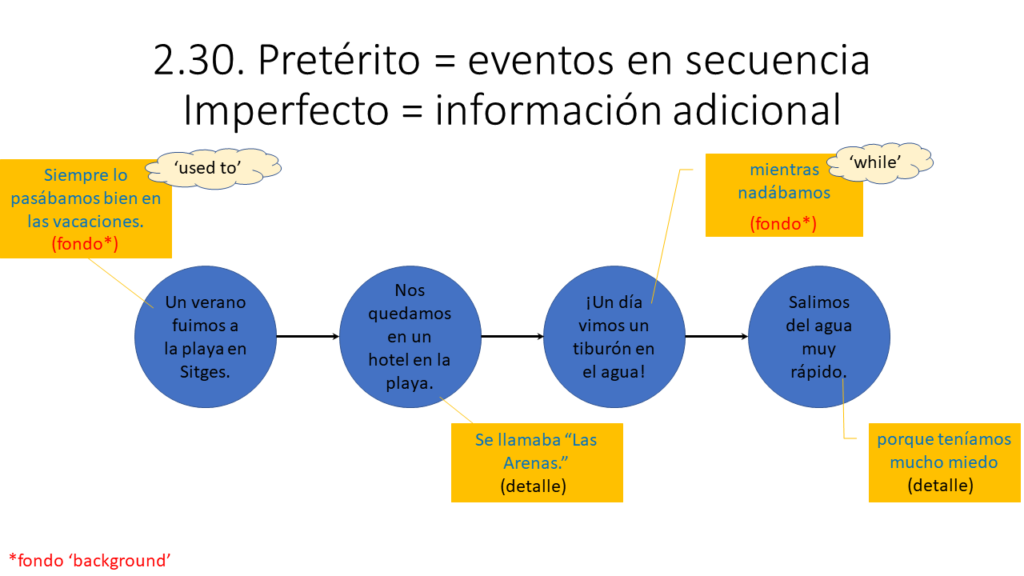
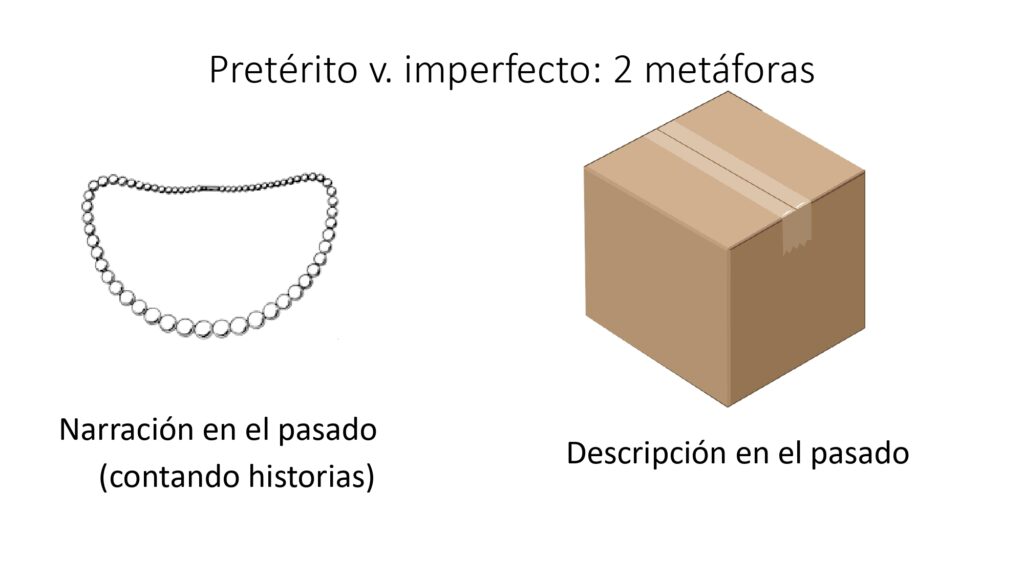
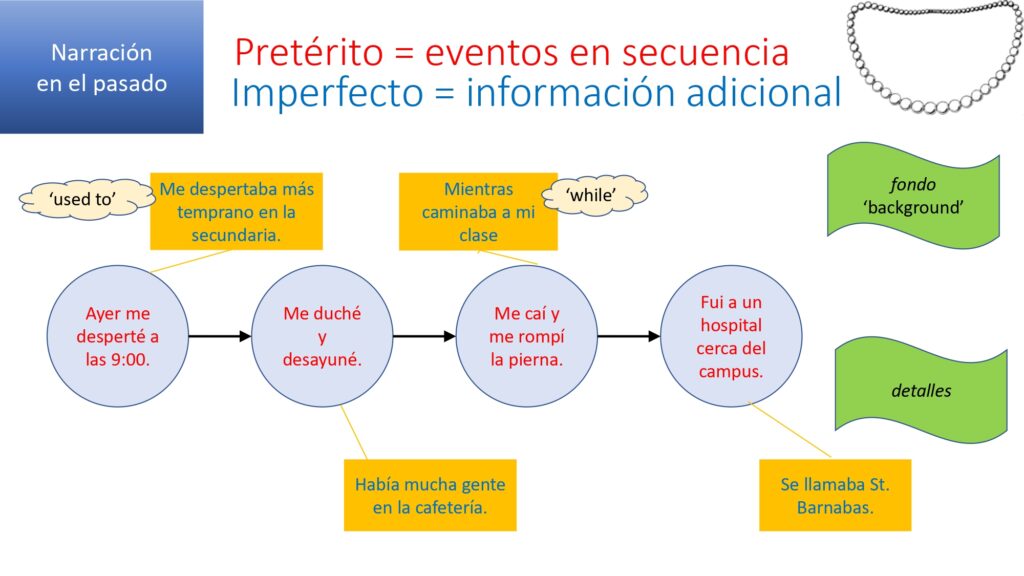
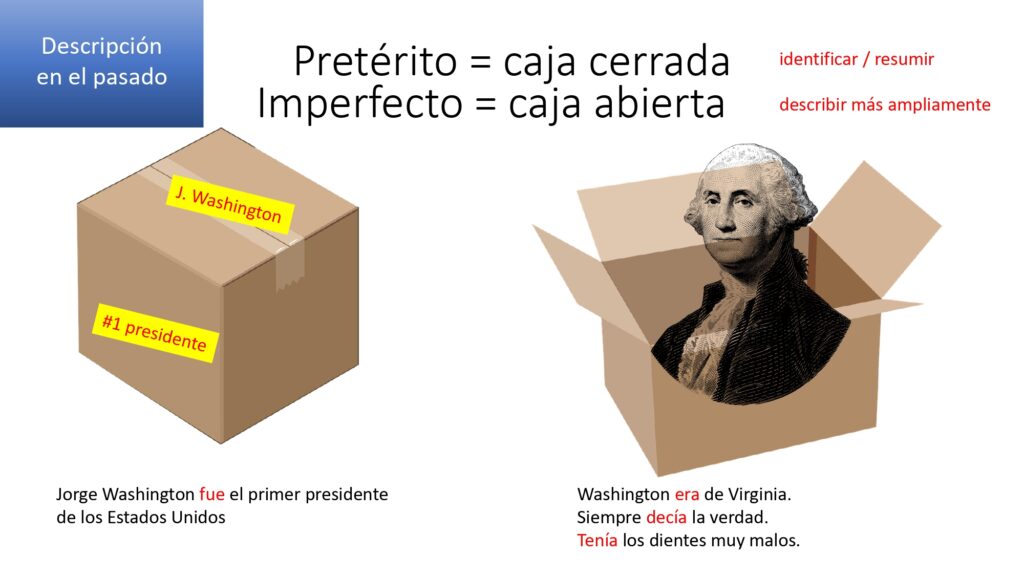
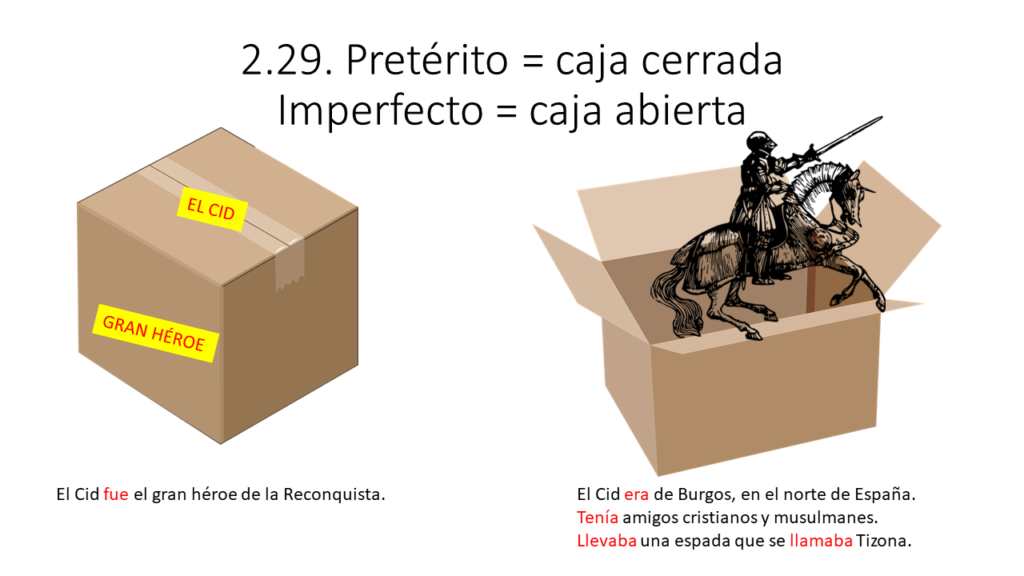
The book’s section on preterite and imperfect introduces two metaphors: beads on a string, and a closed versus open box. Here’s the relevant text from the book, followed by slides that illustrate the metaphors:

The distinction between completed and continuing events is simple in the abstract but elusive in practice. For this reason many teachers train their students to rely on various rules of thumb when deciding between preterite and imperfect. Some of these rules concern the type of past occurrence; for example, students may learn to use the preterite to describe beginnings and endings (e.g. empezó and terminó) and the imperfect to describe the weather (e.g. llovía). Other rules focus on contextual clues, such as specific timeframes for the preterite (e.g. todo el día) and mientras for the imperfect. While helpful, the former rules are fallible (e.g. El orador empezaba a hablar cuando el micrófono falló; Ayer llovió durante tres horas) and the latter are often absent in actual speech or writing. Sooner or later students have to grapple with the aspectual difference itself.

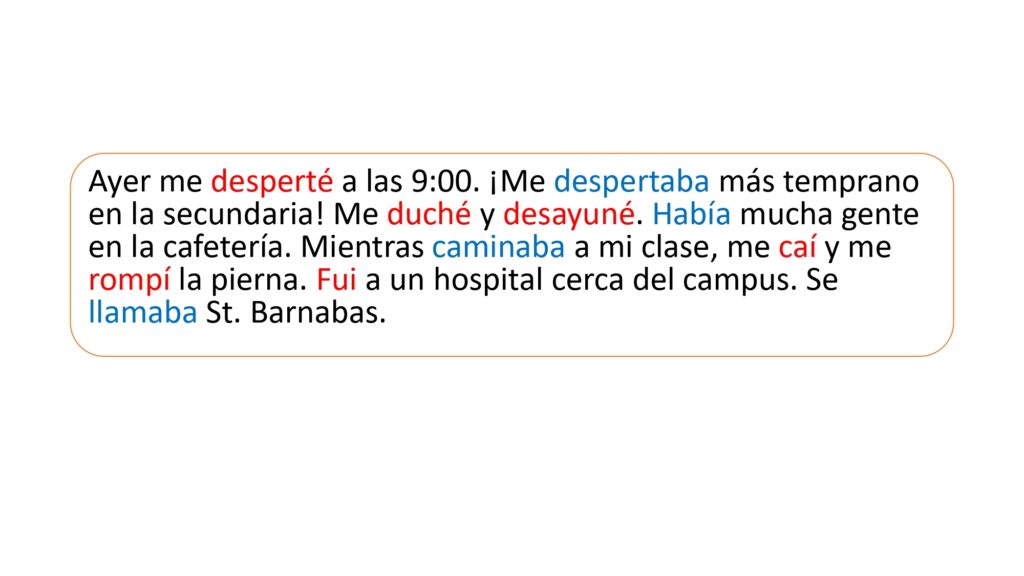
The visual metaphors in Slides 2.29 and 2.30 can help. Slide 2.29 depicts the preterite as a closed box containing a past occurrence (in this case the life of El Cid), and the imperfect as an open box that “unpacks” the occurrence, telling us more about it. This metaphor is particularly helpful when deciding between fue and era. Slide 2.30 depicts multiple preterite events as discrete and sequenceable, like beads on a string. This metaphor is particularly useful when teaching students to construct narratives. The animation in [the PowerPoint version of] Slide 2.30 shows how one can use the imperfect to add color to a bares-bones preterite narrative, an exercise described later in this section. Students may be interested in learning that children usually acquire the two tenses in this same order, i.e. preterite before imperfect (Slide 5.19).

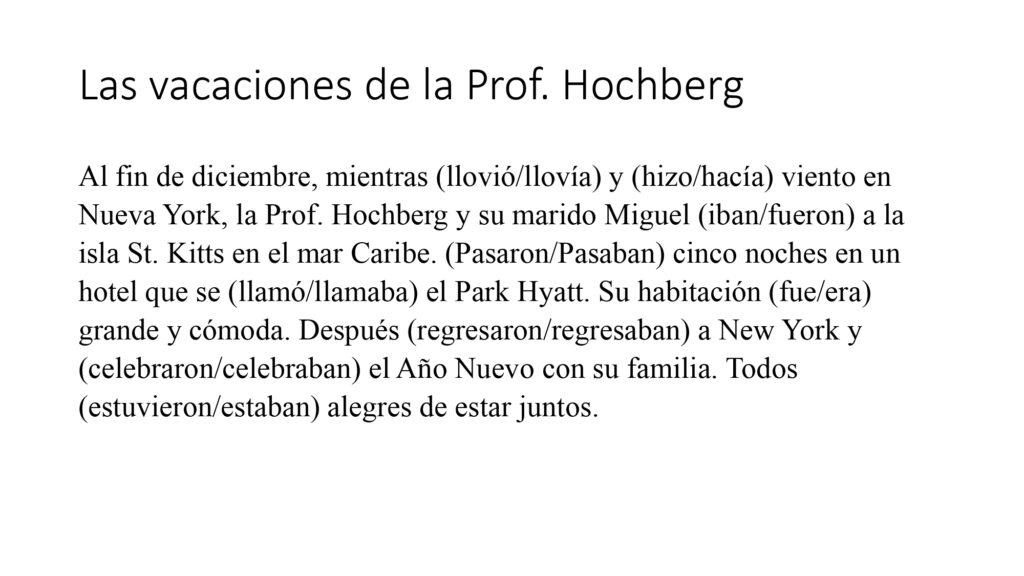
In our first class meeting of the semester, I embedded the slides from my book into a mini-lesson in which I:

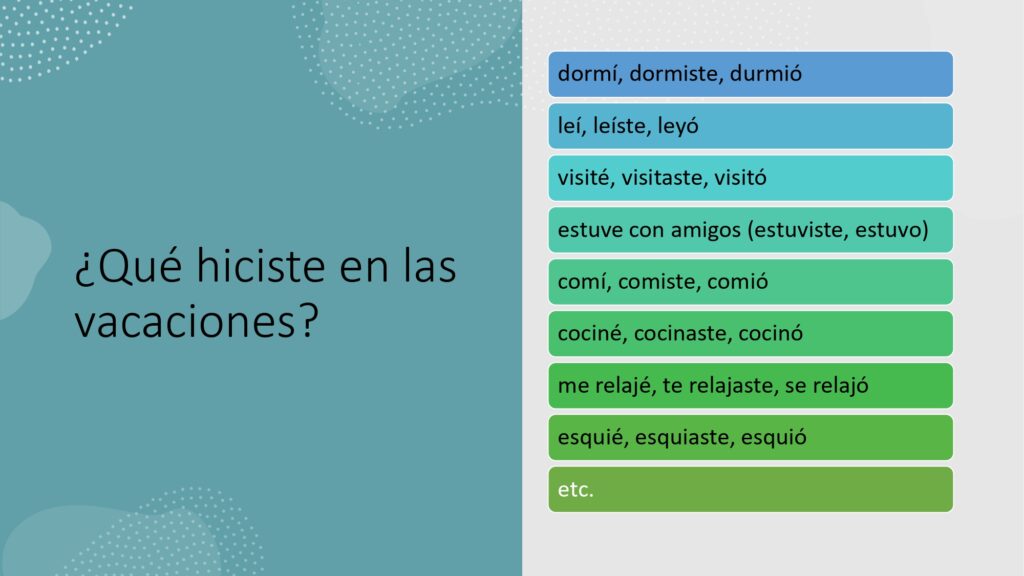
  1. elicited some preterites during a class-opening chat;
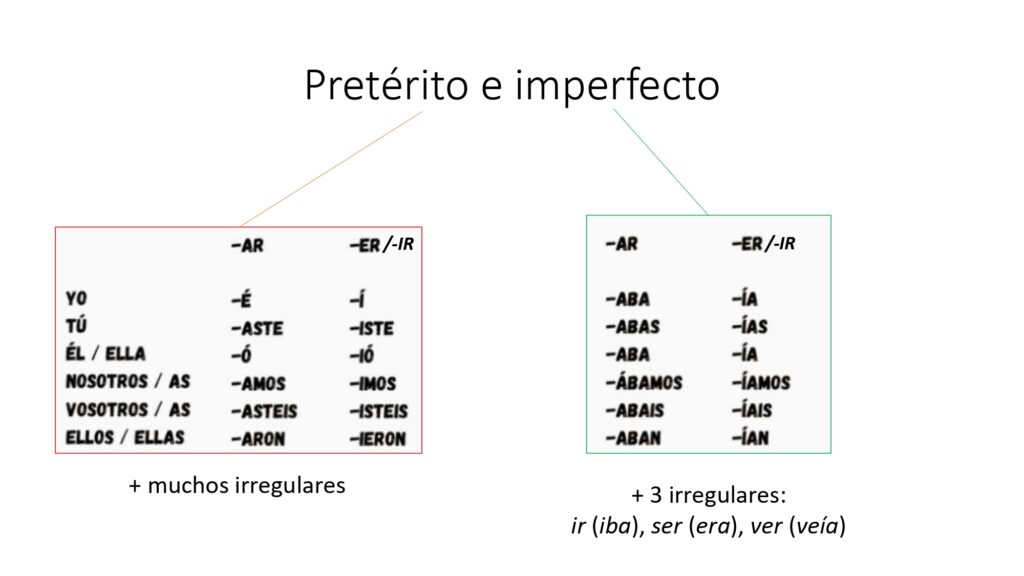
  2. briefly reviewed the two conjugations;
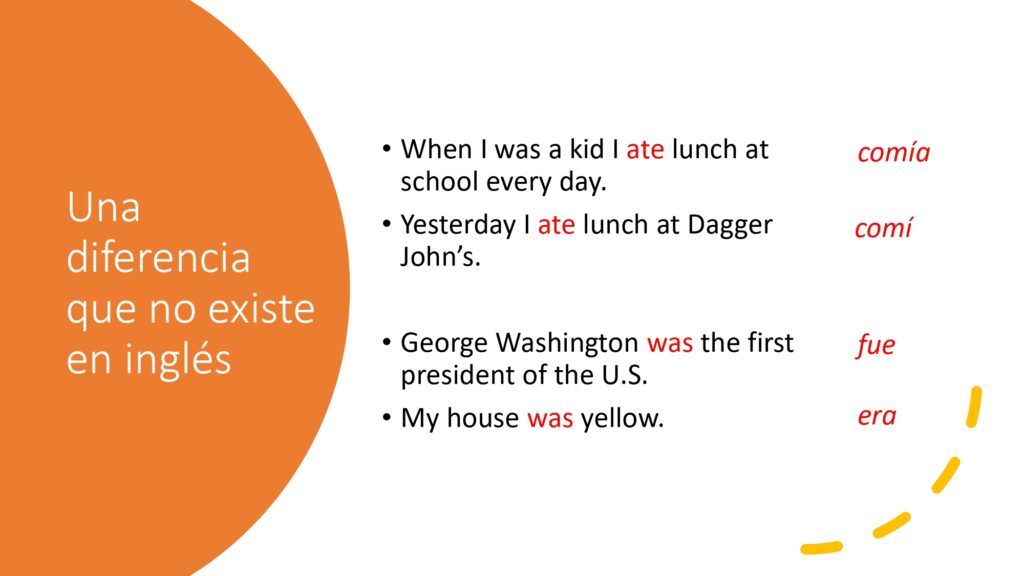
  3. contrasted Spanish with English to explain the challenge of this topic;
  4. presented the two metaphors at a high level;
  5. walked through the “beads in a string” (un collar de perlas) animation in an updated version of my book’s slide 2.30;
  6. showed the result: a natural switching back-and-forth between the two tenses;
  7. presented the open vs. closed box metaphor (again, with an updated version of the published slide);
  8. had students choose between preterite and imperfect in a simple passage.

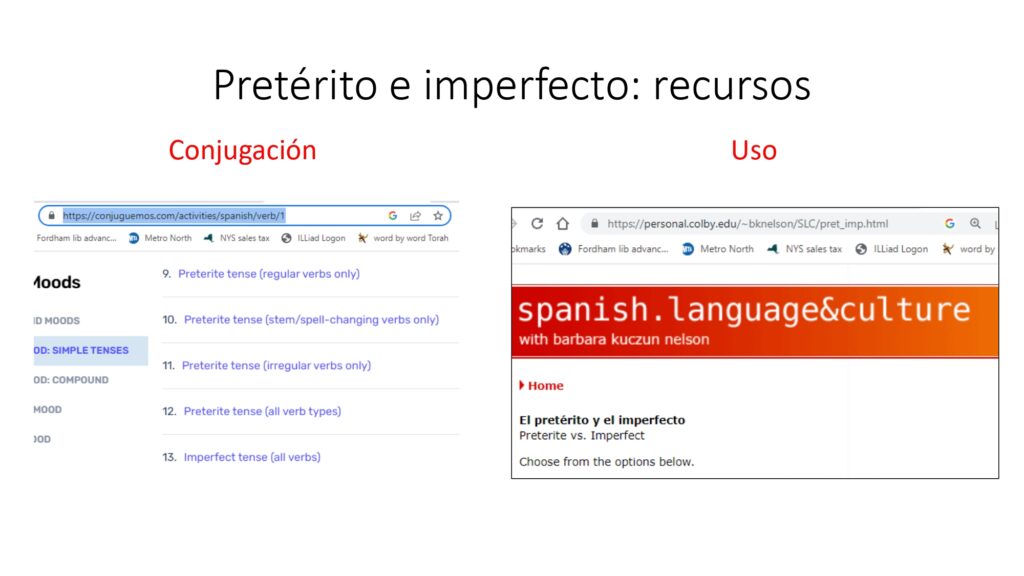
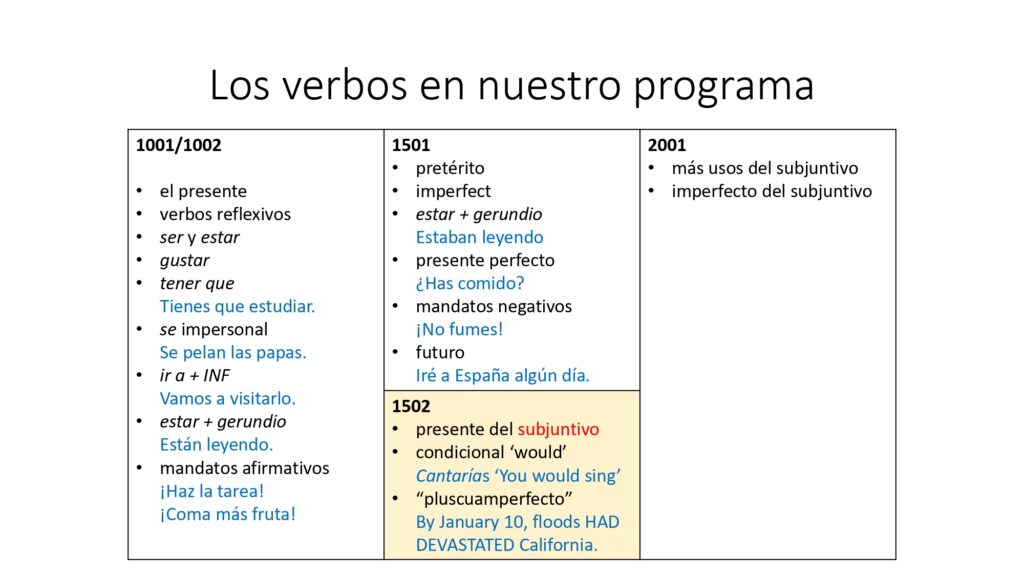
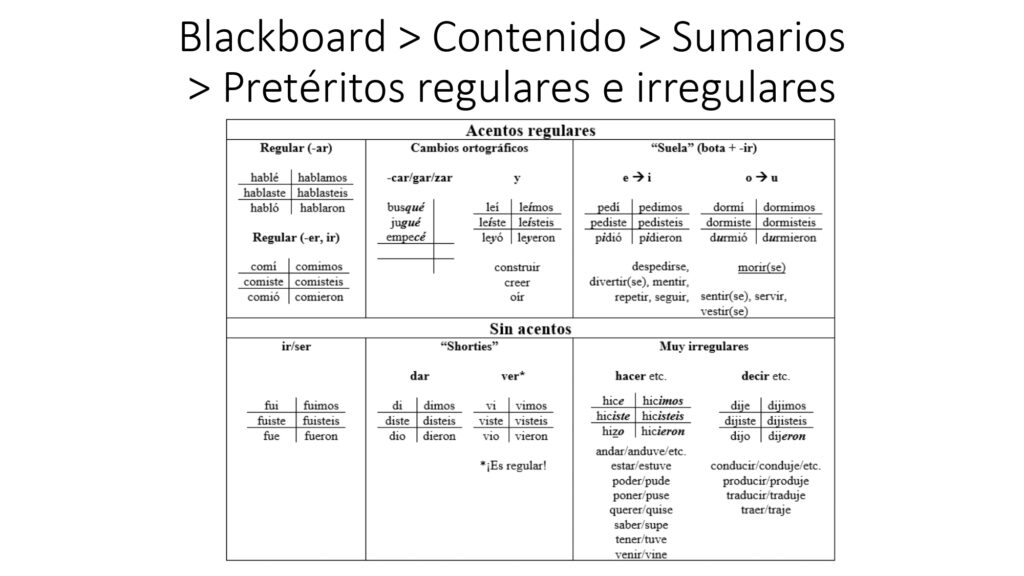
I also presented some favorite resources for students to pursue on their own, including my own divide-and-conquer, one-page summary of the preterite conjugation. A final slide showed them where we were, verb-wise, in our Spanish language sequence.

In the next class, I reviewed the use of preterite and imperfect via a group effort to tell the Cinderella story, then had pairs of students write short and simple narratives of their own, giving them a choice of well-known stories from Noah’s Ark to Avatar. Each pair received three pink index cards on which to write three key events on the preterite, and then white index cards, as needed, for them to add background information and details in the imperfect.

I had never had the chance to classroom-test these specific slides from my book, so it was exciting to finally put them into practice, especially since my students were receptive to the two metaphors. They did a decent job with their narratives; I’ll see how what they learned holds up as the semester rolls on.

Teaching Spanish online

I am now two weeks into teaching my first online Spanish class at Fordham University. I took the spring semester off in 2020 to finish my second book, and then fall semester off because of COVID-19 caution: I didn’t want to commute by train, nor teach in a classroom. So my return to teaching after a year’s absence has coincided with having to learn a new way of doing my job.

My tech background has given me a big head start in this process. Before a dandy mid-life career crisis inspired me to return to my original love of Spanish, I worked for fifteen years as a computational linguistics researcher at Los Alamos National Laboratory, Soliloquy (a start-up that stopped), and IBM’s TJ Watson Research Center. I wrote software for a variety of applications including speech recognition, language identification from document images, dialog analysis, and identification of classified documents. Because of this background, technology doesn’t intimidate me: I enjoy it and retain some decent skills. My heart goes out to instructors who are making the same transition with a more conventional, purely liberal arts background.

Two resources have been particularly helpful in this process: a video by SheriAnn Simpson, the founder of EduNovela.com, and a tool, Google Jamboards.

Dr. Simpson makes a wonderful analogy in her video: teaching in a classroom versus online is like cooking in a kitchen versus a campground. In a kitchen you have all the ingredients and tools that you could possibly need, and can whip up complicated dishes. At a campground you have a smaller set of ingredients and tools, and so are bound for trouble if you try to duplicate in this new venue the same dishes you would attempt at home. Instead, you have to ask yourself, “What kind of dishes can I cook at a campground?” Ideally, you will identify some dishes, such as s’mores, that you could never cook as well at home.

Likewise, you shouldn’t try to duplicate online the same things you do in a classroom. Instead you need to find out what will work online — including techniques that don’t work in the live classroom.

I nodded along with Dr. Simpson when she made this analogy, and shared it with friends, family, and colleagues as I was getting ready to start teaching. But didn’t really sink in until my second online lesson, in which — wouldn’t you know? — I used too many kinds of materials and struck too fast a pace because I was trying to imitate my classroom methodology. Boy, Dr. Simpson sure was right.

In my more recent classes, which have gone better, to avoid overcrowding my lessons I have attempted to apply a second nugget of wisdom from Dr. Simpson’s video. She describes a process of “deconstructing” a syllabus, whereby you identify the main types of activities and assessments that take place during the semester, then choose a limited palette of tools and tasks to accomplish them online. I have been doing this at the level of the individual class, thinking about what I want the class to accomplish and identifying the simplest set of activities and tools that will get us there online.

Specifically (if memory serves), Dr. Simpson recommends not having students use more than two or three different types of software during the semester. Since our students are already using Blackboard (for course communication and some assignments), MyLab (the online component of our textbook), and Zoom, I have decided to keep things simple and only use one software tool during my classes. In January, as I ramped up to teach, I learned about a wide range of tools including Panopto, Screencastify, Peardeck, Edpuzzle, Charlala, Flipgrid, Goformative, Gimkit, Blooket, Nearpod, and Genius Scan. In the end I settled on Google’s Jamboard program because it is so versatile.

In my online classroom, Jamboard takes the place of three tools I use every day in my live classroom: PowerPoint, a whiteboard, and handouts.

  • Like a PowerPoint, a Jamboard can have multiple slides (called “frames”), and can combine text and images. It is less powerful than PowerPoint — for example, you can’t select and arrange multiple objects — but if I have trouble creating something in Jamboard I just make it in PowerPoint and then cut-and-paste it into the day’s Jamboard.

    During the teacher-led portions of my online Zoom classes I screenshare the day’s Jamboard with my students, and use the laser tool to point to different parts of the display. Since Zoom doesn’t let you do a screenshare during a breakout session, I also give my students access to the Jamboard via Google Drive’s sharing settings, so that they can each see the Jamboard on their own devices while in breakout rooms. This is a HUGE advantage.
  • During a live class I write on the whiteboard and often have my students write on it as well. I can do both in Jamboard, the latter by giving students edit access to the Jamboard through Google Drive’s sharing settings. Here is an example, from my most recent class, in which students came up with examples of adjectives with quantifiers. I set up this frame (aka slide) with adjectives as column headings, the vocabulary list on the left, and some examples (the ones labeled “Profe”). The students did the rest, using Jamboard’s sticky notes.

We then went into breakout rooms, during which pairs of students used mas.que, menos…que, and tan…como to compare the people described on this frame. They wrote their comparisons on the next frame (using Jamboard text boxes, not stickies) while I played omniscient teacher and pointed out problems. We then came back as a class and went over their examples.

  • Jamboard also takes the place of handouts. Any informational handout that I would normally distribute in class can be cut-and-pasted into the day’s Jamboard instead. Any handout that I would normally use as the basis for an activity has to be examined and possibly “deconstructed.” In particular, Jamboard doesn’t have tables, so I have to transform any “fill in a table” activity into an alternative format based on stickies or simple text boxes. This is a major nuisance, but Jamboard’s advantages still outweigh this disadvantage (and others).

With only four classes under my belt I still have a lot to learn!!! But I thought it might be helpful to share these first impressions.

Grading Spanish AP tests in Cincinnati

Last month I was among the hundreds of high school and college Spanish instructors who convened in Cincinnati, Ohio to grade Spanish Advanced Placement (AP) tests. [AP tests are a way for U.S. high school students to earn college credit and/or impress the colleges they apply to.] Half the test is multiple choice and is machine-graded. The rest of the test — two speaking tasks and two writing tasks — is graded by humans. I was on the team that graded the writing tasks.

I hadn’t seen an AP Spanish test since I took one as a high school senior! Since then, the test, and its corresponding high school classes, have been divided into two: Spanish Language and Culture, and Spanish Literature. My colleagues and I were in Cincinnati to grade Spanish Language and Culture; the Spanish Literature exam was graded earlier in the month. We were in Cincinnati along with graders for the other Language and Culture tests — Chinese, French, German, Italian, and Japanese — and, oddly, Music Theory. This all took place at the gigantic and soulless Duke Energy Center in downtown Cincinnati.

I applied to be an AP grader a few years ago because my best friend had told me that her own work as an AP economics grader had been a great way to meet colleagues from around the country, and was also a lot of fun. This was the first year the timing worked out for me to participate, and I have to say that my friend was right. According to our orientation, our group included educators from all fifty states, and Spanish speakers from every Spanish-speaking country. It was great to get to know some of them. And the work itself was fascinating.

You don’t sign up for something like this unless you really like grading. I certainly do: it’s always interesting to see what students get right and wrong, and to get a glimpse of their thinking. This experience was, of course, very different from grading my own students’ papers. The main difference was volume. In my own teaching I never have to grade than a couple of dozen papers at a time, or for more than a few hours at a time. In Cincinnati we graded hundreds of papers, working from 8:00 am to 5:00 pm for seven days in a row. Even with morning, lunch, and afternoon breaks, it was hard to keep up one’s energy and attention. It helped that there were no distractions, and that a strong esprit de corps reigned in our giant grading room (Exhibit Hall A). Keeping the good of the test-takers in mind, we aimed to grade the last essay of the day as carefully as the first.

Another difference was that we weren’t grading our own students’ work. It felt strange to be reading essays with a completely blank slate instead of knowing who the students were. This made for a more objective review, however, and is one reason why AP tests are graded centrally instead of by each student’s teacher. it also meant that grading was a single, unidirectional event instead of part of an interactive process. Normally I grade with red pen in hand, pointing out different types of errors for students to fix in a second draft. As an AP grader I wasn’t allowed to annotate the essays I read, or to make notes, even for my own benefit.

A final difference was the type of Spanish in the essays. Most of my students speak English as a first language, and I’m used to reading essays with this population’s typical errors. In contrast, many — or most (65%), according to Wikipedia — AP Spanish test takers are native Spanish speakers. A good fraction of these have not fully mastered the ins and outs of Spanish spelling, despite a year or more of formal study of their language. This means that these essays had a different set of errors: those of someone who has learned Spanish by ear. Typical errors were missing or misapplied accent marks, missing or overused silent h, the substitution of d for r (e.g. pedo for pero ‘but’), and the confusion of ll and y and likewise b and v. (See this earlier blog post for historical examples of the same errors.) I was amazed to see that two students even misspelled the ubiquitous word yo ‘I’ as llo.

The good folks from the College Board did a phenomenal job administering the grading process. This involved recruiting, transporting, housing, and feeding the graders; keeping track of the exam papers; and — most importantly — training the graders so that our scores were calibrated. We spent hours learning how to grade each of the two writing tasks, following a detailed rubric, and had refresher training sessions after each break. Each table of seven graders had a head grader who answered our questions and spot-checked our work. As far as I could see, colleges evaluating AP test results should feel confident that the scores are reliable.

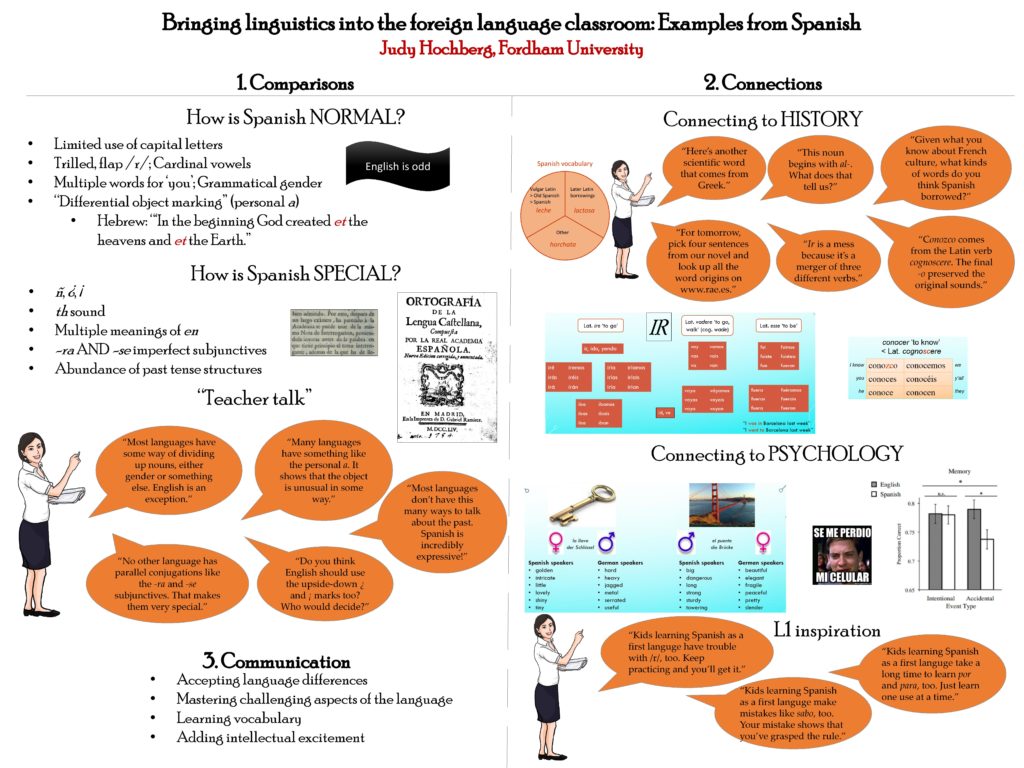
One night during the week was “Professional Night”, and my poster on “Bringing linguistics into the foreign language classroom” (see below) was accepted for the night’s mini-conference. It was well received, and I sold the few spare copies of my book that I had with me. Hooray!

A technical note: I made the poster as a single PowerPoint slide, sized to 4 x 3″, and used “Export PDF” (under the “File” menu) to create the image.


Teacher dreams

I was in fourth grade when I had my first panic dream about school. In this dream I forgot to write an assigned paper about English history; as punishment, my teacher — in real life, a particularly cool guy who drove a Triumph TR6 — “strung me up by my thumbs”, whatever that means. This dream so disconcerted me that at school the next day I delicately inquired among my classmates first thing to make sure we didn’t really have a paper due.

When I started teaching, over ten years ago, my student panic dreams morphed into “teacher dreams” in which I was late to class, horribly unprepared, or otherwise made a mess of my new responsibilities. According to colleagues such dreams aren’t unusual, and in fact Rookie Teaching for Dummies devotes an entire (small) section to the phenomenon. These dreams have definitely declined in frequency as I’ve gained in experience and confidence, but they do come back from time to time.

I wasn’t surprised when I had a doozy of a teacher dream a few nights ago, because this spring I’ll be teaching, for the first time, a higher-level Spanish class with less emphasis on grammar (my comfort zone) and more on reading, writing, and class discussion. In real life I’m looking forward to taking on a new challenge, but obviously my subconscious hasn’t yet gotten the message. In this particular dream I neglected to prepare a lesson plan, left my house late, and then couldn’t find my classroom. A triple failure!

In real life I expect to be ultra-prepared for my new class — not just on day one, but throughout the semester. I hope that with effort, Fordham’s usual terrific students, and a bit of luck, my teaching will grow, my students thrive, and my subconscious give me a break.

13 easy poems from around the Spanish-speaking world

I recently tried out a new idea with an intermediate Spanish class: El día de la poesía (‘Poetry Day’). Each student read a poem from a different Spanish-speaking country and presented it to the class. It was a lot of fun!

Here’s what happened:

  • Each of my students had already randomly picked a Spanish-speaking country to be ‘theirs’ during the semester.
  • I identified an easy poem from each of these countries. For a more advanced or intellectually curious class, I would have asked students to find poems on their own.
  • Each student read the assigned poem, looked up its vocabulary, and met with me to discuss it.
  • Each student prepared a few slides about their poet and their poem’s key vocabulary. These were all combined into a single Google Slides presentation that all students had access to.
  • On El día de la poesía, each student received a photocopy of all the poems (same as download above) and a listening worksheet. The worksheet had a space for students to react to each poem (what they liked or disliked about it) and to evaluate the presentation.
  • Each student presented their poem, first going over their slides, then briefly explaining what the poem was about, and finally reading it out loud. (For a more advanced or intellectually curious class, I would have required them to memorize the poems.)
  • The grading rubric combined preparation, presentation, and listening.