Since I’ve neglected my blog in recent months and even years, a number of links on my Teaching page had become broken. All links on that page are now functioning! If you teach or study Spanish, you should have a look. Please contact me if you ever encounter other broken links on the blog.
This isn’t the post I promised about my next book project. However, it is otherwise related to my “hanging up my sombrero” as a classroom Spanish teacher (same link).
I am now gleefully clearing out Spanish textbooks, and books about teaching Spanish, from my bookshelf. Before discarding Imágenes, a 2007 textbook from Houghton Mifflin by Debbie Rusch, Marcela Domínguez, and Lucía Caycedo Garner, I scanned one of my favorite activities, a retelling of “Jack and the Beanstalk” that helps students acquire the distinction between the preterite and imperfect. Like most English speakers I struggled with this concept, and it wasn’t until I used this specific activity in my own classroom that I finally “got it” myself. Perhaps some of my readers will find it useful as well, for themselves and/or their students.
Many Spanish teachers use familiar stories to teach and practice preterite and imperfect, such as Barbara Kuczun Nelson‘s Superhombre and Ricitos de Oro stories. What I like about this “Jack and the Beanstalk” exercise is that its columnar organization graphically divides the plot elements into those that naturally take the preterite and those that take the imperfect.
By the way, two other Ah-ha!!! preterite/imperfect moments for me were:
When the professor in a summer class I took at the Universidad Complutense de Madrid told us to use the preterite to express an overall evaluation, e.g. thumbs-up or thumbs-down. I later generalized this to an open vs. closed box metaphor.
When an exercise in the same Imágenes textbook showed me that bounded time trumps repetition, so that (for instance) you use the preterite to say that you played golf every day during your vacation. This is an example I’ve mentally returned to over and over again.
The COVID-19 pandemic has really done a number on my brain. I’m not talking about the notorious, long-lasting “brain fog” reported by many survivors of the coronavirus. I haven’t caught the disease and, God willing, will stay healthy until I eventually acquire immunity via vaccination. Rather, I’m talking about a general lack of sharpness. After months of anxiety and cabin fever spiked with a soupçon of political angst, everything I like to do with my normally nimble brain has become a bit harder.
True, I managed to finish, proofread, and index my second book. Maybe that’s “enough to be going on with,” as the saying goes. I’ve also made some headway on my current research project, which concerns Spanish etymology, am gearing up to teach my first online class starting in a few weeks, and have resumed posting on this blog regularly after a substantial hiatus. Beyond Spanish, I’ve forced myself to stay on top of boring but necessary matters like insurance plans and household renovations. I’ve worked with my husband on various photographic projects; those of you who know me personally are aware that this is a vital part of my life and marriage. I’ve even learned how to shop for groceries online, a transition I’ve found surprisingly challenging, both practically and emotionally.
Where I’ve most felt the loss of sharpness is in my reading. I’ve always been an avid reader; my late grandmother always described me as “going around with a book under my arm.” I have happy childhood memories of hours on end spent curled up on the couch with a book. During my junior year of high school I kept track of every book I read, knowing that Harvard’s college application would ask for such a list. This worked out to a mind-blowing average of one serious book and one light book per day, if memory serves (perhaps it doesn’t), excluding books I reread, and also excluding (out of embarrassment) all 24 of Edgar Rice Burroughs’s Tarzan novels, of which I particularly recommend the original Tarzan of the Apes as well as Son of Tarzan and Jane and the Foreign Legion.
This reading mania was only possible because I didn’t have much of a social life, which is pretty sad in retrospect. On the other hand, the many books I read, especially those I enjoyed over and over again, became part of my mental lexicon and taught me how to write by osmosis.
As a child and teenager I read fiction exclusively, dividing my time between meaty 19th century novels, often in translation (e.g. War and Peace and The Count of Monte Cristo), and light 20th century fiction. As an adult I have increasingly read non-fiction, particularly history and biography. I still enjoy light modern fiction but have yet to develop a taste for more serious modern writers such as Paul Auster and John Updike. In recent years I have added light Spanish fiction to the mix as an enjoyable way to continue to build my vocabulary and fluency.
During the pandemic, however, I have found it extremely difficult to muster the focus needed to tackle non-fiction, Spanish, or even, for the most part, novels I haven’t read before. Instead I’ve primarily reread English-language light fiction voraciously, as a kind of mental “comfort food.” This includes all the Jane Austen, Dick Francis, Stephen King, and C. S. Forester novels on my bookshelf, much of the Harry Potter series, some P.D. James, and All Creatures Great and Small, just in time for the new BBC series.
The few non-fiction books I’ve been able to complete, such as Barack Obama’s memoir, have concerned contemporary politics. The one Spanish novel I’ve read, the 11th in my beloved Inspector Mascarell series, took me ages to get into. The fiction I’ve read for the first time has also been light, such as Louise Penny detective novels.
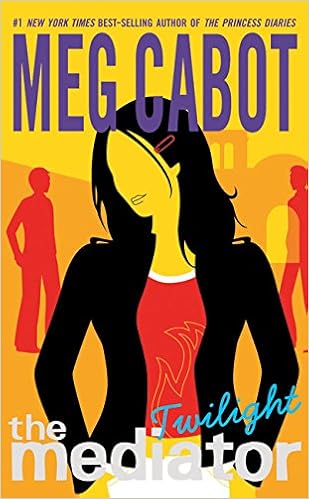
Which brings me to Meg Cabot. Best known for her Princess Diaries series, Cabot is a prolific author who mostly writes for young adults. I harbor the idiosyncratic conviction that her epistolary novel Boy Meets Girl (written for adults) is a work of genius, and am also fond of All-American Girl, which gave me some insight into the artistic process. Of course I reread both of these early in the pandemic. So when my daughter-in-law told me that she used to be into Cabot’s Mediator series, about a teenager who can communicate with the dead, I checked all six Mediator books out of our local library (let’s hear it for curbside pickup!) and had myself a fun time. The first and third books were quite good, but my favorite has to be the sixth, Twilight, which features … drum roll … a paean to learning Spanish!
Specifically, in Twilight‘s climactic scene our heroine Suze has traveled back in time (another mediator ability) to meet “in the flesh” the hunky Jesse de Silva, who was murdered 150 years ago and has been haunting Suze’s bedroom since she moved to California. Suze is unable to understand a crucial conversation between Jesse and his would-be murderer, the nefarious Felix Diego, because — get this — she doesn’t speak Spanish! Suze’s fellow mediator and frenemy Paul translates for her, but first she muses, memorably:
“Why? Why had I taken French and not Spanish?”
There were so many things I liked about this scene. First, it was very funny: for me at least, probably for other Spanish teachers, and hopefully for other readers as well. Second, it was exciting. Suze and Jesse’s relationship had been building over the past five novels, and its fate would depend on the showdown between Jesse and Diego. Third, it was educational. How many young adults today know about the Spanish period in California history? Finally, it showcased the utility of learning Spanish, albeit in a weird context. I hope that this scene inspired some Mediator fans to study the language, or to take their ongoing studies more seriously.
I don’t know whether Cabot speaks Spanish, but I do appreciate her speaking up for my favorite language. ¡Gracias, Meg!
I don’t know why it took me so long, but I finally bought a Kindle. I have been meaning to do this for ages, every since I read this blog post about how easy it is to read a foreign language book on a Kindle. The device comes pre-loaded with a Spanish-English dictionary, so all you have to do is tap on a word and its translation comes up like magic.
My new Kindle in its cute cover
I was also impressed with how easy it was for my friend Sue to “pack” two weeks’ worth of books on her Kindle when we went to Spain together.
The last straw was when my friend Laura raved about her Kindle, and how she likes to check electronic books out of the library. Our local library recently closed for renovations, and I’ve been fuming about the inconvenience of going to the temporary location, which is on the other side of town instead of a few minutes’ walk away. I’m spoiled! So the idea of being able to download a book instead of scheduling a visit had immediate appeal.
I ordered a Kindle Paperwhite ($119) — this is the version that works with the dictionary — and also a cute cover ($13.99) so I can stick the device in my (tiny) handbag and not worry about scratching it. It arrived today and I am already off to the races! I downloaded a random Spanish-language book from Amazon that is included in my Prime membership: Dormir sin lágrimas, a book about getting your baby to sleep through the night. (Thank God I don’t need to actually read it.) Clicked on a random word, and the definition popped up, as promised.
Last week I wrote about my policy of handing out vocabulary lists with the English glosses (translations) written in. (Our textbook does not provide glosses for the end-of-chapter vocabulary lists, only a master list at the end of the book.)
When my students filled out their course evaluations I asked them to let me know what they thought of this practice. My question presented both sides of the issue:
“I like to give you the English translations of the chapter vocabulary to save you time and point out possible pitfalls. But other teachers think that looking up the words yourself is an important step in learning. Which approach do you think is best for you?”
I was pleased to see that my students unanimously appreciated the glosses. Also, even though I forgot ask them to explain their choice, most did so on their own. Saving time was most often mentioned as a benefit. Since this is a most studious group, I wasn’t surprised that many of these students said this was time they could spend memorizing the words or doing other homework.
One student gave a more nuanced perspective on the time factor:
” I looked up all my vocab words myself last year in Spanish class and although it did help me to know them better in the beginning, having the extra time saved from not looking them up meant more time to study them and memorize them later.”
A second benefit often mentioned was accuracy: students said that the glosses kept them from “studying the wrong meanings,” as one student put it.
Given this response, I will definitely continue to provide glosses when I teach this class again.
Some specifics: Sixteen students were present that day, and all responded. Of the thirteen who explained their answer, nine mentioned time and five accuracy. (These add up to fourteen because one student gave both reasons.)
In a workshop I recently gave in Atlantic City, I distributed the following list of possible linguistics-based projects for the foreign language classroom. They are adaptable for a variety of languages and levels of instruction. To download a PDF version, click here.
This list is a subset of the projects included in the companion website for my book, ¿Por qué? 101 Questions about Spanish. Here I divided them into the four categories of “Language history,” “The target language in the world,” “Language learning,” and “Language use”.
If you make use of this list, as an instructor or a student, please write back and let me know how the project(s) turned out.
Language history
Examine a few pages written in an older form of the target language. What are obvious ways that the language has changed?
Look up the origins of the words in either (i) a sample of text from the target language, or (ii) a specific vocabulary domain, such as clothing or animals. Where do the words come from, and what does this teach about the history of your language?
Research and create an infographic about a phase in the history of your language, such as the Golden Age of Spain or the Napoleonic period in France. What were the linguistic landmarks of these periods?
Research vocabulary borrowings into English from the target language. What do they tell you about how the two cultures have interacted?
Research the etymology of a dozen place names (names of cities, towns, etc.) in a country that speaks your target language. What does it this exercise teach you about the language’s history? Summarize your findings on a map or other infographic.
The target language in the world
Use Ethnologue (an on-line database about world languages) to gather data on where the target language is spoken and what other languages are spoken in those countries. Present as an infographic or a slideshow.
Profile a language academy such as the Académie française or the United States branch of the Real Academia Española. Who are the members? What are their activities and/or publications? What would you ask if you could interview them?
Research and present information about a language controversy, such as Catalan versus Castilian in Catalonia, or the historical tussle between French and Alsatian in Alsace.
What information does the most recent USA census provide about speakers of your target language in our country?
Language learning
Try to predict which features of English are most hardest to learn for speakers of other languages. Interview an ESL teacher to test your predictions.
Try a few lessons in the target language from Duolingo, Rosetta Stone, or other language learning software. How does the software try to teach the language? How is this different from classroom learning?
Language use
How might you reform the spelling of your target language to make it easier? Argue for your changes and transform a sample page using your proposed changes.
Pick your favorite language rule: ser vs. estar, passé composé vs. imparfait, and so on. Analyze actual text (perhaps a newspaper article) to see if the rules taught in class explain the actual usage.
Learn how to speak “Pig Latin” in the target language (e.g. Spanish jerigonza). A speed contest may be in order! What do you have to think about as you speak in order to accomplish this?
Find, watch, and compare instructional videos on some difficult aspect of pronouncing your language (like rolling your r’s). Make your own instructional video.
I remember, with excruciating clarity, my most embarrassing moment as a young mother. I was in the supermarket with my two-year-old daughter, Joanna. She always attracted a lot of attention because of her adorable face and her cherubic halo of blond curls. This made it even more humiliating when she decided that she was bored and piped up, in her clear voice that carried for aisles (if not miles), “Mom, let’s get out of this f**ing store!” That’s when I realized it was time for me to clean up my language.
What does this have to do with Spanish?
Last week my second-semester students all gave oral presentations. I had slipped, almost without realizing it, into the habit of dropping the English word so into my Spanish. And just like toddler Joanna, my students did as I did. More than half of them used so in their presentations instead of a proper Spanish hesitation word, like pues or bien. (In Spanish these are called muletillas ‘little crutches’, a term I adore.) As with the supermarket incident, the message was clear: it was time for me to clean up my Spanish.
This incident was particularly galling to me because I am well aware of the linguistic importance of sticking to the target language when using hesitation words. In fact, this was the subject of the best language lesson I ever had as a student, in a class with Harvard’s master French teacher Judy Frommer, Prof. Frommer had every student in the class read out loud a short, innocuous paragraph while attempting to stretch it out as long as possible with French muletillas, or tics de langage, such as bon, donc, alors, and bien. It was a lot of fun, and really drove home an important point: every time you lapse into your own language, even if just for a meaningless syllable, your brain has to do extra work to switch back into the target language.
So — I have turned over a new linguistic leaf, and am doing my best to keep my Spanish pure. I’m sure that my students will register this change, albeit not consciously, and I hope it will help them keep to Spanish themselves.
[Note: I entitled this post “Muletillas revisited” because I thought I had mentioned the topic before…but I haven’t. More’s the pity…]
My previous post presented the Top 10 reasons why Spanish is special. This post presents its opposite: the Top 10 reasons why Spanish isn’t special. Like the previous Top 10 list, it includes examples from Spanish grammar, vocabulary, spelling, and pronunciation.
This Top 10 list was constructed with native speakers of English in mind. It describes core aspects of Spanish that may seem peculiar, but turn out to be normal when considered in a broader linguistic context. Some of these are truly surprising! The inscrutable ‘personal a‘, for example, turns out to be a prime example of a linguistic phenomenon known as Differential Object Marking, while the use of positive expressions like en absoluto (‘absolutely’) with a negative meaning (‘absolutely not’), illustrates a well-known historical process called Jespersen’s Cycle.
To me, the two lists are equally interesting. I love both the special features of Spanish and its reflection of broader cross-linguistic tendencies. I hope you do, too.
[On Halloween, I turned in the manuscript for the book on Hispanic linguistics I’ve been working on for the past 5 years (¡Uy!), and expect to be getting back into more regular posting now that I have more time.]
A contributor to the Spanish subreddit posted some time ago about a terrific website for Spanish learners, called Readlang. Frankly, I don’t know much about Readlang except for what I’ve seen while playing around with the links on the subreddit post, but I strongly recommend that you check it out if you learn or teach Spanish. Each Readlang entry (at least the ones linked to on this post) has a video of a series of speakers reading different thematic passages in Spanish, with the passages reprinted below. You have the usual video controls, plus the ability to slow down or speed up the video. A cursor in the reading passage shows your current location. You can click on any word to get an instant translation.
The entry labeled “Day, Date” gives the country each speaker is from. (I wish all the entries had this feature, but “chiggers can’t be boozers”.)
Here’s a screen shot:
Truly awesome — many thanks to the folks at Readlang and to whoever posted these specific entries on it.
[Today is Spanish Friday so this post is in Spanish. ¡Scroll down for English translation!]
Este aporte no trata de la diferencia entre los verbos saber y conocer, sino de la diferencia entre conocer un aspecto de un idioma abtracta versus íntimamente.
Quisiera empezar con un ejemplo de la experiencia personal de mi marido, cuyo idioma maternal era el francés belga. Entre otras diferencias dialectales, aprendió a usar palabras distintas por 70 (septante) y 90 (nonante) en vez del soixante-dix (60+10) y quatre-vingt-dix (4×20+10) del francés convencional. Cuando habla francés hoy, suele ser con francófonos franceses. Por eso usa los números convencionales: sabe que son lo normal. Pero me dice que cada vez resiste hacerlo. “No puedo creer que verdaderamente usen estos apaños complicados.”
Encontré un fenómeno parecido recientemente cuando estaba preparando un examen para mis clases de español. Como siempre, había incluido una pregunta usando tú y tus amigos para obtener una respuesta usando nosotros. La pregunta específica era algo como ¿Qué van a hacer tú y tus amigos este fin de semana? Una colega española que leyó el examen se quedó horrorizada. Insistió en que la pregunta era gramaticalmente incorrecta porque combinaba la habla informal (tú and tus) y formal (van).
De hecho, solo el español de España mantiene el contraste entre las formas plurales formales e informales. Mi colega, por ejemplo, usa vosotros y sus formales verbales (como vais) cuando habla con amigos, y ustedes (con van) cuando habla con superiores y desconocidos. Pero en Latinoamérica (y Andalucía), se usa ustedes en contextos formales e informales. En este dialecto mi pregunta es correcta.
Para mí, lo interesante de la reacción de mi colega es que por supuesto sabía intelectualmente que “no se usa vosotros en Latinoamérica”. Pero cuando encaró un uso específico, como mi marido con los números “franceses franceses”, su reacción era rechazarlo. Sabe, pero no cree.
Esta diferencia entre conocer y conocer (o saber y saber, o saber y creer) también tiene un gran impacto en el aprendizaje de un idioma extranjero. Cualquier estudiante de español principiante o intermedio se declararía de acuerdo con reglas básicas como “los adjetivos tienen que estar en concordancia con los sustantivos” o “los verbos tienen que estar en concordancia con sus sujetos”. Pero siguen violando estas reglas sin embargo en su español oral y escrito. Por la mayor parte, en mi opinión, es porque no han alcanzado el segundo nivel del conocimiento. Al fondo no han aceptado que el español pueda ser tan diferente del inglés, ni que estas violaciones verdaderamente resulten en español incomprensible. Solo el tiempo y la práctica los van a convencer.
This post isn’t about saber and conocer, the two Spanish verbs that mean “to know”. Rather, it’s about the difference between knowing an aspect of language abstractly versus personally.
Let me illustrate this first with an example from my husband’s experience as a native speaker of Belgian French (no frites jokes, s’il vous plaît). Among other dialectal differences, Belgian French uses distinct vocabulary words for 70 (septante) and 90 (nonante) instead of standard French soixante-dix (60+10) and quatre-vingt-dix (4×20+10). When he speaks French today, it is normally with French speakers from France, and he uses the standard numbers because he knows this is expected. Yet he tells me that every time, he resists doing so. “I can’t believe they actually use those complicated work-arounds.”
I ran into a similar phenomenon recently when preparing a Spanish test. As usual, I had included a question about “you and your friends” (tú y tus amigos) in order to trigger a “we” (nosotros) answer. (The exact question was something like ¿Qué van a hacer tú y tus amigos este fin de semana?) A Spanish colleague who looked over the test insisted that the question was grammatically incorrect because it combined informal address (tú and tus) and the formal plural verb form van.
In fact, only peninsular Spanish, as exemplified in the Spanish of Madrid, maintains a contrast between informal and formal address in the plural. Thus my colleague uses vosotros when addressing friends, and ustedes when addressing superiors and strangers. The same goes for the associated verb forms, such as informal vais versus formal van. But in Latin America, as well as Andalusia (southern Spain), ustedes and its verb forms are used in both formal and informal contexts. In this dialect, my usage was perfectly correct.
What interested me about this exchange is that my colleague certainly knew that “Latin Americans don’t use vosotros“. Yet when it came to a specific application of this knowledge, her reaction was rejection, or even revulsion, just as when my husband has to force himself to use the “French French” numbers. She knows, but she doesn’t believe.
This difference between knowing and knowing also strongly affects second language learning. Any beginning or intermediate Spanish student will agree that “adjectives have to agree with nouns”, “verbs have to agree with their subjects”, and so on. They can probably list examples of correct agreement. Yet they continue to violate the rules in their spontaneous spoken and written Spanish. This is largely, I believe, because they haven’t progressed to the second level of knowing. In their heart of hearts they haven’t truly accepted that Spanish can be so different from English, and that violating these rules genuinely results in incomprehensible language. Only time and practice will drive the reality home.