Author Archives: jhochberg

An imperfect novel

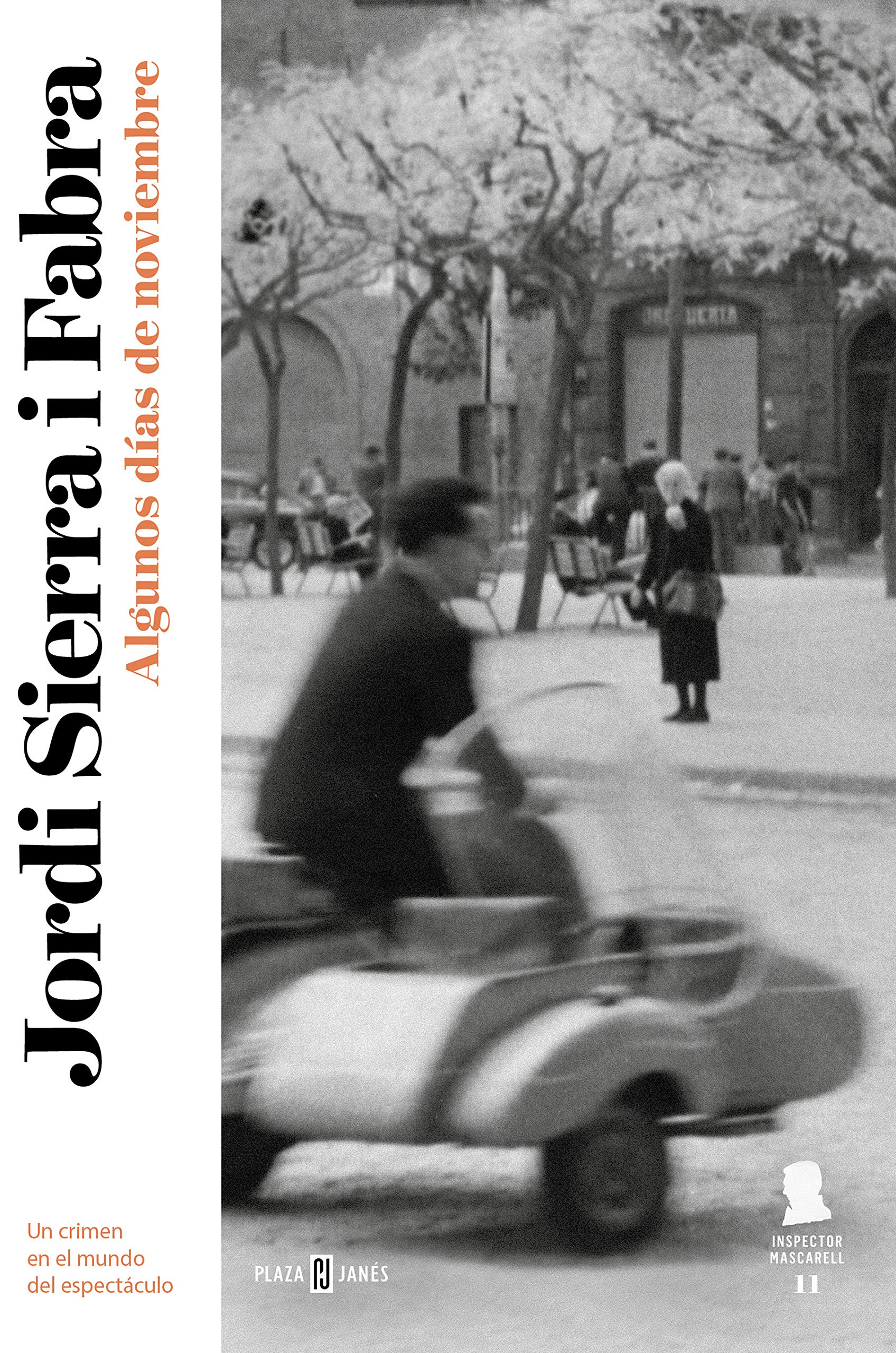
This post is about the eleventh and most recent book in Jordi Sierra i Fabra’s “Inspector Mascarell” series, Algunos días de noviembre, which I finished reading last night. I called this post “An imperfect novel” for two reasons. First, the book contains a fascinating use of the Spanish imperfect tense, which I’ll get to later. But also the novel itself, while enjoyable, struck me as imperfect because it added little to Sierra i Fabra’s serial depiction of life under a dictatorship.

The plots of the previous novels in this series have blurred together for me, but my impression is that they have all related to broad political themes. This is most obvious in the first novels, which take place just before and after Francisco Franco’s victory in the Spanish Civil War. Out of the later novels I remember one that involved an attempt to assassinate Franco, one that featured Civil War graves (or was it missing soldiers?), one about Communists, and so on.

In contrast, the plot of Algunos días de noviembre concerns a theatrical agent who receives threatening letters, and a murder that then ensues in his circle. I kept waiting for something to happen that would tie in this plot with Sierra i Fabra’s major themes. The mystery itself was enjoyable, and I ended up pushing on to the last chapter to find out what happened, but it never made sense that Mascarell, and not some other detective, would be pursuing this investigation.

Beyond this (for me) major problem, Algunos días has all the familiar and pleasurable plot elements of a Mascarell novel, which to this habitual reader feel as comfortable as slipping on a favorite pair of shoes: Mascarell’s traversal of Barcelona, his family (no spoilers!), his dislike of chatty cab drivers, his skill in interviewing suspects and other persons of interest, and his dogged pursual of the truth at any cost. You do learn something about the theatrical and cinematic scene in Barcelona in the early 1950s, thanks to Sierra i Fabra’s research in newspaper archives as described in an afterword.

One of these days I am going to reread these books while consulting a map of Barcelona. The novels have a strong sense of place but I am mostly reading them ‘blind’ beyond major landmarks such as Diagonal, a major street in the city, and the Tibidabo hill.

The Spanish in Algunos días also strikes familiar notes. I’ve previously written about Sierra i Fabra’s ample leísmo and his use of both the -ra and -se imperfect subjunctives, sometimes juxtaposed in a single sentence. The book includes two or three instances each of the verb restar and the noun horma, both old favorites of mine. Beyond these details, I got a kick out of following the often elliptical Spanish in the book’s many casual conversations between Mascarell and his partner David Fortuny, such as the following:

Mascarell: Venga, vamos.
Fortuny: Pero déjeme a mí, ¿eh?
Mascarell: Toda suya.
Mascarell: ¿El arma?
Fortuny: Ni rastro.
Fortuny: Caray, usted impresiona, ¿eh? Sin decir que es policía, la gente se lo suelta todo.
Mascarell: Quien tuvo, retuvo.
Fortuny: Una chapuza.
Mascarell: Más bien sí.
Fortuny: Pero contando con lo aislado que está esto y que nadie sabe mucho de Romagosa…
Mascarell: Lo lógico es imaginar que nadie daría con el cadáver en días, semanas, incluso meses.
Fortuny: Mascarell, ¿por qué habla en plural? “Lo mataron”, “lo arrastraron”, “le quitaron”…
Mascarell: Deformación profesional. No me haga caso.

Reading exchanges like these is like watching a Spanish movie, but without the challenge of understanding rapid speech!

[Spoiler alert!!]

For me, however, the most intriguing bit of Spanish in the novel was the following sentence, which means ‘Concepción Busquets hired them to solve the case and died a few hours later,’ and appears just after Mascarell and Fortuny learn about Busquets’s murder.

Concepción Busquets les encargaba resolver el caso y moría a las pocas horas.

It struck me as bizarre that the verbs encargaba and moría are in the imperfect past tense, which Spanish normally uses to describe ongoing events or to provide background information. Moría, for example, would usually be translated as ‘was dying’ or, in another context, ‘used to die.’ I would expect this sentence to be written instead in the preterite past tense, which is normally used for sequences of events, i.e.

Concepción Busquets les encargó resolver el caso y murió a las pocas horas.

or perhaps

Concepción Busquets les había encargado resolver el caso y murió a las pocas horas.

thus combining the pluperfect había encargado ‘had hired’ with murió ‘died’.

I consulted a variety of sources to solve this riddle, and was amazed to find out how many tertiary uses the imperfect has. The Real Academia Española’s authoritative Nueva gramática de la lengua española describes several less-common uses of the imperfect, none of which accounts for the Concepción Busquets example:

  • the imperfecto onírico o de figuración, which describe dreams (I knew about this, but it doesn’t apply here);
  • the imperfecto de cortesía, which describes present actions politely (doesn’t apply here);
  • the imperfecto citativo, which tactfully distances the speaker from a presumed fact he or she mentions (doesn’t apply here);
  • the imperfecto prospectivo, which talks about things that were going to happen (doesn’t apply here);
  • the imperfecto de hechos frustrados, like the former use but applied to events that didn’t actually happen (doesn’t apply here);
  • instead of the conditional in the “then” part of an “if…then” sentence (doesn’t apply here).
  • The Gramática‘s example of the imperfecto de interpretación narrativa, which describes an action that follows another, is eerily similar to the example at hand: Apretujó mi mano con su mano sudorosa y a los dos días moría ‘She grasped my hand with her sweaty hand and died two days later.’ However, this explanation would leave encargaba unaccounted for.

I had better luck with Ronald Batchelor and Christopher Pountain’s Using Spanish, which points out that “the imperfect is often used in journalistic [officialese] in place of the Preterite.” This could apply in the case at hand, since Mascarell is stepping back and summing up the state of the case. However, my favorite interpretation comes from a native speaker on reddit.com/r/Spanish who thought the imperfect in this context expressed irony. That’s a perfect fit, but I wish I could cite a published work rather than a miscellaneous redditor.

So, all in all, a difficult sentence. I welcome additional theories.

As a final note, Sierra i Fabra’s afterword includes his chronology in writing this 313-page book. He outlined it in five days and wrote it in eighteen. ¡Caramba!

The joys of proofreading

As I mentioned in my previous post, recently I have been immersed in correcting the proofs of my new book and creating an index for it. A few days ago I finished proofreading and emailed back the corrected proofs. The index is basically done but I want to hold onto it a little longer just in case I think of some improvements.

It occurred to me that some aspects of the proofreading process might be interesting to my readers. Those of you who have published a book yourself may find some points in common. Otherwise, you might be surprised at how many different types of problems can crop up along the road to publication. Leaving aside gory details having to do entirely with formatting, such as subsections accidentally being promoted to sections and vice versa, I made a total of 166 corrections to the proofs.

Proofreading is the fifth stage in book production. In my particular case,

  1. I submitted my original manuscript in Microsoft Word, with one file per chapter.
  2. The publisher’s copy editing team edited each file, making comments using Word’s tracking functionality.
  3. I reviewed the edits; my job was to accept, reject, or comment on each one.
  4. Taking into account this review, the publisher produced a typeset version of the entire book in a single PDF file.
  5. I read the proofs and entered my comments in the PDF, using Adobe’s commenting functionality. (I also made a complete printout to work from, but found that the online version was easier to study closely. However, I used it when creating the index.)
  6. I will supply said index.
  7. The publisher will correct the proofs based on step #5 and add the index.
  8. Publication!

Of my 166 corrections, only four of were “do or die.” That is, I can’t imagine the book being published with these errors uncorrected. The first two were essentially “slips of the tongue” on my part — one in English and one in Spanish — that led to nonsensical text. I’m horrified that I made these goofs in the first place, and surprised that they made it as far as the proofs. (As my late sister used to say, “There’s a reason why they included the word mistake in the dictionary.”) The third was a doozy of a typesetting error, and the fourth was a genuine content error. Chances are nobody but me would ever had noticed it, but I had to make it right as a matter of academic integrity.

ErrorWhat happened?
“Most Latin Americans use the two singular pronouns and usted and the plural pronoun vosotros.”I meant ustedes, not vosotros.
La “a personal”, una estructura que evita mencionar la persona que causó un accidente, también afecta el pensamiento.I meant “se accidental,” not “a personal.”
“Real Academia feminine”The copy editor changed my original Española to Español, which I requested they change back to the feminine form Española. Guess I shouldn’t have used the word “feminine.”
“Of the sixty-three other languages Dahl surveyed, only Kikuyu, a Bantu language of Africa with seven major TMA categories, surpassed Spanish.”Having reread my original source, I now see that Catalan also has more major past tenses than Spanish, as shown below, though Spanish is still an outlier. Fortunately I was able to fix this easily, by adding the 2 words “Catalan and.”
Catalan and Spanish both have imperfect, simple past, present perfect, acabar de immediate past, progressive, and pluperfect. But Catalan also uses the verb anar ‘to go’ to make a periphrastic past tense (instead of a future). Based on Osten Dahl (1985), Tense and aspect systems, pp. 170-71.

A few dozen corrections had to do with typesetting conventions for talking about language. These corrections fixed errors that for the most part, were not present in my original manuscript, but were introduced during copy editing and typesetting.

  • Italics were a real nuisance. In linguistics, as in normal typesetting, we use italics to indicate words that are being talked about rather than being used for their own meaning, whether in another language, as in “My favorite Spanish word is disfrutar” (which happens to be true), or in the text’s own language, as in “My favorite English word is salmon” (I just made that up). If a block of text is itself in italics, a word referred to should be in plain roman, as in “The many descendants of Latin ille.” I corrected 29 cases of italics that should have been roman or vice versa, mostly in the book’s headings and subheadings.
  • It’s a linguistic convention to indicate suffixes with a hyphen (e.g. -zco verbs) and likewise to enclose meanings between single quotes (e.g. Latin ille ‘that’), not double quotes. After step #3 above (copy editing) I caught many missing hyphens, and instances of double quotes instead of singles, but a handful remained. In general these errors were not present in the manuscript, but were introduced during copy editing or typesetting.

I made a few dozen corrections to the Spanish in the book. These fell into five categories:

  1. The Oxford comma, as in the second comma in I like vanilla, chocolate, and strawberry. Spanish doesn’t use the Oxford comma, but I’m addicted to it, so this is a hard error for me to avoid. I removed several such commas in step #3 but found twenty (!!) more to remove in the proofs. I hope this has cured me from making the same mistake in the future.
  2. Accent marks. I’m glad to say I did a decent job catching my own accent mark mistakes earlier in the publishing process, but I found two more in the proofs: the missing accents on rincón and one instance of yeísmo. All the other occurrences of yeísmo or yeísta in the book had their proper accents, so I don’t know how I missed this one.
  3. Punctuation. For some strange reason, punctuation such as commas and periods precedes quotation marks in English, as in “I love you,” he said. Spanish is more sensible, putting such punctuation after the speech being quoted, as in “Te amo”, me dijo. I found and corrected one or two instances of English-style punctuation in the page proofs. (My fault.)
  4. Hyphenation. Routledge hyphenated the book as part of the typesetting process. Since Spanish syllabification is one topic I explored in the book, I was amused to find four Spanish words that were incorrectly hyphenated. Obviously Routledge’s software wasn’t programmed for Spanish syllables. The problematic hyphenations were:
    1. pensam-iento (the syllables are pen.sa.mien.to)
    2. pert-enecer (the syllables are per.te.ne.cer)
    3. ust-edes (the syllables are us.te.des)
    4. nu-era (the syllables are nue.ra)
  5. Other mistakes. My Spanish will never be perfect! I caught some missing prepositions, as in el uso DE los signos invertidos and diferenciaban ENTRE sujetos, and a couple of gender errors.

My English is better than my Spanish, but that didn’t stop me from making some mistakes in my own language, such as dropping the the in during the activity, or forgetting the closing comma in an appositive clause (“The teacher first identifies an interesting text, such as a recent article in the Catalan edition of El País (cat.elpais.com) [missing comma here] and reads the first few paragraphs”). Some errors were introduced during typesetting, such as dropping another the in the book’s introduction (“for (the) Chapter 4 in-class activity”). I hope I found (and fixed) all of these.

I tried to clear up inconsistencies, from the spelling of descendants to the capitalization of WebQuest to the uniform use of English terms for places (Cadiz, not Cádiz; Basque Country, not País Vasco) and languages (Mozarabic, not mozárabe).

Finally, I made about two dozen “corrections” that were really improvements, both in punctuation and in wording.

Latinx

I am working ferociously to finish correcting the page proofs for my new book, and to create an index (a painful task that I actually relish), so this is just a short post to say “hello” and share an interesting article I just read in the Washington Post about the word Latinx.

Latinx is an example of gender-neutral Spanish, one of several attempts to reduce or eliminate the use of -o and -os for masculine words and -a and -as for feminine word. In standard Spanish latino (note the lower-case l) is simultaneously masculine and neutral, so it can be used to identify either a Latino male or a Latino of unknown gender, as in La empresa espera contratar un latino para ese puesto ‘The company hopes to hire a Latino for that position.’ Likewise latinos refers to either a group of Latino males or a group of Latinos of mixed gender, male and female.

As in English, where the normative use of he has ceded ground to they, in today’s Spanish many speakers (and writers) try to avoid using gender-specific endings. In Spanish-speaking countries one often sees the @ character (called arroba in Spanish) used as a neuter vowel, as in this ‘Welcome refugees’ sign I saw in Valladolid a few years ago:

The x is also used as an alternative to the @; that’s the source of Latinx, which in my experience is found more often in the United States than in Spain, at least (I can’t generalize to other Spanish-speaking countries).

Anyway, the Washington Post just ran an op-ed, by their reporter José A. Del Real, asserting that “‘Latinx’ hasn’t even caught on among Latinos. It never will.” The article is behind a firewall, so here’s the key claim in case you can’t access the article:

“The label has not won wide adoption among the 61 million people of Latin American descent living in the United States. Only about 1 in 4 Latinos in the United States are familiar with the term, according to an August Pew Research Center survey. Just 3 percent identify themselves that way. Even politically liberal Latinos aligned with the broad cultural goals of the left are often reluctant to use it.”

The anti-Latinx reasons cited in the op-ed are its awkward pronunciation (especially in the plural), the preference among LGBTQ Latinos for Latine, and resistance to stamping a broad community with a single ethnic label. (The latter makes the term Hispano equally problematic.) The op-ed reports that “people of Latin American ancestry in the United States often prefer to describe themselves by referencing their specific countries of heritage, according to a 2019 Pew survey.”

Top 10 slides from my new book

  • As I described in my previous post, each chapter in my forthcoming book is accompanied by a PowerPoint presentation. The presentations display explanations and descriptions, diagrams, word lists, sample data from research studies, maps, quotations, images, and links to other images as well as articles and videos. Some slides provide instructions and supporting materials for in-class activities and take-home projects. The PowerPoints are in Spanish except for an occasional English translation.

The five PowerPoints contain more than three hundred slides in total. You can follow this link to download a PDF file that reproduces my fifty or so favorites, two per page. Besides its title, each slide is identified by its chapter and slide number. Please notice and respect the copyright notice on each page.

Narrowing down further, I created a SlideShare presentation from my “Top 10” of these slides, which you can click through below. It includes examples from all five chapters, thus representing my five “essential questions” for the Spanish language classroom.

Here’s why these slides made my Top 10:

  • Slide 1.21, because the Real Academia Española’s 1763 spelling guide shows both the invention of the inverted ¿ and ¡ marks (blue highlighting) and why the Academia thought they were needed (yellow highlighting). How often does one get to observe the invention of a new language feature? It’s reminiscent of Scott Fahlman’s invention of the first emoticon in 1982. As noted in the slide, the RAE actually invented the inverted marks in 1754.
  • Slide 2.29, because this is one of my favorite metaphors for the difference between pretérito and imperfecto.
  • Slide 2.43, because it illustrates the value of the often-mystifying “personal a.”
  • Slide 3.58, because it demonstrates the variety of languages that Spanish has borrowed words from. The PowerPoint version of this slide (not the SlideShare version), is animated so that students don’t see the “answers” (the language each word came from) until the profe clicks on the slide. There is also a more challenging alternative version that lacks the list of candidate languages.
  • Slide 3.78, because it shows that a little bit of language history goes a long way toward explaining irregular verbs in modern Spanish. A teacher can display this slide in class while saying something like “La forma irregular conozco viene del verbo latino original, cognoscere”, with an emphasis on the sc.
  • Slide 4.41, because the average Spanish student has no idea how many Latin Americans still speak indigenous languages. The contrast with the situation in the United States is startling.
  • Slide 4.53, because I was so happy to find a single illustration that covered so many sociolinguistic bases.
  • Slide 5.9 out of sheer vanity. This slide illustrates one child’s early semantic extensions of some early words: he extended manzana from apples to other fruits, guaguau from dogs to other animals, and agua from water to various objects connected with it. I was tickled pink that I came up with the idea of using colored ovals to neatly distinguish these three groups of words.
  • Slide5.23, because our students will be happy to learn that kids learning Spanish as a first language make the same mistakes that they do!
  • Slide 5.31, because these data on adult native speaker speech errors are not well known, yet provide a fascinating insight into the psychology of language. The thought clouds show what the speakers intended to say. The PowerPoint version of the slide is animated; students have a chance to deduce these meanings for themselves before teachers click on the slide to reveal them.

Book #2 update

My second book, Bringing Linguistics into the Spanish Language Classroom: A Teacher’s Guide, is progressing toward its March 30, 2021 publication date. Although the book hasn’t yet shown up on Amazon it is already available for pre-sale at a 30% discount on Routledge’s website. There you can also see the Table of Contents, which is essentially a list of the linguistic topics the book covers.

To be perfectly honest, I originally conceived of this project as a way to promote my first book, my beloved ¿Por qué?. This is akin to having a second baby just so your first-born has someone to play with. (See also the plot of My Sister’s Keeper.) But like any good writer, or mother, I fell in love with the project for its own sake:

  • as a way to share important information about Spanish with my fellow teachers;
  • for the creativity required to design the in-class activities and take-home projects that accompany each linguistic topic;
  • for the challenge of creating more than 300 PowerPoint slides that teachers can use along with the book;
  • as a way to promulgate the five “essential questions” for foreign language instruction I wrote about here;
  • for the additional insights I gained into Spanish linguistics as I worked on the book.

I submitted my manuscript to Routledge at the end of July. At the end of September I resubmitted it after making some changes in response to a peer reviewer’s feedback. This step was very helpful, which is the whole point of academic peer review. For example, the reviewer pointed out that my section on the history of Spanish pretty much stopped with the conquest of the Americas (whoops), found some Spanish mistakes (¡Ay!), and suggested that I tackle the topic of preterite versus imperfect.

Routledge then turned the manuscript over to codemantra, a book production company based in southern India. (My contact there is a Tamil speaker.) They copy-edited the manuscript and sent it back to me for my own review, which I completed the day after Thanksgiving. I discovered some additional Spanish mistakes, such as a missing accent on marítimo, the invented word *colonista for colonizador, and closing punctuation placed inside quotes as we do in English, e.g. *La “a personal,” for La “a personal”, Between errors like these, and the English typographical errors the copy editor had turned up, I am forcibly reminded of one of my late sister’s favorite sayings, “There’s a reason why they put the word mistake in the dictionary.”

While all this was going on I was working with my Routledge editor on the book’s cover design. You can see the results in this blog’s right-hand sidebar, or click here. I found the speech bubble portion of the cover on the Getty Images website and thought it nicely evoked a classroom environment, The text I chose for the bubbles represents the range of topics and techniques in the book. I am a little worried about the legibility of the word rights in the rightmost bubble, but we weren’t allowed to monkey with Getty’s bubble colors.

Codemantra expects to send me the page proofs in mid-December. I will then have two weeks to create an index, a process I enjoyed when publishing ¿Por qué? There are professional services that will make an index for you but I can’t imagine anyone else understanding the book well enough to do an adequate job. That will be my last input before the book comes out in March.

Between each of these steps I have been working on a new research project regarding Spanish etymologies, which I hope to share with you soon, and also worrying about how to teach my first all-remote Spanish class starting in February. I have also purchased Instagram for Dummies and plan to put it to good use. So, lots to keep me busy!

A mini-festo

Last September the NECTFL Review published my article Essential Questions for Linguistic Literacy in the World Language Classroom. I wrote this article as a warm-up before tackling my next book project, Bringing Linguistics into the Spanish Language Classroom: A Teacher’s Guide, now in press with Routledge. The article was an opportunity to think through the general issues the book would cover before applying them to Spanish. Parts of it found their way into the book’s introduction (with the Review editor’s blessing, for which ¡muchas gracias!).

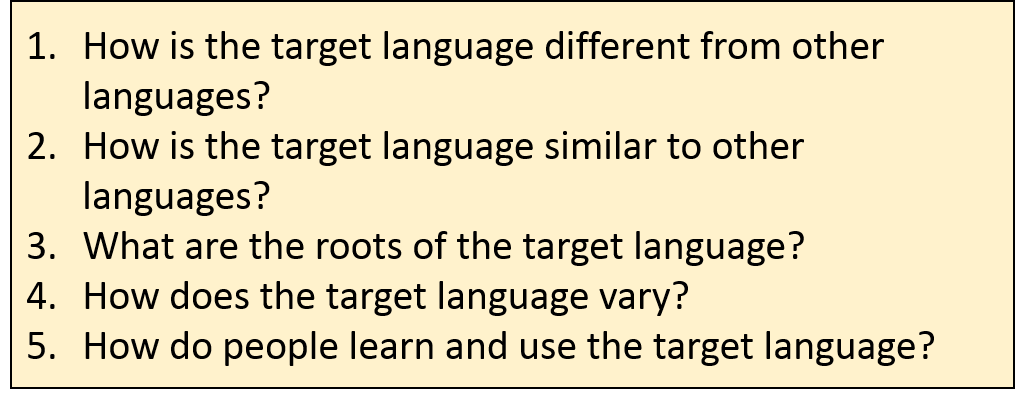
The article proposes five linguistics-based essential questions for world languages, shown at the top of this post. They loosely correspond to the fields of descriptive, theoretical, historical, socio-, and psycholinguistics, respectively. They meet the seven criteria for essential questions put forth by mavens Jay McTighe and Grant Wiggins: they are (i) open-ended, (ii) thought-provoking, and intellectually engaging; they (ii) involve higher-order thinking, (iv) point toward important, transferable ideas that may transcend disciplinary boundaries, (v) raise additional questions, (vi) require support and justification, and (vii) recur over time.

The article gives examples of linguistic insights corresponding to each of these questions from a variety of world languages: Arabic, Chinese, French, German, and Spanish. Some examples are the German letter ß (Question 1), grammatical gender (Question 2), the Indo-European origins of French, German, and Spanish (Question 3), tonal variation in different varieties of Chinese (Question 4), and children’s verb conjugation errors (Question 5).

In the article (and my book) I argue that bringing linguistic insights into the foreign language classroom “add[s] intellectual interest by connecting Spanish to other languages, to general linguistic principles, and to other fields such as history, geography, sociology, and psychology.” This approach can also help students understand seemingly arbitrary aspects of the target language, such as irregular verbs that have simple historical explanations, and encourage students to accept differences between the target language and their first language.

The article describes how teachers can present linguistic insights in the classroom, for purposes of enrichment or explanation, lead related in-class activities, and assign take-home projects that further reinforce and/or explore these topics. As an example of an in-class activity, French students can discuss the advantages and disadvantages of gender-neutral adaptations to French grammar. As an example of a take-home project, Arabic students can ask a pen-pal about their experience communicating with speakers of other varieties of the language.

The downside of this approach, as one of the article’s peer reviewers pointed out, is that it does not contribute directly to proficiency in the target language. My response to this objection is that language is part of culture, and learning about the target language is just as valid as learning about other aspects of culture, such as food and music. To put it another way, If a Spanish class has time to debate their favorite tapa (I just made that up), they can debate whether Spanish writers should continue to use the language’s unique ¿ and ¡ marks. If the class has time to dance a tango, they have time to learn about dialectal aspects of Argentinian Spanish, from its distinctive treatment of yeísmo to voseo.

Compared to other cultural topics, linguistic topics have the obvious advantage of being directly related to the object of study in the world language classroom: the target language itself.


Publishing this article was personally meaningful to me in three ways. First, I hadn’t published a refereed journal article in two decades. For a PhD type like me, that was a long drought — though I did publish a significant and well-reviewed book in the meantime, while focusing primarily on my teaching. The NECTFL Review is “only” an online journal but its refereeing process was rigorous and greatly improved the article. Second, it was a real kick to identify and explain aspects of five unrelated languages that illustrated the essential questions. This was catnip for me as a linguist.

Third, and most importantly, the article (and my forthcoming book) satisfied an itch that has been bothering me since I took teacher training classes at Pace University in the aughts. When we learned about essential questions as a key ingredient in curriculum design, I was disappointed that there did not seem to be an adequate set of questions for world languages. It struck me as axiomatic that these should come from the field of linguistics. It feels great to have finally scratched that itch.

This third reason underlies the title of this post. The article is a manifesto, expressing novel ideas about world language pedagogy that I have been pondering for several years. But it is not only brief, but also modest. It does not insist that world language teachers adopt this approach, but rather introduces it and points out its advantages. In fact, the article (like the book) explicitly suggests different degrees to which teachers might choose to adopt this approach. This could be as minimal as offering linguistic explanations from time to time, to clarify specific topics and/or to add enrichment, or as maximal as maintaining the essential questions as a conceptual framework that the class returns to throughout a year or semester. Hence: a “mini-festo.”


Added: erratum page for ¿Por qué?

I finally added a feature to this blog that has been on the back burner for ages: a list of  errata and other possible changes to my book ¿Por qué? 101 Questions about Spanish. I have been keeping this list in the event that Bloomsbury (or another publisher) ever puts out a second edition, and have just posted it as a new page on the blog. This is for the benefit of both readers and myself, as I hope readers will contact me with additions to the list. Hopefully most of these will be suggestions rather than further errata!

The most important errata concern factual errors. Others point out typographical errors and problems with references.

The page is organized by question number.

Have at it!

One fish two fish pez pescado

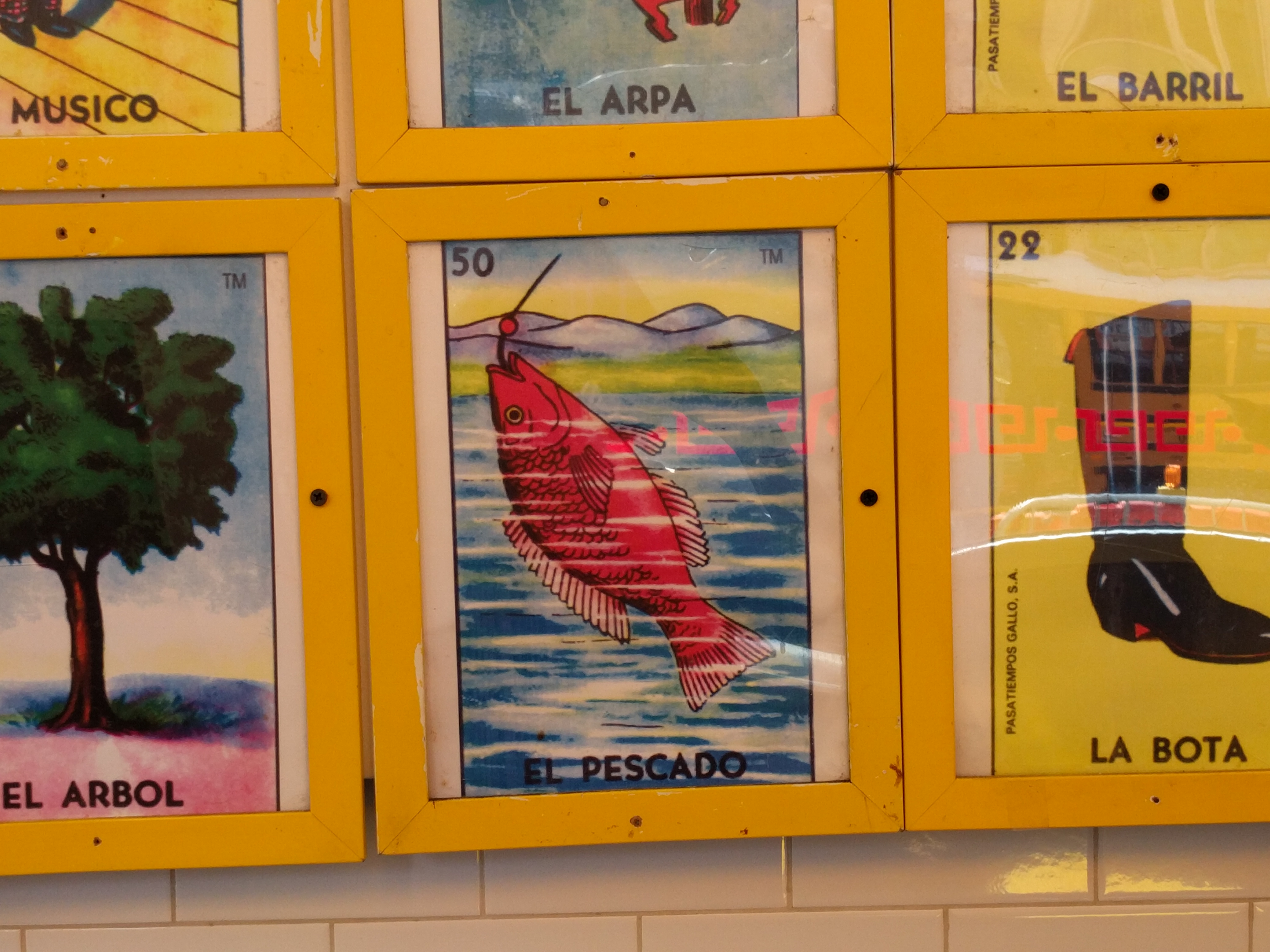
Never having caught a fish in my life, I certainly didn’t imagine that I would ever write a blog post about our aquatic pals, let alone two. Nevertheless this is my second post on the topic. I guess everything is more interesting in Spanish.

As I explained in my first fish post back in 2016, Spanish has two words for fish: pez for a live fish and pescado for one that you see in a pescadería (fish store), supermarket, or restaurant. The verb pescar means ‘to fish’ and pescado is its past participle. So a pescado is simply a pez that has been fished, or caught.

Pez and pescado were at the root of an amusing incident that took place while I was visiting my grandkids in May. This was during the first wave of COVID-19 in the Northeast and my grandsons’ classes had gone online. My younger grandson’s Montessori kindergarten had a weekly Spanish lesson via Zoom and we both thought it would be fun for me to sit in. I have to confess that I stayed out of camera range and fed Zachary answers to the teacher’s questions. (Wouldn’t you?) As you can imagine he was the star of the lesson, getting everything right and amazing the teacher…UNTIL the class started to go through a set of animal words and they got to ‘fish.’

The teacher showed a picture of a pet fish in a bowl and asked if anyone knew ¿Qué es esto? Zachary was the only student to raise his hand. The teacher called on him and he said, correctly, Es un pez, to which the teacher replied No, es un pescado. They went back and forth a few times and the teacher held her ground.

Es un pez


During the rest of the lesson I noticed other mistakes in the teacher’s Spanish. She said that a ‘kangaroo’ was a cangarú, which is basically a Spanish rendering of the English word instead of the proper Spanish word canguro. She also made a gender mistake, saying el serpiente instead of la. Given the teacher’s impeccable accent I concluded that she was a heritage speaker, meaning someone who grew up speaking Spanish at home but never had a formal education in the subject. Such speakers can have gaps in their knowledge.

According to Prof. Zyzik’s comment on this blog, heritage speakers are more prone to gender errors when using words such as serpiente, which lack a telltale -a or -o ending. Kids make such errors as well.

When I was back home in New York the next week, my daughter told me that Zachary had tried to answer el pez again during Spanish class and was again shot down. At this point I decided to do some research, looking up pescado on the Real Academia Española’s online Diccionario de americanismos. The first bullet in the entry read:

MxGuHoESNiPaCuPRCoVeEcPeBoPy. Pez, ya esté dentro o fuera del agua, sea comestible o no.

That is, in a number of Latin American countries pescado can mean a fish ‘in or out of the water, and edible or not.” So now I know.

In retrospect this dialectal variation might also explain the restaurant painting that inspired my first pez/pescado post, which showed a so-called pescado that was in the water (though hooked on a line). Chances are it was painted by someone with a similar background to Zachary’s teacher.

Stay tuned for my next fish post, four years from now.
Bad Spanish: Tampa Bay edition

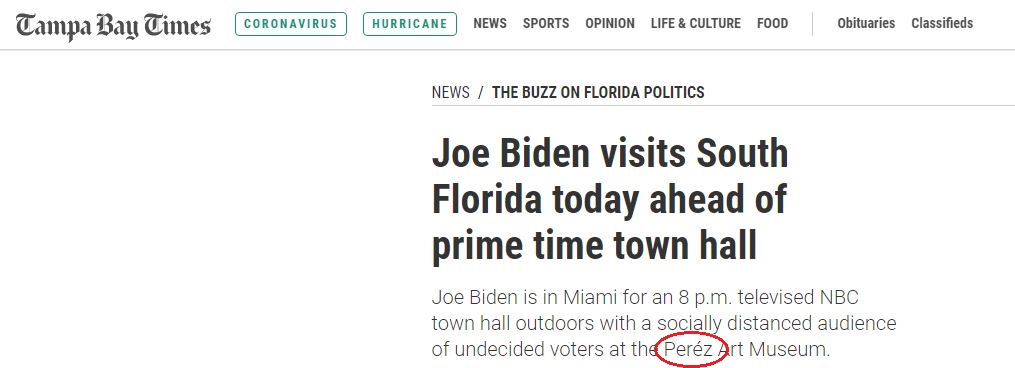
Today’s Tampa Bay Times has an article about Joe Biden’s upcoming town hall with undecided voters at the Pérez Art Museum. I was surprised to see that the newspaper misspelled the museum’s name as Peréz.

Should be Pérez, not Peréz. Duh.

I was surprised for two reasons. First, the museum is a major Tampa cultural institution, and the city’s hometown newspaper should be able to spell its name properly. For crying out loud, they could have checked Wikipedia if they weren’t sure. You can see the name of the museum in both the text and the illustration of the Wikipedia entry, accent mark neatly in place.

Second, the misplaced accent mark is such an obvious Spanish mistake that someone at the the Tampa Bay Times should have caught it. As any Spanish teacher will tell you, Spanish words that end in a consonant, including z, are normally stressed on the last syllable. The accent mark on Pérez indicates an exception to this rule: the name is pronounced PErez, not peREZ. In other words, NO Spanish word that ends with z will ever have an accent mark on its final syllable.

Please be more careful, TBT.

The linguistics of Covid-19

At times like these, with death tolls continuing to mount in New York, where I live, and in Madrid, which I have visited so many times for learning and pleasure, it is reassuring to know that the Real Academic Española is on top of the situation — from a linguistic perspective, at least.

In a recent series of tweets, the RAE weighed in on both the gender and the proper capitalization of Covid-19. Covid-19 falls into the category of nouns that lack obvious gender because they don’t end in -o or -a. One frequent treatment of such nouns is for them to adopt the gender of their broader category. For example, I was always taught that catedral is feminine because it is a kind of church (la iglesia). Likewise, capital is masculine in the sense of money (el dinero) but feminine in the sense of city (la ciudad).

This practice can even make -a nouns masculine. This can be seen in words for masculine players of feminine instruments (el corneta ‘bugler’), masculine users of feminine tools (el espada ‘swordsman’), varieties of wine and liquor named after feminine regions of origen (el champaña, el rioja), since el vino and el licor are both masculine, and el caza ‘fighter plane,’ a type of avión (masculine).

According to this practice, the gender of Covid-19 depends on whether it is a virus or an illness, because el virus is masculine and la enfermedad is feminine. The RAE recommends the masculine gender, in keeping with other virus names such as el zika and el ébola (note that both end in -a), but says that feminine gender is also acceptable when focusing on the illness rather than the virus itself.

Moreover, the RAE’s tweets recommend the use of all-caps when writing the name of the virus (COVID-19), since it is “a recently created acronym,” but envisions switching to lower-case covid-19 if the disease becomes “a common disease name.” In other words, for the time being the appropriate treatment is all-caps with masculine gender, but time may lead to a switch to lower-case letters and feminine gender.

Now, if the RAE could only do something about the shortage of papel higiénico we would all be sitting pretty.