Yearly Archives: 2013

Malayalam is a palindrome

To be honest, this post only tangentially concerns Spanish, by virtue of references to the Indo-European family, and to the delightful word blablablá. And it’s more about language than linguistics. It’s my way of kicking back and celebrating the end of my teaching semester — already!

Although I’m the linguist of the family, my husband has his own way with words. He’s always playing with them in his head, turning them around, looking for palindromes and anagrams. Perhaps this compulsive mental rearrangement comes from years of playing competitive chess as a teenager? His favorite palindrome is wonton ↔ not now, which suggests the following madcap dialogue:

Person A: How do you say wonton backwards?
Person B: Not now!
Person A: No, I really want to know!
Person B: Not now!
and so on…

His skill most impressed me on the day, perhaps ten years ago, that a young driver rear-ended my car on a busy street in the nearby city of New Rochelle. The driver and I chatted while waiting for the police to come, and I learned that his parents were from Kerala in southern India. This meant that he spoke Malayalam at home. While I don’t remember our conversation too well, I’m pretty sure that, compulsively didactic as always, I explained to him that his family’s language, like other languages of southern India such as Tamil and Kannada, was part of the Dravidian language family. These survived when the original languages of northern India were overwhelmed by the Indo-European invasion that swept the subcontinent from the northwest thousands of years BCE. The effects of this invasion can be seen in Indian genetics as well as linguistics.

When I came home that day and announced that “I was rear-ended by a Malayalam teenager in New Rochelle”, my husband asked, without blinking an eye, if I knew that the word Malayalam is a palindrome. This is true, though only with Roman alphabet spelling. The original spelling in the Malayalam script is the asymmetrical

Malayalam

Since then, I’ve had the pleasure of teaching two Fordham students from Malayalam-speaking families. Both were wonderful students, not only bright but gregarious, hard-working, and upbeat. When I met each of them, I of course went into my usual spiel about Indo-European versus Dravidian languages in India (blablablá, an actual, RAE-sanctioned Spanish word!, is perhaps the best way to describe this), combined with my husband’s. Both already knew that Malayalam was Dravidian, but neither had realized that their language name was a palindrome.

So, dear readers, now you know how to amaze any Malayalam-speaking acquaintance. You can tell them both the bad news — that their language is unrelated to Spanish since it’s Dravidian, not Indo-European — and the good — that its name is one for the books.


Another day, another Spanish idiom

Yesterday I came across an interesting article on El País about the founding of the Real Academia Española, one of my favorite institutions. The article relates, with a lamentable lack of detail, how a group of eight Spaniards began meeting in 1713 to create the first Spanish dictionary. Three other colleagues soon joined the project, it received royal sanction the following year, and the rest is (linguistic) history. Missing from the article are the founders’ identities (besides the Marqués de Villena) and backgrounds (more nobility? writers? scholars?). Still, it’s an inspiring tale.

As usual, I read the article with an eye out for unfamiliar vocabulary. All I encountered was a novel (to me) expression: the author compares the RAE’s founding to cuatro gatos [que] se lanzaban al abismo (“four cats who jumped into an abyss”). Lanzarse al abismo was clearly a metaphor for starting a venture into the unknown. Cuatro gatos, on the other hand, seemed purely idiomatic.

Thanks to an appeal to the friendly folks on the wordreference.com Spanish-English vocabulary forum, and a Google search that yielded similar results, I learned that cuatro colloquially refers to a small quantity (in English we’d say “a handful”) and gato can be slang for “person”. (Wordreference.com itself gives a slang interpretation of gato as “person from Madrid”, but the usage seems to be more general.) So the mystery sentence boiled down to “a small group of people started an uncertain venture”.

I love the parallel between this use of gato and the English slang meaning of cat as “a cool person”. The choice of cuatro to stand for “a handful” is also pleasing. As a rule of thumb, I think of three as “a few” and five as “several”; four is right in between. From a literary perspective it was also rather bold to mix literal numbers (8 and 11 founding members) with the metaphorical number 4.

Still, it’s hard to shake off the image of a cat playing a lemming…


A final post on El séptimo velo

After a hiatus of several weeks, I recently took advantage of a cross-Atlantic flight to finally finish Juan Manuel de Prada’s novel El séptimo velo. It has been a tough but exciting slog. I’d recommend the book to an ambitious non-native speaker, or to a native speaker interested in a variety of topics: World War II (especially the German occupation of Paris), mental illness, circuses, or love.

In an earlier post I dissected a single metaphor used in El séptimo veloMore recently I went into a potentially embarrassing level of detail about the book’s challenging vocabulary. It was heartening to hear back from native speakers that some of the words that stumped me were unfamiliar to them as well, or at least struck them as antiguocultorural/rústico, or literario. Several other words that I didn’t know are, in fact, reasonably common, and definitely belong on my “need to know” list. One never stops learning.

Given my linguistic fascination with El séptimo velo, I was intrigued to read a blistering online review of it by Sergio Parra (in Papel en blanco) that took particular issue with the novel’s language. While Parra acknowledges that some of de Prada’s prose “shows stylistic mastery”, he describes the book as, variously:

  • mucha letra y poca historia (“many words but little to say”)
  • 650 páginas que habrían podido resumirse en 200 (“650 pages that should be 200”)
  • que incurre en …el exceso de metáforas, en el exceso de frases preciosistas trufadas de subordinadas…(“over-indulging in metaphors and gaudy sentences crammed with subordinate clauses”)
  • pesada, lenta, morosa, meándrica, superflua, barroca (“heavy, slow, morose, meandering, superfluous, and baroque”)

Personally, I enjoyed de Prada’s almost joyfully complicated prose. A prime example is a 3 1/2-page-long tour-de-force paragraph toward the end of the novel (pp. 583-6 of the Planeta edition). In alternating sentences, it simultaneously narrates both (i) a passionate bout of lovemaking between two main characters, and (ii) a weeks-long chain of events involving the French Resistance, triggered by one of the lovers’ revealing a secret to the other at the beginning of the scene. For me, it worked.

De Prada uses one of the novel’s secondary characters to gently mock his own writing style. His description of the psychologist/hypnotist Portabella is worth quoting at length (p. 518):

Portabella was a virtuoso of conversation, or, more specifically, of monologue. He talked as if speech were as necessary to him as breathing or eating; he spoke, moreover, with extreme precision, using an extensive vocabulary and constructing sentences with satisfaction and accuracy, as befits someone who for professional purposes is familiar with the spell-binding power of language [a reference to hypnotism or to writing]. He never used a common word if an erudite alternative was available; he never used a vague word if he could find a more exact one. It wasn’t a torrent that flowed from his lips, since there was nothing hurried or confused about his speech, but rather a wide river flowing down a valley. It flowed with a tranquil, yet constant force that carried away all everything that opposed its progress.

It’s even better in Spanish! Check it out if you can.

The difference between knowing and knowing

[Today is Spanish Friday so this post is in Spanish. ¡Scroll down for English translation!]

Este aporte no trata de la diferencia entre los verbos saberconocer, sino de la diferencia entre conocer un aspecto de un idioma abtracta versus íntimamente.

Quisiera empezar con un ejemplo de la experiencia personal de mi marido, cuyo idioma maternal era el francés belga. Entre otras diferencias dialectales, aprendió a usar palabras distintas por 70 (septante) y 90 (nonante) en vez del soixante-dix (60+10) y quatre-vingt-dix (4×20+10) del francés convencional. Cuando habla francés hoy, suele ser con francófonos franceses. Por eso usa los números convencionales: sabe que son lo normal. Pero me dice que cada vez resiste hacerlo. “No puedo creer que verdaderamente usen estos apaños complicados.”

Encontré un fenómeno parecido recientemente cuando estaba preparando un examen para mis clases de español. Como siempre, había incluido una pregunta usando tú y tus amigos para obtener una respuesta usando nosotros. La pregunta específica era algo como ¿Qué van a hacer tú y tus amigos este fin de semana? Una colega española que leyó el examen se quedó horrorizada. Insistió en que la pregunta era gramaticalmente incorrecta porque combinaba la habla informal ( and tus) y formal (van).

De hecho, solo el español de España mantiene el contraste entre las formas plurales formales e informales. Mi colega, por ejemplo, usa vosotros y sus formales verbales (como vais) cuando habla con amigos, y ustedes (con van) cuando habla con superiores y desconocidos. Pero en Latinoamérica (y Andalucía), se usa ustedes en contextos formales e informales. En este dialecto mi pregunta es correcta.

Para mí, lo interesante de la reacción de mi colega es que por supuesto sabía intelectualmente que “no se usa vosotros en Latinoamérica”. Pero cuando encaró un uso específico, como mi marido con los números “franceses franceses”, su reacción era rechazarlo. Sabe, pero no cree.

Esta diferencia entre conocer y conocer (o saber y saber, o saber y creer) también tiene un gran impacto en el aprendizaje de un idioma extranjero. Cualquier estudiante de español principiante o intermedio se declararía de acuerdo con reglas básicas como “los adjetivos tienen que estar en concordancia con los sustantivos” o “los verbos tienen que estar en concordancia con sus sujetos”. Pero siguen violando estas reglas sin embargo en su español oral y escrito. Por la mayor parte, en mi opinión, es porque no han alcanzado el segundo nivel del conocimiento. Al fondo no han aceptado que el español pueda ser tan diferente del inglés, ni que estas violaciones verdaderamente resulten en español incomprensible. Solo el tiempo y la práctica los van a convencer.

****************************************************************

This post isn’t about saber and conocer, the two Spanish verbs that mean “to know”. Rather, it’s about the difference between knowing an aspect of language abstractly versus personally.

Let me illustrate this first with an example from my husband’s experience as a native speaker of Belgian French (no frites jokes, s’il vous plaît). Among other dialectal differences, Belgian French uses distinct vocabulary words for 70 (septante) and 90 (nonante) instead of standard French soixante-dix (60+10) and quatre-vingt-dix (4×20+10). When he speaks French today, it is normally with French speakers from France, and he uses the standard numbers because he knows this is expected. Yet he tells me that every time, he resists doing so. “I can’t believe they actually use those complicated work-arounds.”

I ran into a similar phenomenon recently when preparing a Spanish test. As usual, I had included a question about “you and your friends” (tú y tus amigos) in order to trigger a “we” (nosotros) answer. (The exact question was something like ¿Qué van a hacer tú y tus amigos este fin de semana?) A Spanish colleague who looked over the test insisted that the question was grammatically incorrect because it combined informal address ( and tus) and the formal plural verb form van.

In fact, only peninsular Spanish, as exemplified in the Spanish of Madrid, maintains a contrast between informal and formal address in the plural. Thus my colleague uses vosotros when addressing friends, and ustedes when addressing superiors and strangers. The same goes for the associated verb forms, such as informal vais versus formal van. But in Latin America, as well as Andalusia (southern Spain), ustedes and its verb forms are used in both formal and informal contexts. In this dialect, my usage was perfectly correct.

What interested me about this exchange is that my colleague certainly knew that “Latin Americans don’t use vosotros“. Yet when it came to a specific application of this knowledge, her reaction was rejection, or even revulsion, just as when my husband has to force himself to use the “French French” numbers. She knows, but she doesn’t believe.

This difference between knowing and knowing also strongly affects second language learning. Any beginning or intermediate Spanish student will agree that “adjectives have to agree with nouns”, “verbs have to agree with their subjects”, and so on. They can probably list examples of correct agreement. Yet they continue to violate the rules in their spontaneous spoken and written Spanish. This is largely, I believe, because they haven’t progressed to the second level of knowing. In their heart of hearts they haven’t truly accepted that Spanish can be so different from English, and that violating these rules genuinely results in incomprehensible language.  Only time and practice will drive the reality home.

The origins of Spanish -ar, -er, and -ir verbs

I never would have thought to look into the origins of the Spanish verb classes if I hadn’t studied Hebrew. While Spanish has three verb classes (-ar, -er, and -ir), Hebrew has seven, called binyanim. Each is conjugated differently, as in Spanish, but each binyan additionally imparts meaning. For example, the three-consonant Hebrew root k-t-v, which refers to writing, appears in all seven binyanim. As shown in the table below, based on this helpful summary, each binyan reflects a different aspect of writing.

Binyanim

There are no patterns like this in modern Spanish; that is, you can’t infer anything about a verb’s meaning from its conjugation class. Differences like reflexive and passive are expressed through pronouns and auxiliary verbs, i.e. se escriben (“they write to each other”) and está escrito (“It is written”). But I’ve often wondered whether, if one goes back far enough, one can find any semantic logic behind which verbs are in which class.

Cornell’s Michael Weiss discusses exactly this topic in chapter 36 of his terrifyingly authoritative Outline of the Historical and Comparative Grammar of Latin. It turns out that there were clear connections between certain semantic categories and the conjugation classes of Latin, although this patterning was in no way as tidy or as far-reaching as in Hebrew. Some highlights are below.

Latin’s -āre verb class, which evolved into the -ar class of Spanish, was used:

  1. to turn nouns and adjectives into verbs. Some examples are curare “to care” from cura “care”, navigare “sail” from navex “sailor”, and novare “to renew” from novus “new”.
  2. for repeated or frequent actions. Some examples are dictare “recite” from dicere “say” and factitare “to practice” from facere “to do, make”.
  3. for intensives (with a prefix). One example is ocupare  “to seize” from capere “to take”.

Latin’s -ēre class, which evolved into the -er class of Spanish, was used:

  1. for causatives, such as monere “warn” from men “think” (i.e. to cause someone to think) and docere “to teach” from dek “accept” (i.e. to cause someone to accept).
  2. for verbs that describe states, e.g. calere “to be hot”, frigere “to be cold”, pendere “to be hanging”.

Latin’s -ĕre class, which merged into the -er class of Spanish, included a group of change-of-state verbs, e.g. calescere “get hot” (from calere) and tacescere “become quiet” (from tacere “to be quiet”).

Latin’s -īre class, which evolved into the -ir class of Spanish, was used:

  1. to turn nouns into verbs, as in finire “to finish” from finis “end” and servire “to serve, be a slave” from servus “slave”. I don’t know what, if anything, distinguished these from the verbs-from-nouns in the -are class.
  2. for desires, e.g. esurire “to be hungry” from esse “to eat”, parturire “to be in labor” from parere “to give birth”.

This partial patterning reminds me of gender. There’s nothing inherently masculine about most masculine nouns in Spanish, nor inherently feminine about most feminines. Yet one can see in such common words as el padre and la madre the meaningful basis of the original category difference. It’s refreshing to find that there’s likewise some logic, however fragmentary and forgotten, to the seemingly arbitrary verb classes of Spanish.

Festive Spanish plurals

I’ve always loved explaining to my students that the Spanish word for vacation, vacaciones, is almost always plural. “Spanish people love vacations so much that they never take just one!” This is one of those fun linguistic facts that appear to be culturally indicative regardless of their actual history.

In fact, if you look up the abbreviation U. m. en pl. (“Usado o usada más en plural”) in the Real Academia’s own documentation you will see that vacaciones is one of 664 normally plural words in Spanish, and they aren’t a particularly fun group. They include accesorias (added-on wings of a building), alineamientos (“alignments”), and alpes (a tall mountain, obviously derived from the Alps). You can see that I didn’t get beyond the a‘s…

I don’t know how vacaciones developed its standard plural usage. It isn’t universal in Romance. The French and Portuguese words are also plural (les vacances and férias, which obviously uses a different Latin root). But Italians and Romanians take singular vacations (vacanza, vacanţă), which implies that the plural usage is a Western Romance innovation.

Regardless of the history and linguistic context of vacaciones, I was delighted when I happened to look up the etymology of fiesta today and saw that it comes from the Latin plural festa (the singular is festum). Of course the etymology has no relevance for how people think of the word today, even if they know its origin. But it’s a delightful coincidence nevertheless. You have to love a language where vacations and parties are intrinsically plural!


Categories or cases for Spanish grammar

My time and thoughts have mostly been in my classroom over the last few weeks, so this post is more teacher-y than usual. But it does, I hope, contain some interesting observations about some core grammatical issues in Spanish.

As I noted in an earlier post, Spanish teachers have to explain many differences that exist in Spanish but not in English. These vary in difficulty for the native English speaker. Simple vocabulary differences such as tocar versus jugar, which both mean “to play” (an instrument versus a sport), are the easiest. Other vocabulary differences are more complicated: for example, how por and para divvy up the various meanings of English “for”, or ser and estar the meanings of “to be”. Harder still are grammatical differences that English lacks either mostly (e.g. subjunctive versus indicative moods) or entirely (e.g. the pretérito and imperfecto aspects of the past tense).

When teaching these more challenging differences, I’m often torn between explaining them in terms of categories or cases. The former approach seeks overarching principles that distinguish the Spanish forms. The latter metaphorically throws up its hands and instead details the specific sub-uses of each form. As a linguist I much prefer the former since categorical differences often relate to core semantic concepts. In practice I always provide both frameworks and emphasize one or the other, depending on the topic at hand.

I ran head-first into this issue the first time I taught the Spanish past tense. The usual sequence in an American classroom is to teach the pretérito first, then the imperfecto, then how to use them in conjunction. For the final stage I followed the practice of a more experienced colleague and taught the students the SIMBA CHEATED mnemonic. SIMBA stands for some basic uses of the pretérito: Single actions, Interruptions, Main events, Beginnings and endings, and Arrivals or departures. CHEATED does the same for the imperfecto: describing someone or something’s Characteristics, Health, Emotion, or Age, telling Time, describing Endless activities, and giving a Date.

The net result: my students didn’t see the forest for the trees. In other words, they learned the specific cases covered by SIMBA CHEATED but failed to generalize to the overall difference between the two aspects: that the pretérito relates events, i.e. “what happened”, while the imperfecto describes the past, providing backgrounds and details.

This failure was a loss at an intellectual level, for this aspectual distinction is a perfect example of how different languages encode the world in different ways. At a practical level, the mnemonic slowed students down, since they tended to run through the entire mental checklist before using a past tense. It also proved useless when we moved on to subtler distinctions in the past tense. For example, while conocer retains its core meaning of “to know someone” in the imperfecto, in the pretérito it means “to meet” someone. This makes perfect sense — if one focuses on the overarching use of the pretérito to relate events.

I therefore now try to emphasize the broad categories of “event” and “description” as much as possible when teaching the past tense. While I do provide a reference sheet (see my teaching page) that shows some specific applications of these categories, I stay away from mnemonics and always aim to extract the basic principles from the examples that come up in class.

My approach to the indicative/subjunctive distinction still focuses mostly on categories, but veers slightly in the direction of cases (again see my teaching page). I focus on the overarching use of the indicative for reality and the subjunctive for uncertainty since this covers most uses of the two moods. However, in this case I do teach an acronym: the famous WEIRDO (Wish/Want, Emotions, Impersonal expressions, Require/Recommend, Doubt/Deny, and Ojalá). This is partly because some of the uses it covers trump the reality/uncertainty difference (e.g. emotional contexts like Me alegro de que Pablo esté aquí, where Pablo actually is here), but mostly as a handy way to remind students to practice a variety of subjunctive contexts in their written work.

My approach to por and para (teaching page again), in contrast, focuses almost entirely on cases. These two words correspond to so many different meanings of English “for” that I find it most helpful to emphasize individual uses, such as para for destinations and por for duration. However, since at a very high level para often implies directionality and por, apportionment, I also suggest the graphical metaphors of an arrow for para (X > Y) and a ratio line for por (X/Y). While I don’t expect the average student to find these useful in practice, he or she should at least be aware that the division of “for” into por and para isn’t random. There’s a method to the Spanish madness!


Spanish vocabulary that’s hard to learn

Writing Sunday’s post about unfamiliar vocabulary in El séptimo velo, and in particular the words metralla and ametrrallada, started me thinking somewhat nostalgically about Spanish vocabulary I’ve found hard to learn, and what strategies have worked for me. In general, since I’m an analytic thinker, especially when it comes to language, I have trouble with words that I can’t tackle using cognates or other types of linguistic analysis. Strangely, the best solution for me in such cases is often anti-analytic. I specialize in truly ad hoc mnemonics, often based on false cognates (so-called amigos falsos). The more far-fetched, the better.

Some kinship terms beyond the basics caused me a headache “back in the day”. Sobrino and sobrina “nephew/niece”, for instance, lack an English cognate. My ad hoc mnemonic for them is therefore based on a false cognate: I think of a “sober” (i.e. non-drinking) nephew. Nieto and nieta “grandchild” are cognate with “nephew”, unfortunately; we owe to French the perversion of the original Latin meaning, which Spanish has preserved. My solution, then, is to picture a “nice” grandchild.

In-law terms were a mixed bag for me. Suegro and suegra “parents-in-law” came easily. These are ugly words — they sound like sweat or suet — which I have always found reminiscent of the negative stereotype of these relatives, especially mothers-in-law. (My own mother-in-law is an exception, thank goodness.) I had more trouble with other in-law terms. I finally mastered cuñado/cuñada “brother/sister-in-law” after learning the word cuna “cradle”, since one might visit one’s sister-in-law to admire her baby. My mnemonics for yerno and nuera “son/daughter-in-law” are truly bizarre. To me these sound like terms one might associate with animal husbandry, like yearling or nursling. And the propagation of the family line is, after all, the point of acquiring these relations.

Going back to metralla and ametrrallada, I’ve been seeing the word ametralladora “machine gun” for years without managing to remember it. I think the noun’s ending was playing with my analytic brain. The noun suffix or or -ora usually connotes a person or object that produces something. A tostador (or tostadora) makes toast. An escritor creates written work. An aspirador creates suction. But an ametralladora doesn’t make anything; it just kills.

Had I looked up the word’s etymology, as I finally did on Sunday, I would have known that metralla means shrapnel. Now I will always remember the word, because an ametralladora produces metralla. I guess the moral here is that one should always research etymology when dealing with a stubborn word.

My current struggle is with a substantial class of action verbs beginning with de- or des-, including derrotar, derretirse, derrumbar, deslizar, and desmoronar. These all have negative meanings: defeat, melt, demolish, slide (this can be negative if you’re on a cliff), and collapse. I have trouble with these words because I encountered all of them at about the same time, when I started teaching Spanish and began working on my language skills seriously again. I think of this as the geshem/shemesh problem. These two words mean “snow” and “rain” in Hebrew (or is it “sun” and “rain”?), but because I learned them together, I can never remember which is which.

The solution for the de(s)- set seems to be continued vigorous reading. Each time I see one of these words in context it becomes a little more distinct. Maybe in the not-to-distant future I’ll be ready to use them in conversation. Then I can go on to the next hurdle! There is always more to learn.

Spanish vocabulary in El séptimo velo

For the last several weeks I’ve been making slow but steady progress through Juan Manuel de Prada’s towering novel El séptimo velo. Like this blog, it’s been taking back seat to my teaching. As described in an earlier post, El séptimo velo is a romantic novel set mostly in post-war France and contemporary Spain. I learned of it from a reading list distributed by a professor at the Universidad Complutense de Madrid.

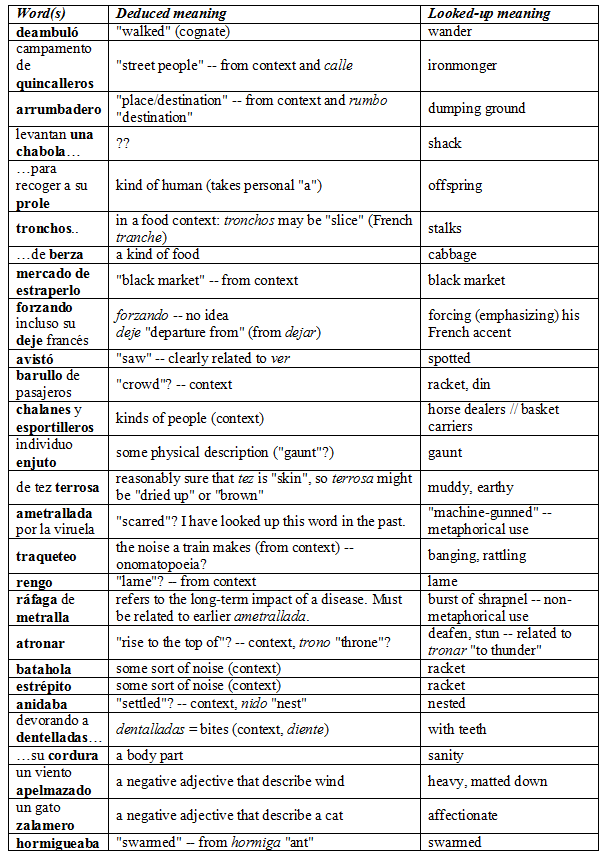
This novel is unbelievably rich in vocabulary. My Spanish is excellent, I think, good enough to tear through a sophisticated thriller like Guillermo Martínez’s La muerte lenta de Luciana B. in a matter of hours, and in a typical book I rarely find more than two or three new words on a page. De Prada’s Spanish came as such a shock that I decided, as an intellectual exercise, to (i) write down all the new words I encountered on a random page, (ii) record what I thought they meant, and why (iii) look up their actual meanings, and (iv) blog the results. The random page was p. 315 of the 2008 Harper Collins Planeta paperback.

This humbling experiment turned up 30 new words on one page!!! — of which I correctly interpreted more than half. The first part of this statistic gave me second thoughts — and even third and fourth — about writing this post. Revealing how much Spanish vocabulary I still don’t know, after years of studying and teaching the language, is somewhat embarrassing. But I decided to go ahead because vocabulary, and how we learn it, is such an important topic.

For one thing, while English speakers may be aware that English has an enormous lexicon — over 450,000 words, according to David Crystal — they may not realize the extent of the Spanish lexicon. The Real Academia‘s dictionary has about 162,000 words, almost 100,000 more than an educated person learns in a lifetime (again according to Crystal). The Spanish lexicon combines a native Latin base with substantial borrowings, mostly from Arabic, Germanic, other Romance languages, Latin (again) and Greek, English, and native American languages.

Second, since I’m always telling my students to use context, cognates, and familiar Spanish vocabulary to deduce meanings, I was curious to see how far this actually takes a reader (i.e., me). The use of context in particular is of broad linguistic interest, because it enables babies to learn language, and adults to communicate under difficult conditions, for example over a poor telephone connection.

Finally, I’ve become fascinated with de Prada’s Spanish. His vocabulary is not only immense but also erudite.  Elsewhere in the book, for example, he uses preñada, instead of embarazada, to mean “pregnant”. I would love to hear how native Spanish readers of this blog respond to the vocabulary listed below. How obscure is it?

The table below details the fruits of my analysis. As a summary:

  • The only word I couldn’t even guess at was chabola.
  • I misinterpreted several words: troncho, deje, forzar (in a weird context), barullo, ráfaga, metralla and ametrralladaatronar, corduraquincalleros, and zalamero. Of these, I came closest on deje (“accent”), recognizing its connection with dejar, and with barullo “racket, din” — I guessed “crowd”. The most personally galling were metralla and ametrrallada, because I’ve tried to memorize the word ametralladora (“machine gun”) several times. I’ve also run into zalamero and may even have flash-carded it a few years ago.
  • I correctly deduced the general semantic category of several words from context, like a good Spanish student (or baby). For example, I assumed that berza “cabbage” was a kind of food, and batahola “racket, din” a kind of noise. Other words in this category were chalánproleenjutoestrépitoapelmazado, esportillero, and arrumbadero. The last two were quite obscure. Esportillero wasn’t in wordreference.com, though I found it in the RAE. Arrumbadero was in neither. I “looked it up” by consulting the friendly and expert participants in the Word Reference Spanish vocabulary forum.
  • I figured out several meanings thanks to English cognates and my existing Spanish vocabulary. For example, English amble and ambulatory gave me deambuló, and Spanish hormiga “ant” gave me hormiguear “to swarm”.
  • Context made estraperlo and traquateo absolutely clear. Onomatopoeia also helped with the latter.

Séptimo velo